
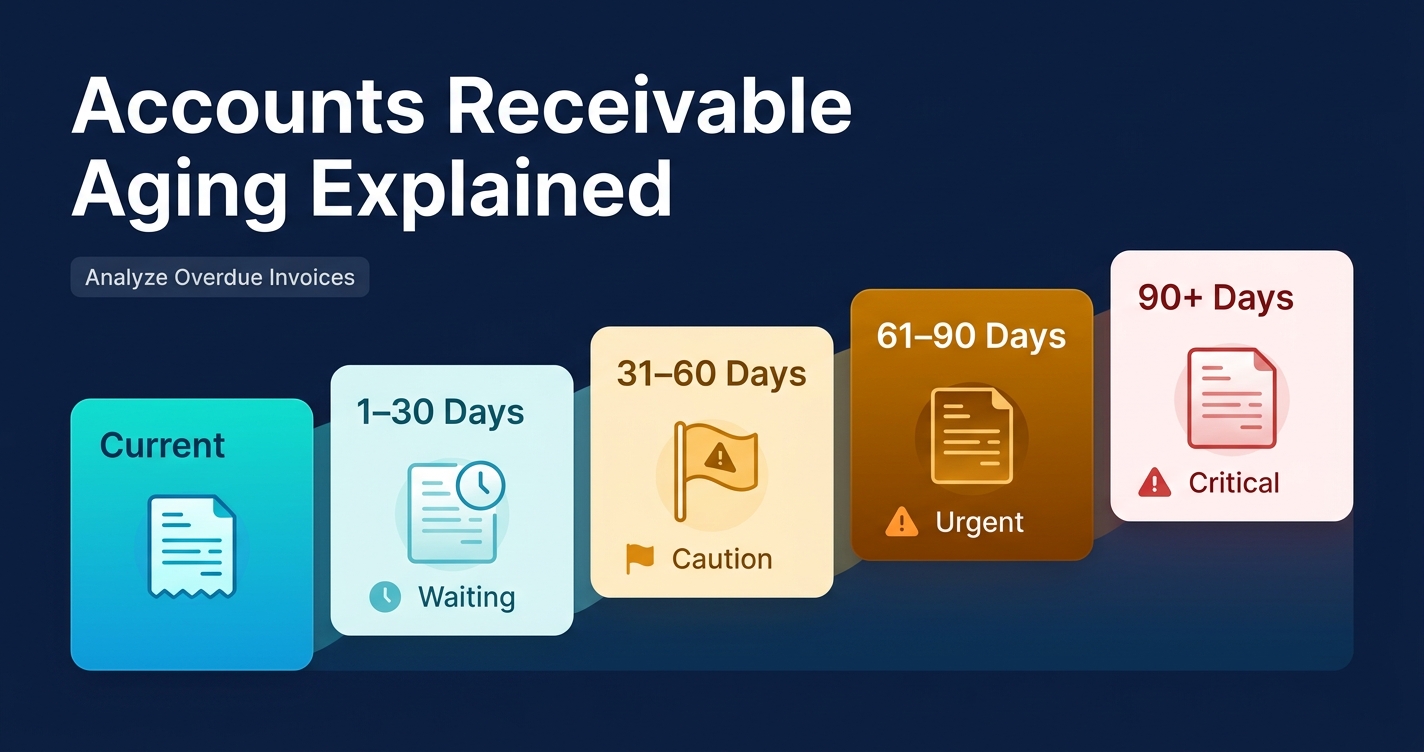
Accounts Receivable Aging Explained: How to Analyze Overdue Invoices
An accounts receivable aging analysis helps businesses understand not only how much customers owe, but also how long that money has been outstanding.
That distinction matters.
A company with $200,000 in accounts receivable where nearly every invoice is current is in a very different position from a company with the same $200,000 balance where a large percentage is more than 90 days overdue.
You can analyze your receivables using the free PaymentPilotHQ Accounts Receivable Aging Calculator.
What Is Accounts Receivable Aging?
Accounts receivable aging is the process of grouping unpaid customer invoices based on how long they have been outstanding.
Typical aging buckets include:
- Current
- 1–30 days
- 31–60 days
- 61–90 days
- 90+ days
The older an invoice becomes, the more attention it may require.
An aging analysis allows finance teams and business owners to quickly see whether overdue receivables are becoming concentrated in higher-risk categories.
What Does an Accounts Receivable Aging Report Show?
An AR aging report usually starts with your total outstanding receivables and then categorizes them by age.
For example:
| Aging Bucket | Amount |
|---|---|
| Current | $80,000 |
| 1–30 Days | $25,000 |
| 31–60 Days | $15,000 |
| 61–90 Days | $10,000 |
| 90+ Days | $20,000 |
Total accounts receivable would be $150,000.
But the total alone does not tell the full story.
The company would also want to know what percentage is overdue, how much is 60+ days old, and how much has reached 90+ days.
The free Accounts Receivable Aging Calculator calculates these metrics automatically.
Why Accounts Receivable Aging Matters
Aging helps you identify collection risk that can be hidden inside a single AR balance.
If most receivables are current, the total outstanding balance may not be especially concerning.
But if a significant portion is more than 60 or 90 days old, the business may be facing greater collection risk.
An aging analysis can help you answer questions such as:
- How much money is currently overdue?
- What percentage of AR is past due?
- How much is more than 60 days old?
- How much is more than 90 days old?
- Which customers require immediate follow-up?
- Is collection risk increasing or decreasing?
What Percentage of Accounts Receivable Should Be Overdue?
There is no universal percentage that applies to every business.
Acceptable aging varies by industry, contract structure, customer type, and standard payment terms.
However, businesses generally want as much of their AR balance as possible in the current and early aging buckets.
A growing 60+ or 90+ balance is worth investigating because older invoices can become more difficult to collect.
The key is to monitor trends rather than looking at aging only once.
If the percentage of overdue receivables steadily increases from month to month, it may indicate a developing collection problem.
How to Analyze an AR Aging Report
A useful analysis goes beyond simply looking at the total balance.
Start With Total Accounts Receivable
Determine the total amount customers currently owe.
This establishes the size of your receivables portfolio.
Calculate Total Overdue AR
Next, separate current invoices from invoices that have passed their due dates.
This shows how much of the receivable balance requires collection attention.
Calculate the Percentage Overdue
Divide overdue AR by total AR.
For example, if total AR is $100,000 and $30,000 is overdue:
$30,000 ÷ $100,000 = 30% overdue
Review the 60+ Day Balance
Receivables that move beyond 60 days may require more focused collection activity.
Monitor both the dollar amount and percentage of your total AR.
Pay Close Attention to 90+ Day Receivables
Invoices in the 90+ category deserve special attention.
They may involve disputes, customer financial difficulty, administrative issues, or accounts that have simply not received adequate follow-up.
Why Aging Risk Can Increase Quickly
A receivable can move through aging buckets faster than teams realize.
An invoice that is only slightly overdue today can become a 60-day or 90-day problem if follow-up is inconsistent.
Common causes include:
- Invoices sent to the wrong contact
- Missing purchase orders
- Customer disputes
- Incorrect billing information
- Unclear payment terms
- Lack of automated reminders
- Slow internal escalation
- Customers experiencing cash flow problems
Frequent aging reviews can help teams catch these issues earlier.
AR Aging vs. DSO
Accounts receivable aging and Days Sales Outstanding are related, but they answer different questions.
DSO asks: How quickly are we collecting overall?
AR aging asks: Where is our collection risk concentrated?
A company can use the free PaymentPilotHQ DSO Calculator to measure collection speed and the Accounts Receivable Aging Calculator to analyze the distribution of outstanding invoices.
Together, these metrics provide a stronger view of AR performance.
What to Do With Aging Results
Once you identify aging risk, prioritize collection activity.
Start with:
- High-value overdue invoices
- 90+ day accounts
- Customers with multiple overdue invoices
- Accounts with unresolved disputes
- Customers whose payment behavior is deteriorating
You can also compare aging results month over month to determine whether collection performance is improving.
Analyze Your Accounts Receivable Aging for Free
Knowing your total accounts receivable balance is useful, but understanding the age of those receivables is even more valuable.
Use the free PaymentPilotHQ Accounts Receivable Aging Calculator to calculate:
- Total AR
- Total overdue receivables
- Percentage overdue
- Percentage 60+ days
- Percentage 90+ days
- Aging risk
Regular aging analysis can help your business identify collection problems earlier, prioritize follow-up, and make better cash flow decisions.