
What to look for in a SaaS terms of service agreement
Contractor Agreements: The Hidden Risks Most People Miss Before Signing
Whether you’re hiring a freelancer to build your website, bringing on an independent contractor for a construction project, or outsourcing a critical business function, contractor agreements are the legal backbone of the relationship. They define who does what, when, how much gets paid, and what happens when things go wrong. Yet most people skim them, sign them, and only discover the problems when it’s too late.
Contract Risk Finder was built specifically for moments like these — to catch what your eyes gloss over when you’re excited to get a project started. In this article, we’re breaking down the most common risky clauses buried inside contractor agreements, so you know exactly what to look for before you put pen to paper.
Why Contractor Agreements Deserve More Scrutiny Than You Think
Contractor agreements are not boilerplate. Even when they look standard, the specific wording of individual clauses can expose you to serious financial and legal liability. A single ambiguous sentence about deliverables can cost you thousands in disputes. A missing termination clause can trap you in a bad working relationship with no clean exit. An overly broad indemnification clause can make you responsible for problems you had nothing to do with.
The stakes are especially high because contractor agreements often lack the protections that come with employment contracts or vendor agreements governed by strict consumer laws. What you sign is largely what you get.
Red Flag Clauses to Watch For
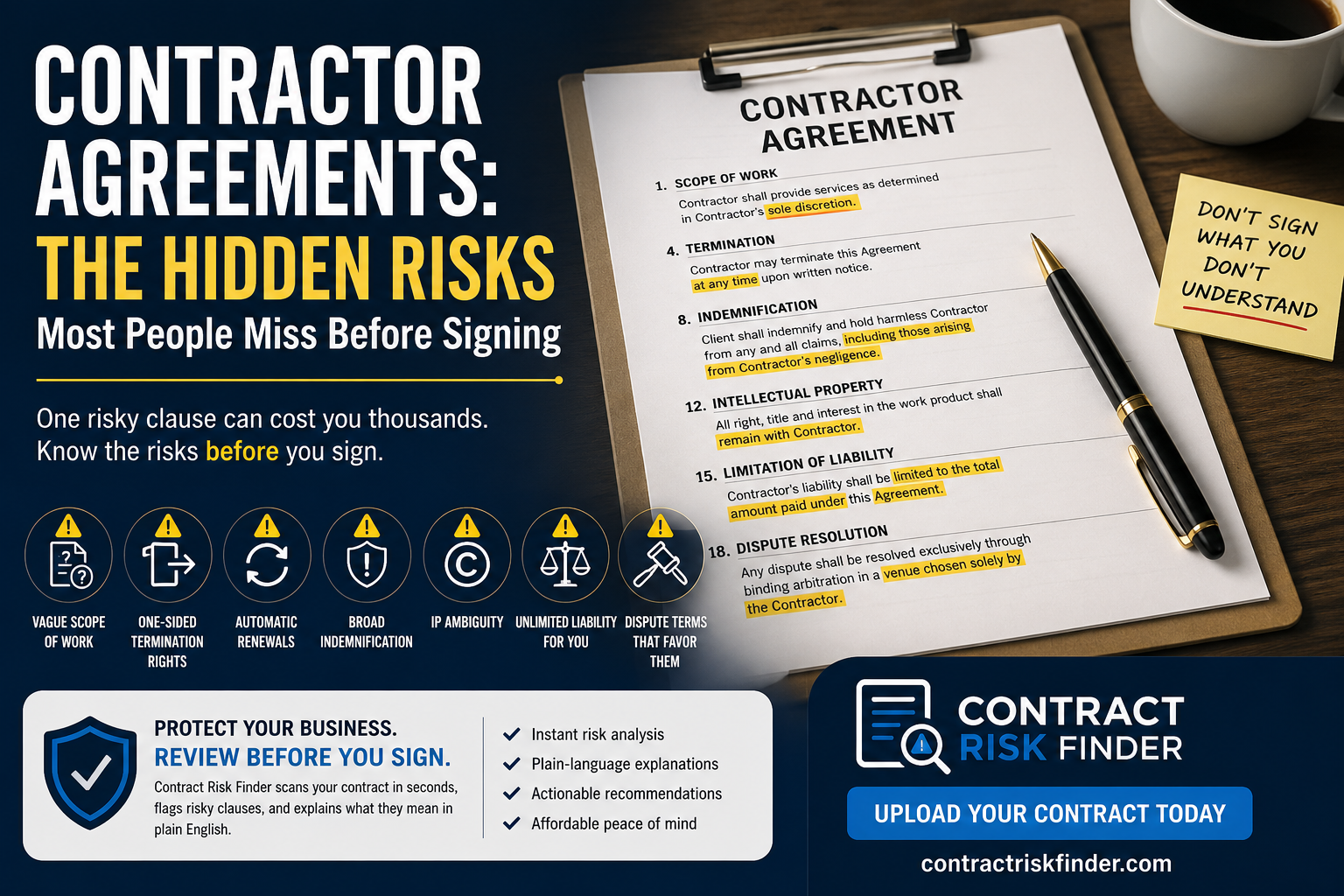
Here are the most dangerous clauses commonly found in contractor agreements — and why they matter:
- Vague Scope of Work: If the contract doesn’t clearly define deliverables, timelines, and acceptance criteria, you’re setting up a dispute waiting to happen. A contractor can argue that nearly any revision or additional request is “out of scope” — and bill you accordingly.
- One-Sided Termination Rights: Some contracts allow the contractor to walk away at any time with minimal notice, while locking you into strict cancellation terms. Look for symmetry. If they can exit easily, you should be able to as well.
- Automatic Renewal Clauses: Sneaked into the fine print, these clauses roll the contract over for another full term unless you give notice within a narrow window — sometimes as short as 30 days before expiration.
- Broad Indemnification Language: Watch for clauses that require you to indemnify the contractor for nearly any claim, including claims arising from the contractor’s own negligence. This is a major red flag that can shift enormous financial risk onto you.
- Intellectual Property Ambiguity: If the contract doesn’t explicitly state that you own the work product upon final payment, you may not actually own it. Some contractors retain IP rights by default, meaning they can reuse, resell, or modify your commissioned work.
- Unlimited Liability for You, Capped Liability for Them: Many contractor agreements cap the contractor’s liability at the value of the contract — while leaving your exposure unlimited. This asymmetry can be devastating if a contractor’s error causes downstream harm to your business or your clients.
- Dispute Resolution Clauses Favoring the Contractor: Mandatory arbitration in a jurisdiction far from you, or with arbitrators chosen by the contractor’s preferred body, can make dispute resolution expensive and practically impossible for you to win.
What You Should Always Demand in a Contractor Agreement
A fair contractor agreement clearly defines the scope of work with measurable deliverables. It includes mutual termination rights, a balanced indemnification clause, explicit intellectual property assignment language, and a dispute resolution process that is geographically and financially accessible to both parties. Payment terms should be tied to milestones or deliverables — not arbitrary calendar dates that benefit the contractor regardless of progress.
You should also look for a confidentiality clause that protects your business information and a non-solicitation clause if you’re worried about the contractor poaching your clients or employees. These provisions protect your interests and are often omitted from contractor-drafted agreements.
Don’t Rely on “This Is Our Standard Contract”
When a contractor tells you something is their “standard contract,” that’s exactly when you need to read it most carefully. Standard contracts are standard for the party who drafted them — not for you. Every clause in that document was written to protect the contractor’s interests. Your job is to identify where your interests are exposed and negotiate accordingly.
Frequently Asked Questions
Can I negotiate a contractor agreement even if it’s presented as standard?
Yes. Almost every contract is negotiable. The fact that something is labeled “standard” doesn’t make it legally fixed. You can request changes to any clause, and a reputable contractor will engage in good faith negotiation.
What’s the biggest mistake people make when signing contractor agreements?
Skipping the fine print around termination, indemnification, and intellectual property. These are the clauses that cause the most expensive disputes, and they’re routinely overlooked.
How do I know if a clause is actually risky?
Context matters, but certain language patterns — like “sole discretion,” “unlimited liability,” “automatically renews,” or “waive any right to” — are strong signals that a clause deserves closer review.
Do I need a lawyer to review every contractor agreement?
Not necessarily. AI-powered tools can flag the most common and serious risks quickly and affordably, giving you a clear picture before you decide whether a lawyer’s deeper review is warranted.
Get Your Contract Reviewed Before You Sign
You don’t have to navigate contractor agreements alone. Contract Risk Finder scans your contract in seconds, flags risky clauses, and gives you a plain-language breakdown of what you’re actually agreeing to. Upload your contractor agreement today at contractriskfinder.com.