AI Can Review Your Contract in Minutes—but Here’s What It Should Actually Do
Artificial intelligence can summarize a 30-page agreement.
That is useful.
But a good contract-risk process should answer a more important question:
What in this document deserves my attention before I sign it?
For a business owner, freelancer, consultant, independent contractor or entrepreneur, that distinction matters.
The goal is not simply to make a contract shorter.
The goal is to make risk easier to see.
Why Contract Review Is Difficult for Small Businesses
Large companies may have legal, compliance and risk-management teams.
Small companies usually do not.
The owner might personally handle:
- Sales
- Hiring
- Vendors
- Insurance
- Customer relationships
- Operations
- Contracts
That creates a practical problem.
Contracts require attention at exactly the moment the business owner is most motivated to move the deal forward.
A new client is ready.
A lease needs signing.
A contractor needs to start.
A vendor is waiting.
Speed becomes the priority.
That is when overlooked language can become dangerous.
AI Should Help You Ask Better Questions
The most useful role for an AI contract analyzer is not pretending to replace a lawyer.
It is helping you spot the issues that may require a closer look.
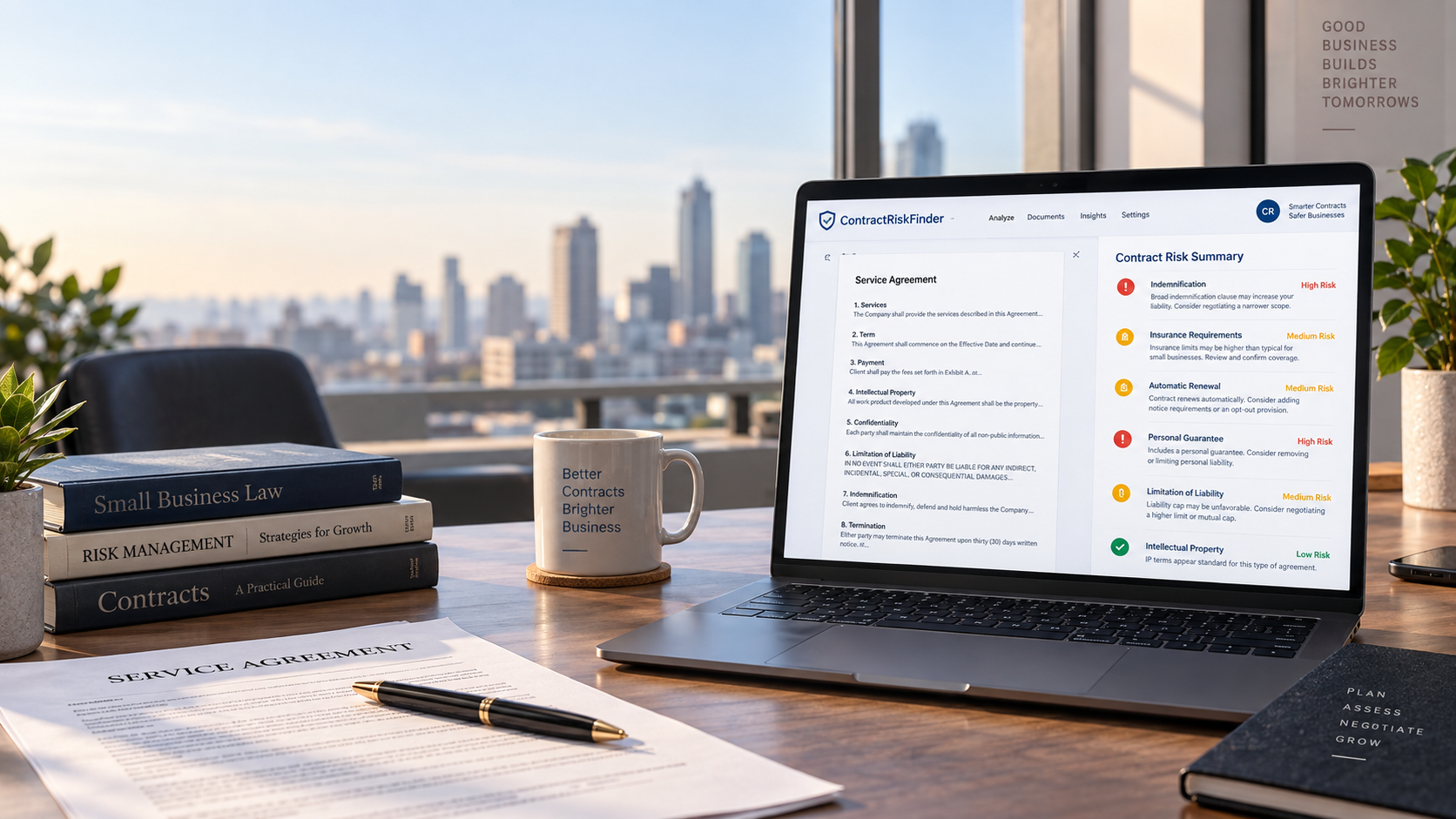
A risk-focused review may call attention to areas such as:
Indemnification
Who may be responsible for certain claims, losses, damages or expenses?
Insurance Requirements
Does the agreement require particular coverage, limits, endorsements or additional insured status?
Automatic Renewal
Will the contract extend automatically if you miss a cancellation window?
Termination
Can both parties leave the agreement under reasonable circumstances?
Personal Guarantees
Could an individual potentially be taking on obligations beyond the business entity?
Limitation of Liability
Does the agreement restrict what one party may recover if something goes wrong?
Intellectual Property
Who owns the work, technology, content, data or other intellectual property involved?
Payment and Fees
When is payment due? Are there penalties, deposits, cancellation fees or other financial obligations?
These are not automatically “bad” clauses.
They are decision points.
That Is the Idea Behind ContractRiskFinder
ContractRiskFinder is built around contract risk identification.
Instead of treating a contract as an enormous wall of legal language, the platform helps surface provisions that may deserve additional attention.
The workflow is straightforward:
1. Upload the contract.
2. Analyze the agreement for potential risk areas.
3. Review the findings.
4. Ask better questions before making the commitment.
For higher-stakes or legally complex agreements, those questions can then be taken to qualified legal counsel.
Where Insurance Enters the Picture
Contractual risk does not end with the contract.
Many agreements contain requirements that directly interact with insurance.
A client contract may require professional liability.
A vendor relationship may require cyber coverage.
A lease may require certain liability limits.
A contractor agreement may require certificates, endorsements, or other evidence of insurance.
Meanwhile, an indemnification clause may create contractual responsibilities that need to be understood separately from what an insurance policy actually covers.
This connection is one reason ContractRiskFinder fits naturally within the broader risk-intelligence approach of Island Insurance Group.
Island Insurance Group currently focuses on helping businesses and professionals understand exposures involving commercial insurance, professional liability, cyber risk and other forms of business protection.
Contract analysis helps move that process earlier:
Before the claim.
Before the dispute.
Before the renewal.
Before the signature.
AI Is a Starting Point, Not the Final Decision
AI can make contract review faster.
But speed should not be confused with legal judgment.
For an important agreement, the strongest approach can involve multiple layers:
AI risk identification → business review → insurance review → legal review when appropriate → informed decision
Technology helps you get to the right questions faster.
Professionals help you answer the questions that require professional judgment.
Five Contracts Worth Scanning Before You Sign
Small businesses should consider paying particular attention to:
- Client service agreements
- Vendor agreements
- Independent contractor agreements
- Commercial leases
- Partnership or strategic agreements
Other employment, financing, licensing, technology and subscription agreements may deserve the same attention depending on the circumstances.
The Best Contract Problem Is the One You Find Early
Once a dispute has begun, your choices may already be limited.
Before signing, you still have options.
You can ask.
You can clarify.
You can negotiate.
You can obtain professional advice.
And you can walk away if the risk does not make sense.
That is the real value of reviewing a contract before the signature.
Do not wait for a clause to become a problem before you discover it exists.
Start your contract review with ContractRiskFinder.
For broader business-risk and insurance guidance, visit Island Insurance Group.
DISCLAIMER
ContractRiskFinder is an educational risk-identification tool and is not a law firm, attorney, or substitute for legal advice. AI-generated analysis should be independently reviewed when appropriate. Insurance coverage depends on actual policy terms, exclusions, conditions, endorsements, underwriting, facts and applicable law.