Can Physicians Safely Use ChatGPT? | HIPAA & Medical Liability Guide
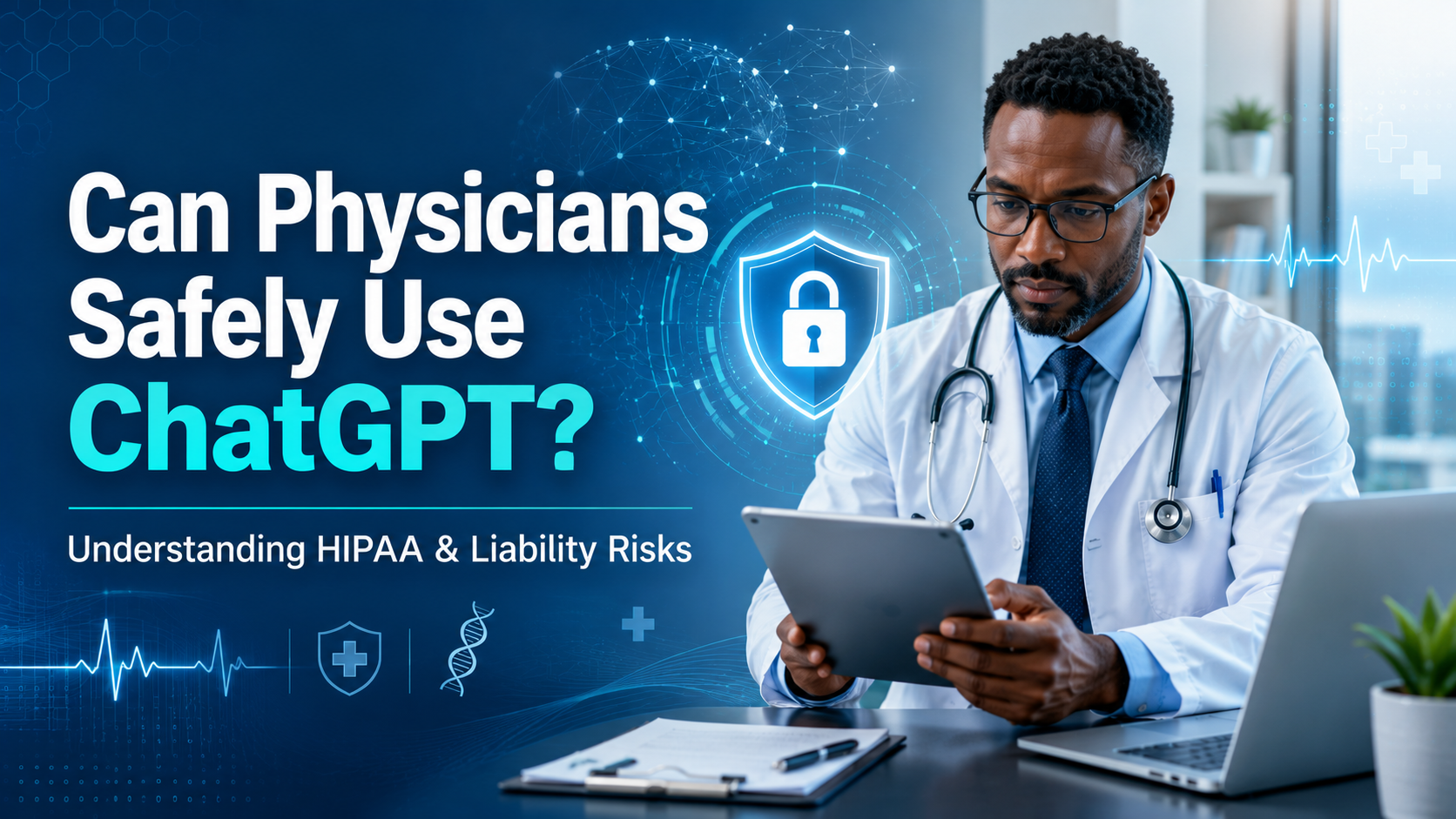
Can Physicians Safely Use ChatGPT? Understanding HIPAA and Liability Risks
Artificial intelligence is rapidly changing healthcare. From clinical documentation to administrative support, AI-powered tools like ChatGPT are helping healthcare professionals save time and improve efficiency.
However, many physicians have an important question:
Can physicians safely use ChatGPT while remaining HIPAA compliant?
The answer depends on how the technology is used. AI can be a valuable productivity tool, but it should never replace professional medical judgment or compromise patient privacy.
Understanding the legal, ethical, and cybersecurity considerations can help healthcare providers use AI more responsibly while reducing unnecessary liability.
How Physicians Are Using ChatGPT Today
Healthcare professionals are exploring AI for a wide range of non-diagnostic tasks.
Common examples include:
- Drafting patient education materials
- Creating discharge instructions
- Summarizing medical literature
- Developing office policies
- Writing blog articles and newsletters
- Preparing presentations
- Creating marketing content
- Brainstorming patient communication strategies
These applications can improve efficiency while allowing physicians to spend more time with patients.
Understanding HIPAA and AI
The Health Insurance Portability and Accountability Act (HIPAA) establishes national standards for protecting patients’ protected health information (PHI).
Examples of PHI include:
- Patient names
- Dates of birth
- Medical record numbers
- Addresses
- Social Security numbers
- Insurance information
- Treatment details linked to an identifiable patient
When using AI tools, physicians should avoid entering identifiable patient information into systems that are not approved by their organization or covered by appropriate contractual and compliance safeguards.
If you’re unsure whether an AI application is appropriate for handling sensitive information, consult your organization’s privacy officer, compliance team, or legal counsel.
Potential Liability Risks
AI can generate helpful content, but it can also produce inaccurate, outdated, or incomplete information.
Healthcare providers should carefully review any AI-generated material before using it professionally.
Potential risks include:
- Incorrect medical information
- Incomplete documentation
- Outdated clinical guidance
- Misinterpretation of patient information
- Overreliance on AI recommendations
Ultimately, physicians remain responsible for their clinical decisions and patient care.
Best Practices for Using ChatGPT Responsibly
Healthcare organizations are increasingly adopting internal AI policies.
Physicians can reduce risk by following several best practices.
Never Enter Identifiable Patient Information
Avoid submitting:
- Patient names
- Dates of birth
- Medical record numbers
- Insurance information
- Photographs
- Any combination of information that could identify a patient
When discussing clinical scenarios, use fully de-identified or fictional examples unless your organization has approved AI tools specifically designed for handling protected health information.
Verify Every Response
AI should assist—not replace—clinical judgment.
Always verify:
- Clinical recommendations
- Drug information
- Treatment guidelines
- Medical calculations
- Coding suggestions
- Documentation
Current clinical guidelines, peer-reviewed literature, and trusted medical references should remain the primary sources for patient care decisions.
Follow Your Organization’s AI Policy
Many healthcare systems now have policies governing AI use.
These policies may address:
- Approved AI applications
- Privacy requirements
- Documentation standards
- Security controls
- Employee training
- Acceptable use
Understanding your organization’s expectations helps reduce compliance risks.
Protect Your Login Credentials
Cybersecurity remains an essential part of responsible AI use.
Healthcare professionals should:
- Use strong passwords
- Enable multi-factor authentication
- Keep software updated
- Avoid suspicious links
- Report phishing attempts promptly
Good cybersecurity practices protect both providers and patients.
AI Is a Tool—Not a Replacement for Clinical Judgment
Artificial intelligence can improve efficiency, but it does not replace medical expertise.
Physicians must continue to:
- Evaluate each patient individually
- Exercise independent clinical judgment
- Follow evidence-based guidelines
- Document care accurately
- Communicate clearly with patients
Responsible oversight remains essential regardless of the technology being used.
Medical Malpractice Insurance Still Matters in the AI Era
As AI becomes more common in healthcare, professional liability risks continue to evolve.
Even when AI assists with documentation or administrative tasks, healthcare providers remain accountable for the care they deliver.
Medical malpractice insurance helps protect physicians and other healthcare professionals against covered claims arising from allegations related to patient care.
Regularly reviewing your professional liability policy helps ensure your coverage reflects your specialty, scope of practice, and evolving technology risks.
Learn more about your options by visiting:
👉 https://www.islandinsurancegroup.com/medical-malpractice-insurance/
Partner with Island Insurance Group
Technology continues to reshape healthcare, but one thing remains constant: protecting your practice is essential.
At Island Insurance Group, we help physicians, surgeons, dentists, nurse practitioners, CRNAs, physician assistants, and healthcare organizations find medical malpractice insurance solutions tailored to their unique needs.
Whether you’re adopting new technologies, expanding your practice, or reviewing your current policy, our experienced team can help you evaluate your coverage and identify insurance solutions that support your professional goals.
Learn More
Medical Malpractice Insurance
Can Physicians Safely Use ChatGPT? Understanding HIPAA and Liability Risks
Artificial intelligence is rapidly changing healthcare. From clinical documentation to administrative support, AI-powered tools like ChatGPT are helping healthcare professionals save time and improve efficiency.
However, many physicians have an important question:
Can physicians safely use ChatGPT while remaining HIPAA compliant?
The answer depends on how the technology is used. AI can be a valuable productivity tool, but it should never replace professional medical judgment or compromise patient privacy.
Understanding the legal, ethical, and cybersecurity considerations can help healthcare providers use AI more responsibly while reducing unnecessary liability.
How Physicians Are Using ChatGPT Today
Healthcare professionals are exploring AI for a wide range of non-diagnostic tasks.
Common examples include:
- Drafting patient education materials
- Creating discharge instructions
- Summarizing medical literature
- Developing office policies
- Writing blog articles and newsletters
- Preparing presentations
- Creating marketing content
- Brainstorming patient communication strategies
These applications can improve efficiency while allowing physicians to spend more time with patients.
Understanding HIPAA and AI
The Health Insurance Portability and Accountability Act (HIPAA) establishes national standards for protecting patients’ protected health information (PHI).
Examples of PHI include:
- Patient names
- Dates of birth
- Medical record numbers
- Addresses
- Social Security numbers
- Insurance information
- Treatment details linked to an identifiable patient
When using AI tools, physicians should avoid entering identifiable patient information into systems that are not approved by their organization or covered by appropriate contractual and compliance safeguards.
If you’re unsure whether an AI application is appropriate for handling sensitive information, consult your organization’s privacy officer, compliance team, or legal counsel.
Potential Liability Risks
AI can generate helpful content, but it can also produce inaccurate, outdated, or incomplete information.
Healthcare providers should carefully review any AI-generated material before using it professionally.
Potential risks include:
- Incorrect medical information
- Incomplete documentation
- Outdated clinical guidance
- Misinterpretation of patient information
- Overreliance on AI recommendations
Ultimately, physicians remain responsible for their clinical decisions and patient care.
Best Practices for Using ChatGPT Responsibly
Healthcare organizations are increasingly adopting internal AI policies.
Physicians can reduce risk by following several best practices.
Never Enter Identifiable Patient Information
Avoid submitting:
- Patient names
- Dates of birth
- Medical record numbers
- Insurance information
- Photographs
- Any combination of information that could identify a patient
When discussing clinical scenarios, use fully de-identified or fictional examples unless your organization has approved AI tools specifically designed for handling protected health information.
Verify Every Response
AI should assist—not replace—clinical judgment.
Always verify:
- Clinical recommendations
- Drug information
- Treatment guidelines
- Medical calculations
- Coding suggestions
- Documentation
Current clinical guidelines, peer-reviewed literature, and trusted medical references should remain the primary sources for patient care decisions.
Follow Your Organization’s AI Policy
Many healthcare systems now have policies governing AI use.
These policies may address:
- Approved AI applications
- Privacy requirements
- Documentation standards
- Security controls
- Employee training
- Acceptable use
Understanding your organization’s expectations helps reduce compliance risks.
Protect Your Login Credentials
Cybersecurity remains an essential part of responsible AI use.
Healthcare professionals should:
- Use strong passwords
- Enable multi-factor authentication
- Keep software updated
- Avoid suspicious links
- Report phishing attempts promptly
Good cybersecurity practices protect both providers and patients.
AI Is a Tool—Not a Replacement for Clinical Judgment
Artificial intelligence can improve efficiency, but it does not replace medical expertise.
Physicians must continue to:
- Evaluate each patient individually
- Exercise independent clinical judgment
- Follow evidence-based guidelines
- Document care accurately
- Communicate clearly with patients
Responsible oversight remains essential regardless of the technology being used.
Medical Malpractice Insurance Still Matters in the AI Era
As AI becomes more common in healthcare, professional liability risks continue to evolve.
Even when AI assists with documentation or administrative tasks, healthcare providers remain accountable for the care they deliver.
Medical malpractice insurance helps protect physicians and other healthcare professionals against covered claims arising from allegations related to patient care.
Regularly reviewing your professional liability policy helps ensure your coverage reflects your specialty, scope of practice, and evolving technology risks.
Learn more about your options by visiting:
👉 https://www.islandinsurancegroup.com/medical-malpractice-insurance/
Partner with Island Insurance Group
Technology continues to reshape healthcare, but one thing remains constant: protecting your practice is essential.
At Island Insurance Group, we help physicians, surgeons, dentists, nurse practitioners, CRNAs, physician assistants, and healthcare organizations find medical malpractice insurance solutions tailored to their unique needs.
Whether you’re adopting new technologies, expanding your practice, or reviewing your current policy, our experienced team can help you evaluate your coverage and identify insurance solutions that support your professional goals.
Learn More
Medical Malpractice Insurance
https://www.islandinsurancegroup.com/medical-malpractice-insurance/
Contact Island Insurance Group
https://islandinsurancegroup.com/contact-island-insurance-group-get-in-touch/
Contact our team today to request a personalized quote or schedule a complimentary coverage review.
Frequently Asked Questions
Can physicians use ChatGPT for patient care?
AI can assist with administrative and educational tasks, but physicians should exercise independent clinical judgment. They should also follow their organization’s AI policies and applicable privacy requirements.
Is ChatGPT HIPAA compliant?
HIPAA compliance depends on how an AI tool is deployed and managed. Healthcare providers should not enter identifiable patient information into AI systems unless the tool has been approved for that purpose and appropriate compliance safeguards are in place.
Can AI replace physicians?
No. AI is designed to support healthcare professionals by improving efficiency and assisting with certain tasks. Clinical decision-making, patient communication, and medical responsibility remain with licensed healthcare providers.
Does malpractice insurance cover AI-related claims?
Coverage depends on the specific policy language and the facts of a claim. Physicians should review their medical malpractice insurance with an experienced insurance advisor to understand how their coverage applies to evolving practice risks.
Disclaimer: This article is for informational purposes only and does not constitute legal, medical, or insurance advice. Healthcare providers should consult qualified legal counsel, compliance professionals, and their malpractice insurance advisor regarding the use of artificial intelligence in their practice and the applicability of HIPAA and other laws.
Can Physicians Safely Use ChatGPT? Understanding HIPAA and Liability RisksContact Island Insurance Group
https://islandinsurancegroup.com/contact-island-insurance-group-get-in-touch/
Contact our team today to request a personalized quote or schedule a complimentary coverage review.
Frequently Asked Questions
Can physicians use ChatGPT for patient care?
AI can assist with administrative and educational tasks, but physicians should exercise independent clinical judgment. They should also follow their organization’s AI policies and applicable privacy requirements.
Is ChatGPT HIPAA compliant?
HIPAA compliance depends on how an AI tool is deployed and managed. Healthcare providers should not enter identifiable patient information into AI systems unless the tool has been approved for that purpose and appropriate compliance safeguards are in place.
Can AI replace physicians?
No. AI is designed to support healthcare professionals by improving efficiency and assisting with certain tasks. Clinical decision-making, patient communication, and medical responsibility remain with licensed healthcare providers.
Does malpractice insurance cover AI-related claims?
Coverage depends on the specific policy language and the facts of a claim. Physicians should review their medical malpractice insurance with an experienced insurance advisor to understand how their coverage applies to evolving practice risks.
Disclaimer: This article is for informational purposes only and does not constitute legal, medical, or insurance advice. Healthcare providers should consult qualified legal counsel, compliance professionals, and their malpractice insurance advisor regarding the use of artificial intelligence in their practice and the applicability of HIPAA and other laws.