
Common pitfalls in independent contractor agreements
Vendor Contracts: The Hidden Clauses That Could Cost Your Business Thousands
Every business owner knows the feeling. You’re ready to close a deal with a new vendor, the relationship feels right, and the contract lands in your inbox. You skim through it, feel reasonably comfortable, and sign. Weeks or months later, something goes wrong — a missed delivery, a price hike, a service that doesn’t match what was promised — and suddenly you’re staring at contract language that seems to say the exact opposite of what you thought you agreed to.
Vendor contracts are among the most commonly signed and least carefully reviewed documents in business. Whether you’re a startup founder bringing on a software provider, a small business owner hiring a logistics company, or an operations manager sourcing materials, the contracts you sign with vendors carry serious financial and legal risk. Understanding what to look for before you sign is not just smart — it’s essential.
Why Vendor Contracts Deserve More Scrutiny Than They Usually Get
Most vendor contracts are written by the vendor’s legal team. That means they are designed to protect the vendor — not you. Standard boilerplate language often includes clauses that shift liability, limit your ability to exit, and give the vendor far more flexibility than you realize. By the time a dispute arises, it’s too late to renegotiate.
The problem is compounded by the sheer volume of contracts businesses sign. A mid-sized company might execute dozens of vendor agreements in a single year. Reading each one carefully — let alone understanding the legal implications — requires time and expertise that most teams simply don’t have.
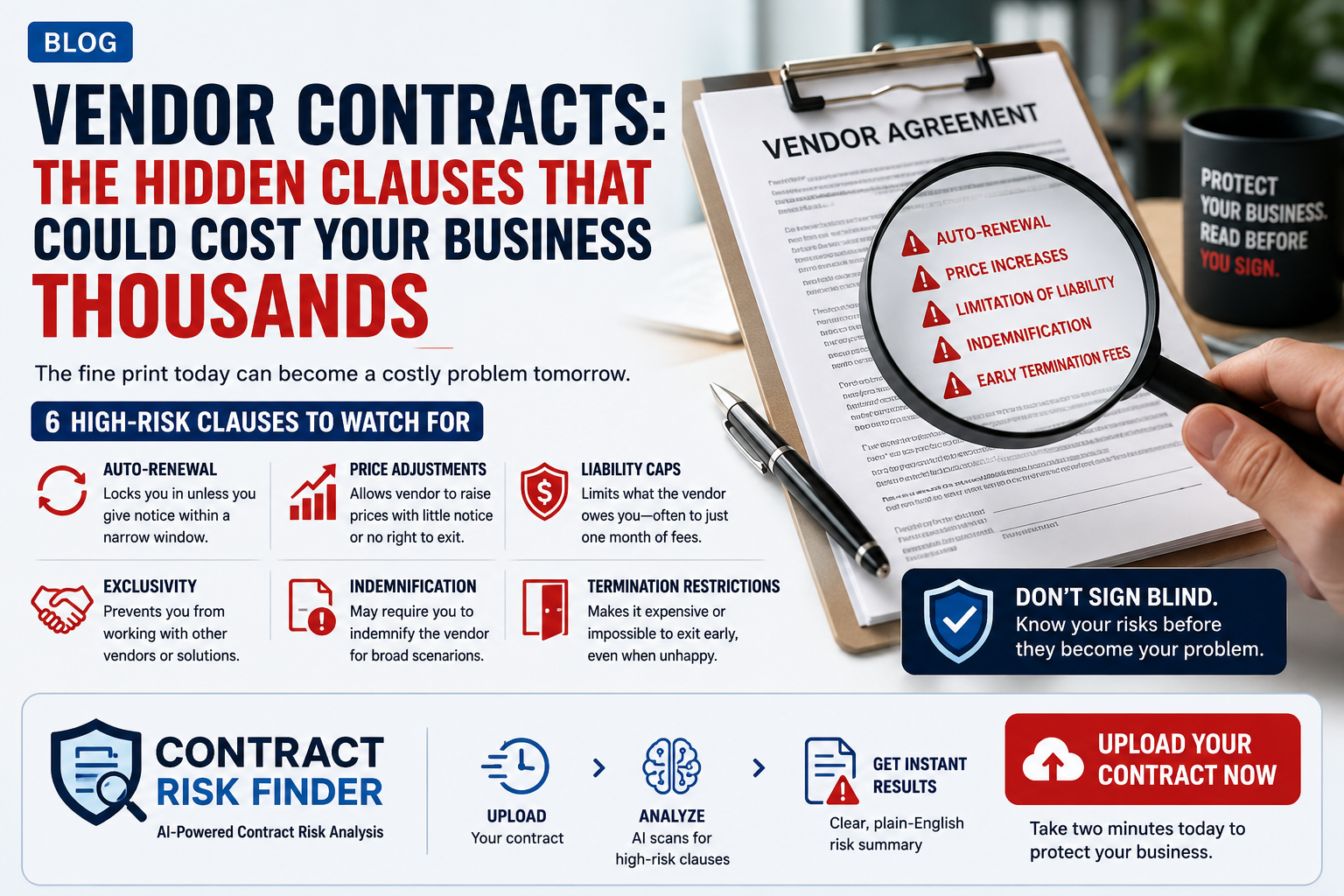
Six High-Risk Clauses to Watch for in Vendor Contracts
Not all contract language is created equal. Here are six clause types that consistently create problems for businesses that don’t catch them in advance:
- Auto-renewal clauses: Many vendor contracts include language that automatically renews the agreement for another term — sometimes a full year — unless you provide written notice within a narrow window. Missing that window can lock you in for another cycle with no easy exit.
- Unilateral price adjustment rights: Some contracts allow vendors to increase their fees with minimal notice and no right for you to exit without penalty. This can destroy budget projections and leave you paying significantly more than you planned.
- Limitation of liability caps: Vendors frequently cap their liability at a fraction of what you’ve paid them — sometimes just one month of fees. If their failure causes you a six-figure loss, you may have no meaningful legal recourse.
- Exclusivity provisions: These clauses can prevent you from working with competing vendors, limiting your flexibility and creating dangerous single-source dependencies in your supply chain or operations.
- Broad indemnification language: Some contracts require you to indemnify the vendor for a wide range of scenarios, including situations where the vendor’s own negligence contributed to the problem.
- Termination for convenience restrictions: Many vendor contracts make it expensive or impossible to exit early, even if the vendor is underperforming. Look carefully at termination rights, cure periods, and early exit fees.
The Real Cost of Signing Without Reading
It’s tempting to think that vendor relationships will work themselves out in good faith. And many do. But even the most well-intentioned vendor will rely on contract language when money is on the line. Businesses that sign without reviewing the fine print often discover that they have no leverage when things go sideways — and no legal ground to stand on.
The good news is that most risky vendor contract clauses are negotiable — if you catch them before you sign. Once ink hits paper, your options narrow dramatically.
How Contract Risk Finder Helps You Catch Problems Before They Become Expensive
Contract Risk Finder was built specifically for this problem. Our AI-powered platform scans vendor contracts and flags high-risk clauses instantly — auto-renewals, liability caps, indemnification traps, and more. You don’t need to be a lawyer to use it. You just need to upload your contract and let the system do the heavy lifting.
Instead of spending hours reading dense legalese or paying expensive attorney fees for a preliminary review, you can get a clear, plain-English breakdown of what your contract actually says and where the risks are concentrated. That gives you the information you need to negotiate better terms or walk away from a bad deal entirely.
Frequently Asked Questions About Vendor Contract Risks
What makes a vendor contract clause “high risk”?
A clause is high risk when it significantly limits your rights, exposes you to unexpected costs, or gives the vendor disproportionate control over the relationship — especially without reciprocal obligations.
Can I negotiate a vendor’s standard contract?
Yes. Most vendors expect some negotiation. The key is identifying which clauses to push back on before you sign, not after.
Do small businesses really need to review every vendor contract carefully?
Absolutely. Small businesses often have less financial cushion to absorb the consequences of a bad contract. A single unfavorable clause can have outsized impact on a smaller operation.
How long does it take to review a vendor contract with Contract Risk Finder?
Most contracts are analyzed in minutes. You upload the document, and the platform returns a flagged summary highlighting clauses that warrant your attention.
Don’t Sign Until You Know What You’re Signing
Vendor contracts protect vendors. It’s that simple. If you want protection on your side of the deal, you need to understand what you’re agreeing to before the contract is executed. The clauses that seem like fine print today can become costly problems tomorrow.
Take two minutes right now to protect your business. Upload your vendor contract to Contract Risk Finder and get an instant red-flag review. Know what’s in your contract — before it’s too late to do anything about it.