
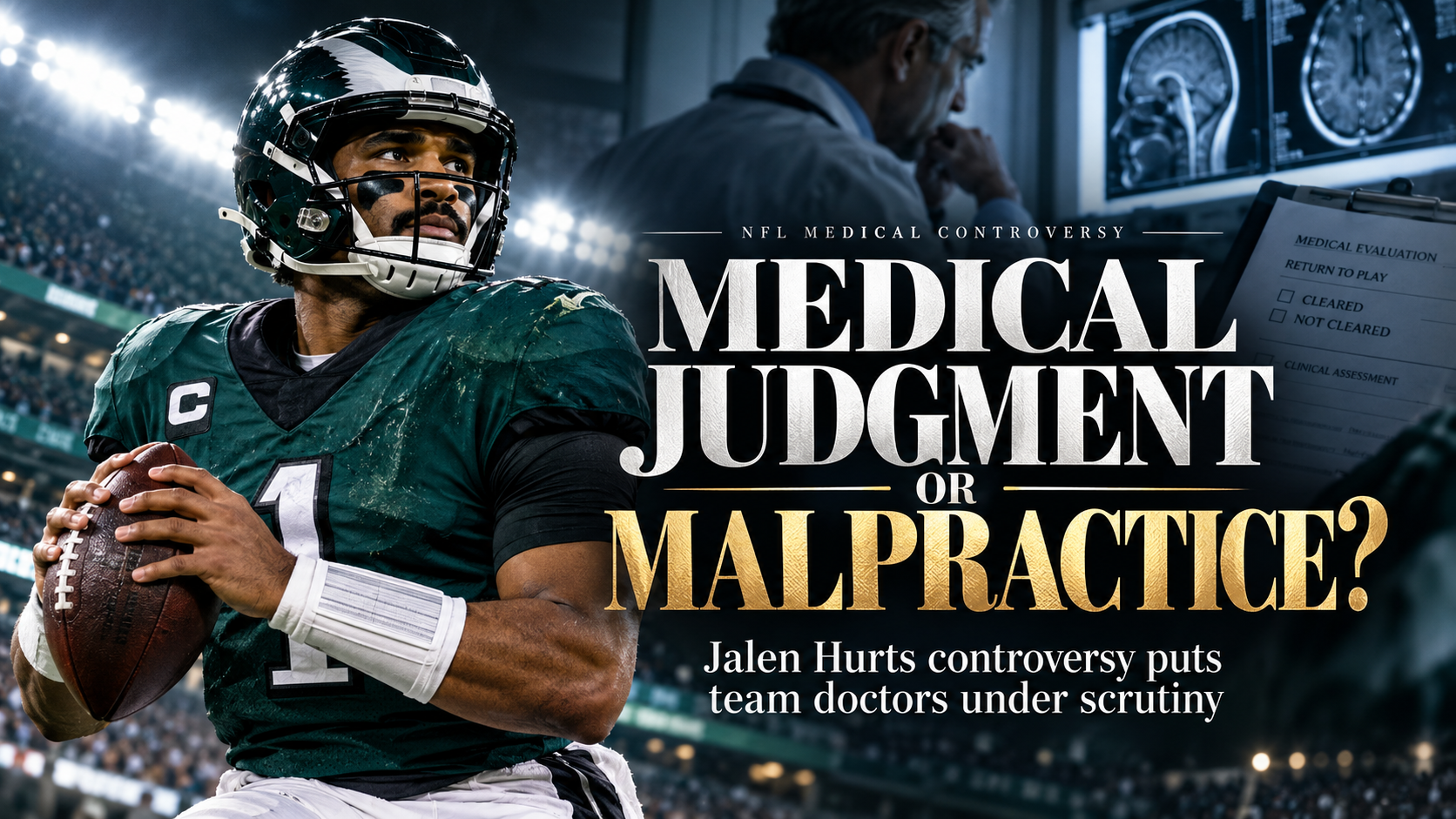
Jalen Hurts Malpractice Controversy: Former Eagles Player Calls It Negligence as NFL Defends Medical Decisions
Did the Philadelphia Eagles’ medical staff commit malpractice by allowing Jalen Hurts to play after a blood clot diagnosis? Former Eagles linebacker and sports commentator Emmanuel Acho has publicly raised that accusation. But the NFL has reportedly concluded that the team’s handling of the quarterback’s medical condition was appropriate.
The conflicting reactions have turned Hurts’ medical situation into a broader debate about athlete safety, independent medical judgment, professional negligence, and the responsibilities of physicians working in professional sports.
For team physicians and sports medicine specialists, the controversy raises another important question: What happens when a medical decision becomes the subject of public accusations, even when the treating professionals maintain that they acted appropriately?
Important distinction: As of October 20, 2026, the public reporting reviewed for this article does not establish that the Eagles’ medical staff committed professional negligence. Acho’s comments are allegations, not a judicial finding or an independent medical determination.
Why Emmanuel Acho Is Questioning the Eagles’ Medical Decisions
On October 20, 2026, Pro Football Network reported that Emmanuel Acho, a former Philadelphia Eagles linebacker, had sharply criticized the handling of Jalen Hurts’ medical situation.
In comments highlighted by the publication, Acho characterized the circumstances using the words “negligence” and “malpractice” and suggested that Hurts should consider legal action against Philadelphia.
Acho’s concerns focused on the decision to allow Hurts to participate in a game in London after clinicians had identified a superficial blood clot in his leg.
Subsequent medical evaluations revealed a more serious condition: deep vein thrombosis and blood clots in both lungs.
The criticism reflects a question many observers are asking: If the medical situation later became more serious, should the quarterback have been allowed to play earlier?
That is a legitimate subject for medical review and public discussion. However, the progression of a medical condition does not, by itself, establish that a previous treatment or clearance decision violated the applicable standard of care.
Original reporting: Pro Football Network — Emmanuel Acho Questions Eagles’ Medical Decisions.
What the NFL Said About the Medical Handling of Jalen Hurts
The controversy gained another dimension when Reuters reported on October 20 that the NFL considered the Eagles’ handling of Hurts’ medical situation appropriate.
The report described the involvement of medical professionals and coordination surrounding the team’s international game arrangements.
The NFL’s position differs from Acho’s public accusations.
However, the league’s assessment should not be confused with a court judgment resolving every possible legal question. Likewise, the existence of an allegation does not establish wrongdoing.
Both developments deserve to be presented accurately.
Read the report: Reuters — League Says Eagles Handled Hurts’ Medical Condition Appropriately.
A Timeline of Jalen Hurts’ Blood Clot Diagnosis
Understanding the controversy requires distinguishing what clinicians reportedly identified before the game from what additional testing established afterward.
October 4–10: Initial Injury and Evaluation
According to the Philadelphia Eagles’ public account, Hurts experienced a calf injury during the team’s October 4 game against the Los Angeles Rams.
He subsequently reported symptoms, and a medical examination in London on October 10 identified superficial vein thrombosis in his left calf.
The Eagles said their medical staff and consulting physicians evaluated the situation and determined that he could participate in the following game.
October 11: Hurts Plays in London
Hurts participated in the Eagles’ game against the Jacksonville Jaguars after the initial evaluation.
The decision subsequently became controversial when additional testing identified more significant blood clotting.
October 14–17: Follow-Up and Injured Reserve
According to the team’s reported timeline, follow-up testing prompted further evaluation. Hurts was ruled out of the following game and placed on injured reserve.
October 19: Deep Vein Thrombosis and Pulmonary Emboli Confirmed
The Eagles and Hurts’ agent, Nicole Lynn, announced that further evaluations had identified deep vein thrombosis and bilateral pulmonary emboli.
The statement described Hurts as clinically stable and indicated that he was expected to recover fully.
His treatment includes anticoagulation medication. He is not permitted to participate in contact football while receiving that treatment.
The announcement did not establish an exact return-to-play date.
Source: Official Philadelphia Eagles Medical Update — October 19, 2026.
What Actually Constitutes Medical Malpractice?
Medical malpractice is not established simply because a patient experiences an unexpected complication, receives a more serious diagnosis, or disagrees with an earlier medical decision.
In general, a professional negligence claim involves several essential legal questions.
1. Did the Physician Owe a Duty of Care?
A professional duty may arise from the physician-patient relationship and the circumstances under which medical services were provided.
2. Was the Applicable Standard of Care Breached?
The standard-of-care analysis examines whether the clinician’s conduct met the applicable professional requirements under the circumstances.
It generally involves the medical information reasonably available at the time of the decision, not simply the benefit of hindsight.
3. Did the Alleged Breach Cause the Injury?
A malpractice claim must address whether an alleged departure from the standard of care caused legally relevant harm.
The fact that a medical condition progressed does not automatically answer that question.
4. Were There Legally Recoverable Damages?
A claimant must also establish damages recognized under applicable law.
The details and legal requirements vary by jurisdiction.
Applying these principles to an individual medical decision would require far more information than news reports ordinarily provide, including clinical records, diagnostic findings, the medical reasoning at the time, and appropriately qualified expert analysis.
Can a Physician Be Accused of Malpractice Without Having Committed Negligence?
Yes. An allegation is not the same as proof.
A patient, commentator, or other person may publicly question a medical decision. A formal complaint or lawsuit may also contain allegations that have not yet been established.
Whether those allegations are ultimately substantiated is a separate matter.
For physicians, this distinction explains why medical malpractice insurance is not only about paying covered settlements or judgments.
Depending on the policy, professional liability insurance may also provide defense-related protection when a covered claim is asserted.
The scope of that protection depends on policy language, insured activities, reporting requirements, exclusions, and other conditions.
Why Professional Sports Medical Decisions Receive Intense Scrutiny
Medical decisions in professional sports can attract extraordinary public attention.
Star athletes have substantial professional and financial interests in continuing to compete. Teams operate under demanding schedules, and high-profile medical events may generate immediate scrutiny from fans, commentators, journalists, and other stakeholders.
These pressures make independent medical judgment and clear clinical communication especially important.
However, the existence of competitive or financial pressure in professional sports does not prove that such pressure influenced a particular physician’s decision.
In Hurts’ case, publicly available information does not establish improper interference with medical judgment.
The broader lesson is that physicians working in sports environments should understand their professional responsibilities, document clinical decisions appropriately, and ensure their insurance arrangements accurately reflect their duties.
What Happens When a Team Physician Is Accused of Malpractice?
When a physician faces a professional negligence allegation, the insurance response may depend on several factors:
- Whether the physician is a named insured under the applicable policy
- Whether the alleged services fall within covered professional activities
- Whether the claim involves an insured location or assignment
- Whether the claim was reported according to policy requirements
- Whether defense expenses are covered and how they affect policy limits
- Whether exclusions or endorsements apply
- Whether another policy provides potentially applicable protection
- Whether contractual indemnification provisions affect the parties’ responsibilities
A professional sports organization, hospital, individual physician, or medical group may maintain separate insurance arrangements.
Physicians should not assume that being employed by a team or treating its athletes automatically guarantees personal professional liability protection.
For a more detailed overview, visit Team Physician and Sports Medicine Malpractice Insurance in Florida.
Are Team Physicians Adequately Insured for High-Value Athletes?
Medical liability exposures associated with professional athletes may involve substantial financial questions.
An athlete’s future earnings can be relevant to certain alleged economic losses, although contract value does not automatically equal recoverable malpractice damages.
A 2025 study published in the American Journal of Sports Medicine explored modeled financial liability exposure for physicians treating NFL, MLB, and NHL athletes.
The study examined how certain hypothetical financial exposures compared with common medical malpractice insurance limits.
Its modeling does not establish actual lawsuit outcomes or demonstrate that every sports physician requires a particular limit.
It does provide an additional reason to evaluate coverage limits, defense provisions, employment contracts, and potentially applicable excess protection.
Related article: $1 Million in Malpractice Coverage. A $50 Million Athlete. Is the Team Doctor Protected?
Five Insurance Questions Every Team Physician Should Ask
1. Does My Existing Policy Cover the Services I Perform for a Team?
Physicians should confirm whether their approved professional activities include team medical care, sideline responsibilities, emergency treatment, and other relevant duties.
2. Who Pays for My Legal Defense if a Covered Claim Is Filed?
The applicable policy and contractual arrangements determine the insurer’s defense obligations, subject to relevant terms and conditions.
3. Are My Coverage Limits Appropriate?
Limits should be evaluated against professional activities, contractual obligations, other available insurance, and the characteristics of the risk.
4. Am I Covered for Medical Director and Supervisory Activities?
Medical oversight and supervisory duties may require specific disclosure and underwriting consideration.
5. What Happens When My Team Assignment Ends?
Physicians with claims-made coverage should review retroactive dates, prior-acts protection, and extended reporting provisions when employment or contractual arrangements change.
What Florida Physicians Can Learn From the Hurts Controversy
Although this news involves an NFL team, the underlying professional liability questions extend to physicians working with college athletics, school sports programs, community competitions, and private sports medicine practices.
Florida physicians should consider both applicable financial responsibility requirements and the separate obligations associated with their professional arrangements.
Florida Statute 458.320 addresses financial responsibility requirements for physicians licensed under Chapter 458, including specified methods of compliance and exemptions.
Compliance with a financial responsibility requirement does not automatically establish coverage for every medical activity or contractual assignment.
Sports medicine specialists, orthopedic surgeons, emergency physicians, and medical directors should review the actual policy and relevant insurance arrangements before assuming that outside activities are covered.
Explore Your Medical Malpractice Insurance Risk Profile
Island Insurance Group provides a free medical malpractice quoting tool that helps physicians explore preliminary premium estimates and underwriting considerations.
Physicians can use the platform to begin evaluating general factors that may influence professional liability insurance costs.
Explore Your Free Medical Malpractice Premium Analysis →
The platform does not determine whether a particular medical decision constitutes negligence, confirm coverage for a sports organization, or guarantee a carrier quotation.
Specialized team physician and medical director assignments require individualized evaluation of professional duties and applicable insurance terms.
Frequently Asked Questions
Did Emmanuel Acho accuse the Eagles of medical malpractice?
Yes. According to Pro Football Network’s October 20 reporting, Acho publicly characterized aspects of the Eagles’ handling of Jalen Hurts’ medical situation as negligence and malpractice. These are his allegations, not established legal findings.
Did the NFL defend the Eagles’ medical decisions?
Reuters reported on October 20, 2026, that the NFL considered the Eagles’ handling of Hurts’ medical situation appropriate. That report should be distinguished from an independent judicial determination.
Can Jalen Hurts sue the Philadelphia Eagles or their medical staff?
Potential legal rights and remedies depend on applicable law, contractual arrangements, relevant facts, and other circumstances. Public criticism alone does not establish the merits of a potential lawsuit. This article does not assess whether Hurts has a valid legal claim.
Does an unfavorable medical outcome automatically establish malpractice?
No. Professional negligence generally requires proof of an applicable duty, breach of the standard of care, causation, and legally recoverable damages. The precise requirements depend on jurisdiction.
Does team physician malpractice insurance cover legal defense?
Many professional liability policies include defense-related provisions for covered claims. Actual defense obligations, expenses, limits, and conditions depend on the individual policy.
The Bigger Lesson: Medical Judgment Deserves Protection, Too
The Jalen Hurts controversy illustrates how quickly a medical decision can become a national discussion about professional responsibility.
Emmanuel Acho has publicly questioned the Eagles’ medical decisions, while the NFL has reportedly concluded that the medical handling was appropriate.
Those positions should not be confused with established findings of professional negligence.
For physicians, the practical lesson is broader than professional football.
Medical decisions may be scrutinized, challenged, or misunderstood. Appropriate documentation, clear clinical responsibilities, and carefully reviewed professional liability coverage are important parts of managing those risks.
Island Insurance Group works with Florida physicians and medical practices to evaluate professional liability insurance needs, including specialized medical activities and complicated underwriting circumstances.
Explore our Team Physician and Sports Medicine Malpractice Insurance page, visit our Insurance Resources Center, or use our free medical malpractice assessment tool to help organize underwriting information.
Schedule a Professional Liability Insurance Consultation →
Samuel Bennett, Licensed Insurance Agent
Island Insurance Group
Email: sam@islandinsurancegroup.com
Phone: 954-804-8144
Editorial disclaimer: This article is based on public reporting available October 20, 2026. It does not allege or establish that the Philadelphia Eagles, their medical personnel, or any individual physician committed professional negligence. Statements attributed to Emmanuel Acho represent his views. This article provides general insurance education, not legal or medical advice. Coverage availability, limits, premiums, and policy terms depend on insurer underwriting and individual circumstances.