
Federal Nursing Home Staffing Rules Were Repealed. What Protects Florida Residents Now?
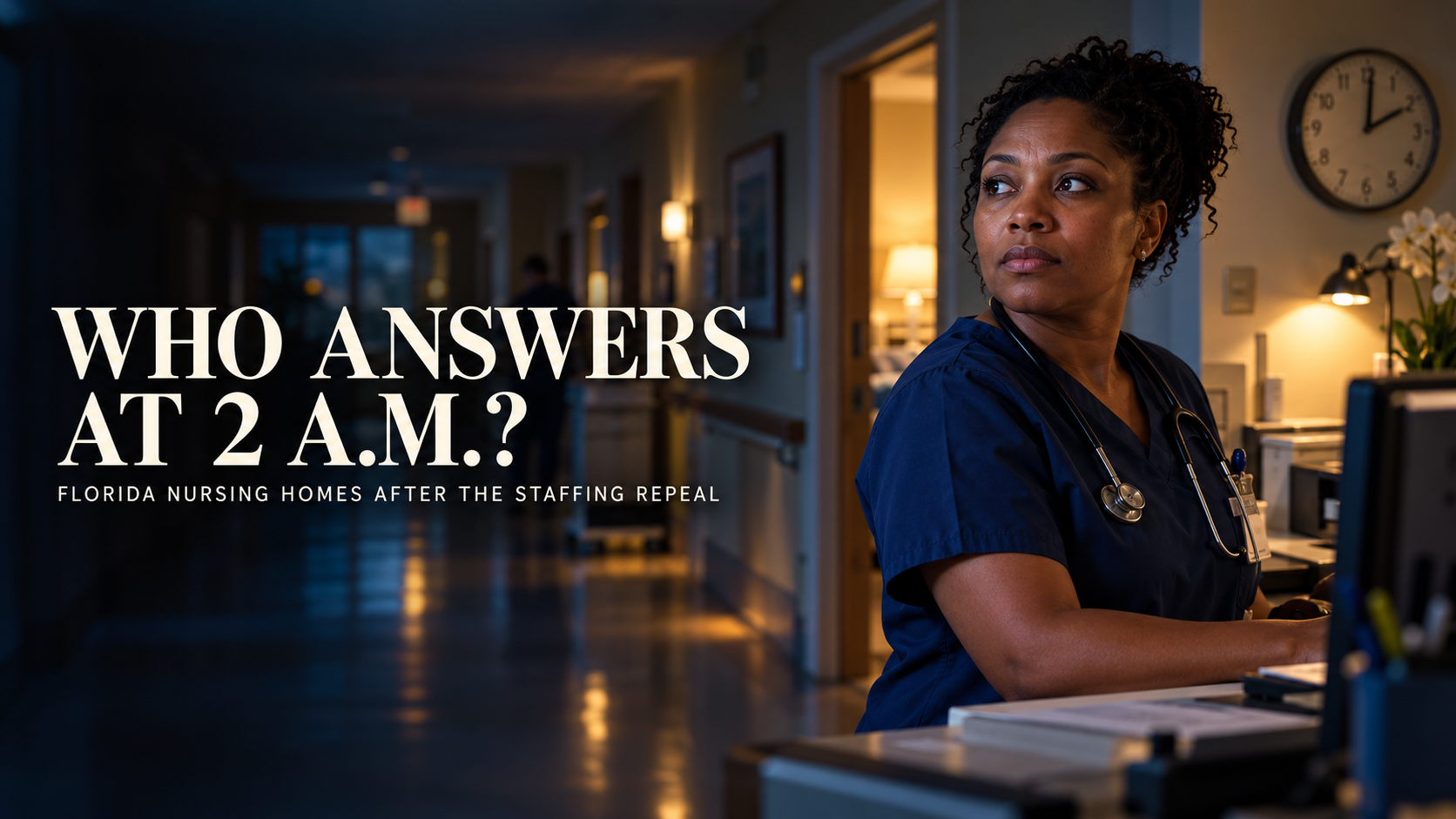
Who answers when a nursing home resident needs help at 2 a.m.? That question brings the CMS nursing home staffing rule repeal into focus. Effective February 2, 2026, CMS removed the 2024 federal numerical staffing standards and universal requirement for a registered nurse onsite around the clock. Source: CMS repeal rule.
For Florida families, the question is what protections remain. For facility owners and medical directors, it is how to make staffing and insurance decisions that stand up to scrutiny when someone needs care.
Updated October 20, 2026. This article addresses nursing homes and skilled nursing facilities, which operate under different rules from assisted living facilities and home health agencies.
What happened to the federal nursing home staffing rule?
CMS’s December 2025 interim final rule repealed requirements adopted in 2024 for:
- An onsite RN 24 hours a day, seven days a week.
- 3.48 total nursing hours per resident daily.
- Within that total, 0.55 RN hours and 2.45 nurse-aide hours.
Federal law also blocks implementation, administration, or enforcement of the affected provisions through September 30, 2034. The end of that moratorium does not automatically restore the repealed standards. Read the Federal Register explanation.
The important question now is how facilities evaluate the people, skills, and coverage they need under the requirements that remain.
Can a nursing home operate without adequate overnight nursing care?
No. Current federal rules require sufficient nursing personnel around the clock to meet residents’ care needs. Staffing must reflect assessments, care plans, and the facility’s resident population.
The general federal RN baseline is at least eight consecutive hours daily, seven days a week, plus a full-time RN director of nursing, subject to applicable waivers. The repeal of the universal 24/7 RN mandate did not erase these obligations. Source: 42 CFR § 483.35.
Before changing a schedule, an administrator should be able to explain who handles a resident’s sudden change in condition, who covers an unexpected absence, and who can call for additional help.
What protects Florida nursing home residents now?
Florida retains its own staffing requirements. Under § 400.23(3), general minimums include:
- A weekly average of 3.6 direct-care hours per resident daily.
- 2.0 CNA direct-care hours per resident daily, with no fewer than one CNA per 20 residents.
- 1.0 licensed-nurse direct-care hour per resident daily, with no fewer than one licensed nurse per 40 residents.
Staffing must also reflect assessed resident needs. Florida’s broader direct-care measure differs from the repealed federal nursing-hours measure, so comparing 3.6 with 3.48 alone does not establish compliance. Detailed counting rules and separate requirements for certain residents under 21 apply. Source: Florida Statutes § 400.23.
What should families ask before choosing a nursing home?
Ask how the facility handles a difficult shift. A useful conversation goes beyond the number of people listed on a schedule.
- Who is here overnight? Ask which nursing roles are present and how residents receive urgent assessment.
- What happens when someone calls out? Ask who arranges replacement coverage and how quickly backup can arrive.
- How do you account for my family member’s needs? Discuss mobility, cognition, medication assistance, and other individual care requirements.
- Who follows up on concerns? Ask for a named contact and the process for reviewing an unresolved issue.
Take notes and ask for clarification when answers are vague. A polished tour is useful, but a specific explanation of how care is delivered is more informative.
For owners, when does a cost saving become a risk?
Consider a hypothetical overnight shift: one resident needs urgent assessment while another needs assistance with a transfer. An employee has called out. The remaining team must decide what happens first and who can help.
This is a planning scenario, not a reported incident. Its purpose is to test whether a staffing plan works when demands overlap.
Before approving a change, ask clinical leadership to walk through that scenario using the actual resident population and available backup. Document the decision, the assumptions, and the circumstances that would trigger additional staffing.
A proposed payroll saving deserves the same scrutiny as any other major financial decision. Ask what must go right for it to work—and what the response will be when conditions change.
Does the staffing repeal change your liability insurance?
Do not assume a regulatory change rewrites an insurance policy or automatically lowers its premium. Use the repeal as a reason to review the actual contract with your agent and insurer.
Start with these five questions:
- Who is insured? Identify the legal entities, locations, employed professionals, contractors, and medical-director activities addressed by the policy.
- What happens to the limit during a claim? Ask whether defense expenses reduce available limits and how deductibles, retentions, and aggregates apply.
- Does the operating plan match the application? Review staffing arrangements and services so underwriting information remains accurate.
- What language deserves special attention? Ask about relevant exclusions, conditions, endorsements, and any requirements concerning operational changes.
- What happens if you change insurers? For claims-made coverage, ask about the retroactive date, reporting requirements, continuity, and any extended-reporting need before moving coverage.
These are review questions, not a description of benefits guaranteed by any insurer. Request answers tied to your policy forms and endorsements.
Explore Island Insurance Group’s insurance resources before your next coverage discussion.
What should nursing home medical directors review?
Medical directors should bring a written description of their duties to the insurance discussion. Separate administrative oversight, supervision, and direct patient care, then ask how the facility’s policy and the physician’s own policy address each activity.
For physician-specific preparation, use the free medical malpractice assessment tool and review our Florida medical malpractice insurance guidance. The assessment organizes information for review; it does not bind coverage or guarantee eligibility or pricing.
What should facility leaders do next?
Bring your administrator, clinical leader, compliance adviser, and insurance agent into the same planning process. Prepare current policies, staffing agreements, recent surveys, corrective-action records, and insurer-issued loss runs.
Then answer three questions in writing: What care does the resident population need? How will the operating plan provide it? What does the insurance program actually address?
That is a more useful response to the staffing repeal than making a budget decision from a headline.
Frequently asked questions
When did the CMS nursing home staffing repeal take effect?
The repeal took effect February 2, 2026.
Did Florida eliminate its nursing home staffing requirements?
No. Florida maintains separate staffing requirements under § 400.23.
Does the repeal guarantee lower insurance premiums?
No. Obtain a facility-specific underwriting review and compare coverage terms alongside price.
Review your coverage before changing your operating plan
Contact Island Insurance Group to discuss your operations and insurance questions. You can also explore our free business assessment tool for broader business planning. It does not determine staffing compliance.
Samuel Bennett, Licensed Insurance Agent
sam@islandinsurancegroup.com
954-804-8144
Schedule an appointment
Educational information only; not legal advice or a facility-specific compliance determination. Coverage, eligibility, premiums, limits, exclusions, and availability depend on the applicant, policy, and insurer.