Non-compete clause red flags for employees
Non-Compete Clauses: What You Need to Know Before You Sign
You’ve just received a job offer or a new business contract, and buried somewhere in the fine print is a non-compete clause. These clauses are among the most commonly misunderstood — and most frequently abused — provisions in modern contracts. Signing one without fully understanding what you’re agreeing to can limit your career options, restrict your business activities, and even expose you to costly litigation down the road.
This guide breaks down exactly what non-compete clauses are, why they’re risky, and what red flags to watch for before you put your name on the dotted line.
What Is a Non-Compete Clause?
A non-compete clause — also called a non-competition agreement or covenant not to compete — is a contractual provision that restricts one party from engaging in business activities that compete with the other party for a defined period of time and within a defined geographic area. These clauses are commonly found in:
- Employment contracts
- Business sale agreements
- Partnership and shareholder agreements
- Freelance and independent contractor agreements
On the surface, a non-compete sounds reasonable. A company invests in training you or shares proprietary information with you, and in return, they want some assurance you won’t immediately take that knowledge to a direct competitor.
That logic makes sense — until the clause becomes so broad that it effectively prevents you from working in your entire industry for years at a time.
Before signing any agreement, many professionals now use tools like Contract Risk Finder to identify restrictive language, flag high-risk provisions, and better understand the legal obligations hidden inside complex contracts.
Why Non-Compete Clauses Can Be Dangerous
The danger in non-compete clauses lies in the details — specifically, in overly broad scope, duration, and geography. A clause that prevents you from working for any competitor within 50 miles for three years might sound like legal boilerplate, but it could realistically lock you out of your professional field entirely depending on where you live and what industry you work in.
Here are some of the most common ways these clauses cause real harm:
Career Paralysis
You leave a job only to discover the non-compete prevents you from accepting positions within your area of expertise.
Business Restrictions
Entrepreneurs sometimes sign agreements without realizing they are prohibited from launching similar businesses for years after leaving a company or partnership.
Enforcement Threats
Even if a clause may ultimately prove unenforceable, the threat of litigation alone can discourage people from pursuing new opportunities.
Vague Language
Terms such as “competitive activity,” “similar services,” or “related business” often create uncertainty about what activities are actually prohibited.
AI-powered contract review platforms such as Contract Risk Finder can help identify these vague terms before you sign, allowing you to ask questions or negotiate revisions.
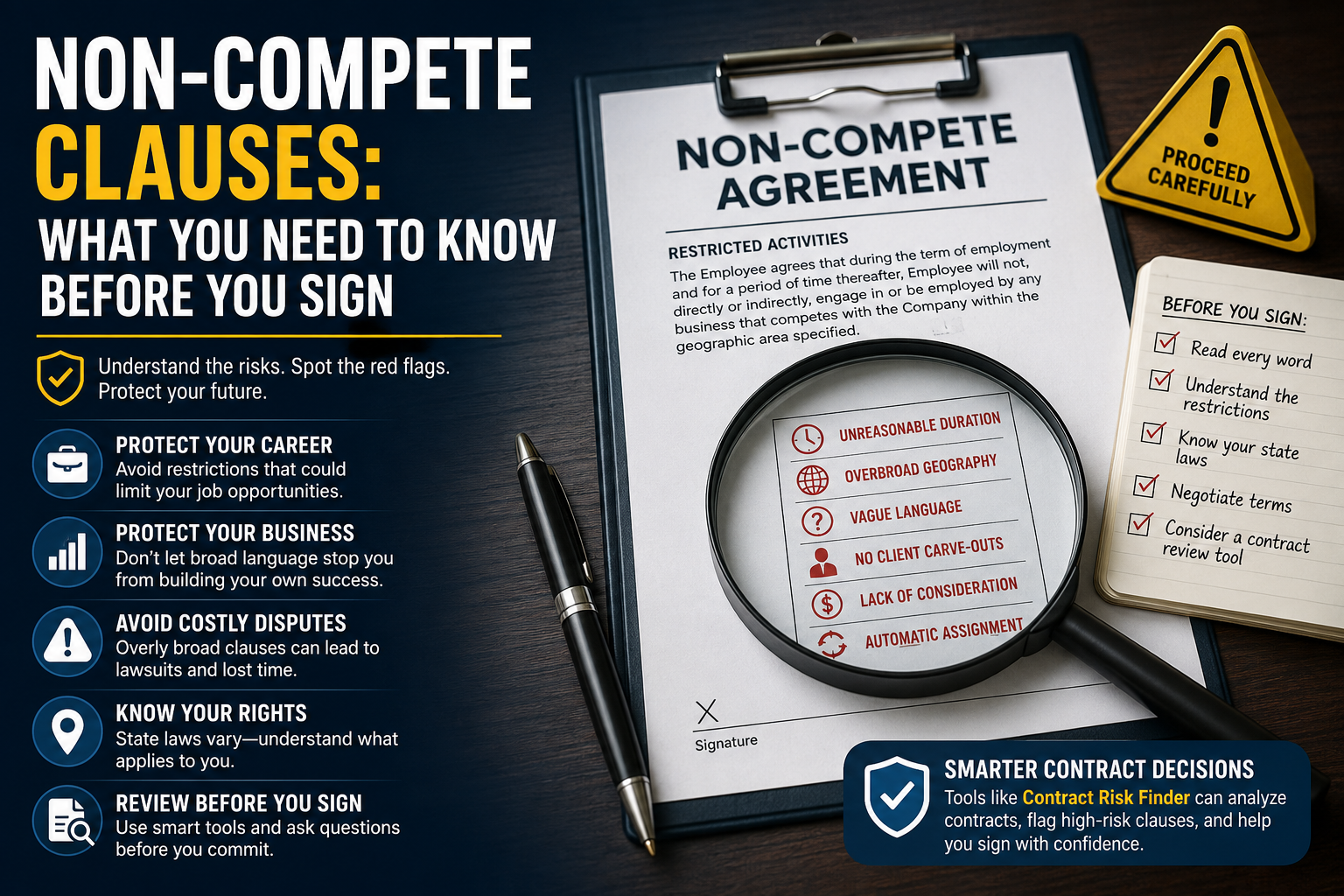
Key Red Flags to Watch For
Not all non-compete clauses are created equal. Some are reasonable and narrowly tailored; others attempt to control your professional future far beyond what is necessary.
Unreasonable Duration
Anything beyond 12 to 24 months deserves careful scrutiny. Restrictions lasting three to five years are often considered excessive.
Overbroad Geography
A clause covering multiple states or an entire country may be difficult to justify for many positions.
Vague Definitions of Competition
If the agreement fails to clearly define what constitutes a competing business, the company may have broad discretion to interpret the restriction.
No Carve-Outs for Personal Clients
Some agreements prohibit you from working with clients you developed independently before joining the company.
Lack of Consideration
In some jurisdictions, employees asked to sign a non-compete after employment begins must receive additional compensation or benefits.
Automatic Assignment Clauses
These provisions allow a non-compete to transfer to a future owner if the company is sold or acquired.
Reviewing contracts with a tool like Contract Risk Finder can help highlight these provisions and identify potentially problematic language before it becomes a legal issue.
Know Your State Laws
Enforceability of non-compete clauses varies significantly by state.
- California broadly prohibits most employment-related non-compete agreements.
- Florida generally enforces reasonable non-compete provisions.
- Some states allow courts to modify overly broad clauses.
- Others may invalidate unreasonable provisions entirely.
Because laws continue to evolve, understanding your state’s requirements is essential. A contract review — whether by legal counsel or through an AI-assisted analysis tool — can provide valuable insight before signing.
Frequently Asked Questions About Non-Compete Clauses
Are Non-Compete Clauses Always Enforceable?
No. Enforceability depends on state law, the reasonableness of the restrictions, and whether adequate consideration was provided. Many overly broad clauses are challenged successfully.
Can I Negotiate a Non-Compete Clause?
Yes. Employers and businesses often expect some negotiation. You may be able to reduce the duration, narrow the geographic scope, or clarify prohibited activities.
What Happens If I Violate a Non-Compete?
You could face legal action seeking damages or an injunction preventing you from continuing certain activities. Even if the clause is ultimately unenforceable, litigation can be expensive.
Should I Have a Lawyer Review My Non-Compete?
For high-value agreements, legal advice is highly recommended. However, an initial review using tools like Contract Risk Finder can quickly identify potentially risky provisions and help you determine whether additional legal guidance is needed.
Don’t Sign Until You Know What You’re Agreeing To
A non-compete clause can affect your career, business opportunities, and financial future long after a contract ends. The consequences of signing a poorly understood agreement can be significant.
Before you commit, make sure you understand every restriction, obligation, and limitation contained in the agreement.
The smartest first step may be using technology to identify hidden risks. Tools like Contract Risk Finder can analyze contract language, flag concerning clauses, and help you make more informed decisions before you sign.