Understanding indemnification clauses in business contracts
Hidden Dangers in Contracts: How to Spot Risky Clauses Before You Sign
Signing a contract is one of the most consequential things you can do in business or in your personal life. Whether you’re entering a vendor agreement, a commercial lease, an employment contract, or a freelance arrangement, the language buried in those pages can either protect you or expose you to serious financial and legal risk. The problem? Most people skim contracts, trust that the other party wouldn’t include anything unfair, and sign on the dotted line without a second thought.
That’s a costly mistake. Contract disputes are among the most common sources of business litigation, and the clauses that cause the most damage are rarely the obvious ones. They’re the quiet, technical, buried phrases that seem harmless until something goes wrong. Understanding how to identify risky contract clauses before you sign is one of the most valuable skills you can develop — and with the right tools, it doesn’t have to take hours of legal expertise.
Why Risky Contract Clauses Are So Easy to Miss
Legal language is deliberately complex. Attorneys draft contracts using precise terminology that can completely shift the meaning of a sentence based on a single word or phrase. Phrases like “indemnify and hold harmless,” “sole discretion,” “liquidated damages,” or “automatic renewal” carry enormous implications that most non-lawyers don’t fully appreciate in the moment.
Beyond the technical language, contracts are often long. A commercial services agreement can run 30 to 50 pages. A software licensing agreement might be even longer. The sheer volume of text encourages skimming, and the riskiest clauses are frequently tucked away in sections labeled with boring titles like “Miscellaneous,” “General Provisions,” or “Representations and Warranties.”
The Most Dangerous Types of Contract Clauses
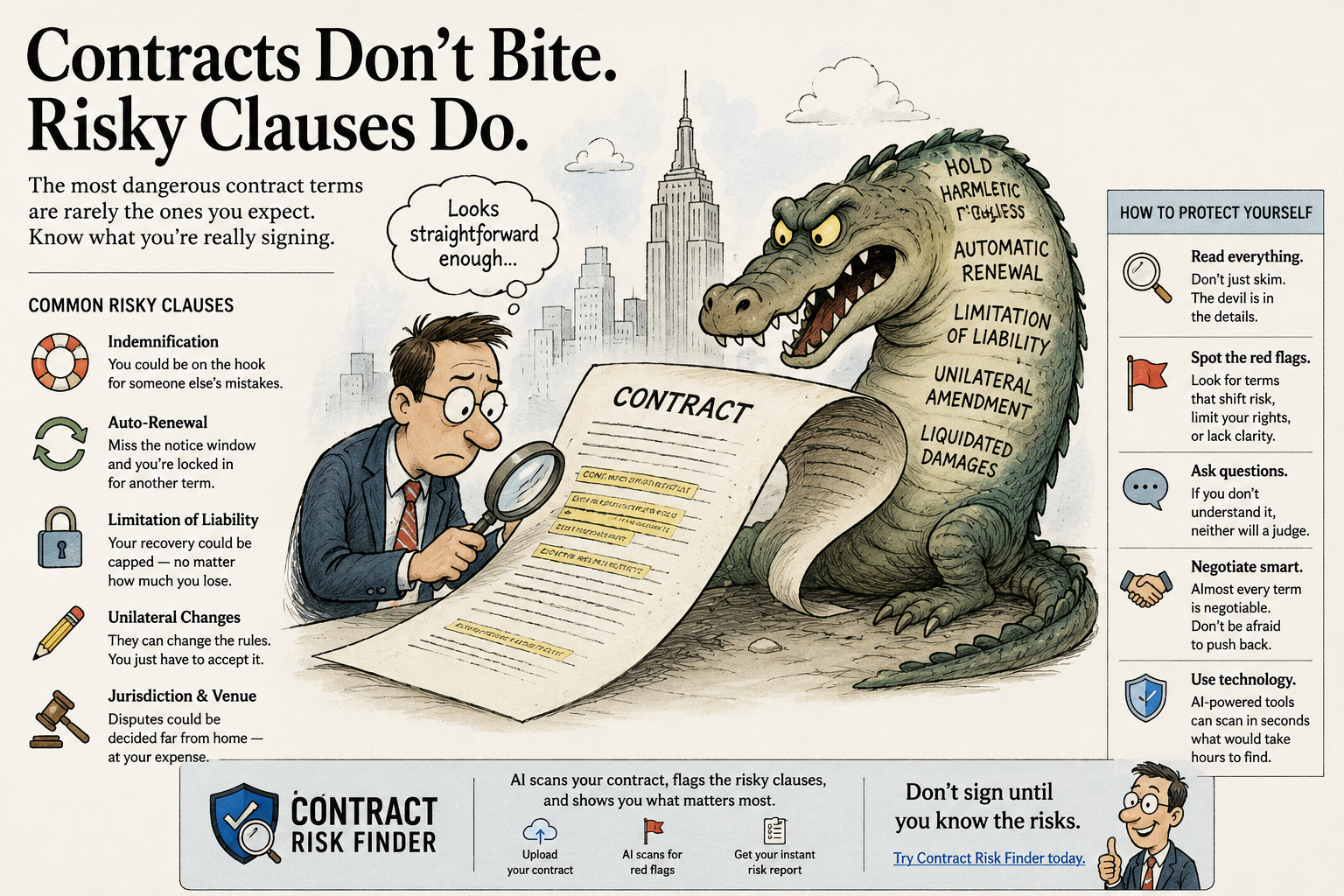
Not all contract clauses carry equal risk. Some are standard boilerplate that you can accept without concern. Others can fundamentally change your rights and obligations. Here are the clause types that most commonly lead to disputes, unexpected costs, and legal exposure:
- Indemnification clauses: These require you to cover another party’s legal costs and damages in certain situations. Broad indemnification language can make you liable for things that aren’t your fault.
- Auto-renewal clauses: Many service contracts renew automatically unless you provide written notice within a specific window, sometimes 30 to 90 days before the renewal date. Missing that window can lock you in for another full term.
- Limitation of liability clauses: These cap the amount the other party owes you if something goes wrong — sometimes at a fraction of what you actually lose.
- Unilateral amendment clauses: Some contracts give the other party the right to change terms without your explicit consent, often with minimal notice.
- Non-compete and non-solicitation clauses: In employment and consulting agreements, these can severely restrict your ability to work in your industry after the relationship ends.
- Jurisdiction and venue clauses: These determine where disputes are resolved. If you’re a small business in one state and the contract requires all disputes to be handled in another state, the cost of litigation alone can be prohibitive.
- Penalty and liquidated damages clauses: These specify fixed dollar amounts owed if you breach the contract, which can far exceed the actual harm caused.
How to Review a Contract More Effectively
Even without a law degree, you can significantly improve your contract review process by following a few core practices. First, always read the entire document — not just the sections that seem relevant. Second, pay close attention to definitions. The way a contract defines a term like “deliverable,” “confidential information,” or “cause” can reshape your understanding of entire sections. Third, look for asymmetry. If a clause gives the other party broad rights but limits yours, that’s a red flag worth questioning.
Fourth, and perhaps most importantly, use technology to your advantage. AI-powered contract review tools can scan documents in seconds and surface clauses that warrant closer inspection, giving you a head start before you bring in legal counsel or push back on terms.
Frequently Asked Questions About Risky Contract Clauses
What makes a contract clause “risky”?
A clause is risky when it disproportionately benefits the other party, limits your rights or remedies, exposes you to unexpected liability, or includes terms that could bind you in ways you haven’t fully considered.
Do I need a lawyer to review every contract?
Not necessarily. For high-stakes agreements, legal counsel is strongly advisable. But for smaller or more routine contracts, an AI-powered review can help you identify the clauses that deserve deeper attention before deciding whether attorney review is warranted.
Can I negotiate contract terms after they’ve been presented?
Yes, in most cases. Contracts are starting points for negotiation. Flagging a risky clause and requesting modified language is a normal and expected part of the contracting process.
How common are problematic clauses in standard business contracts?
Extremely common. Studies suggest that the majority of commercial contracts contain at least one clause that could expose the signing party to unintended risk.
Don’t Sign Until You’ve Done This One Thing
Before you put your name on any contract, take one simple step: get a red-flag review. Contract Risk Finder scans your contract instantly, highlights the clauses that carry the most risk, and gives you a clear picture of what you’re agreeing to — before it’s too late to walk away or negotiate better terms.
Upload your contract to Contract Risk Finder now and get your instant red-flag review. It takes minutes and could save you thousands.