
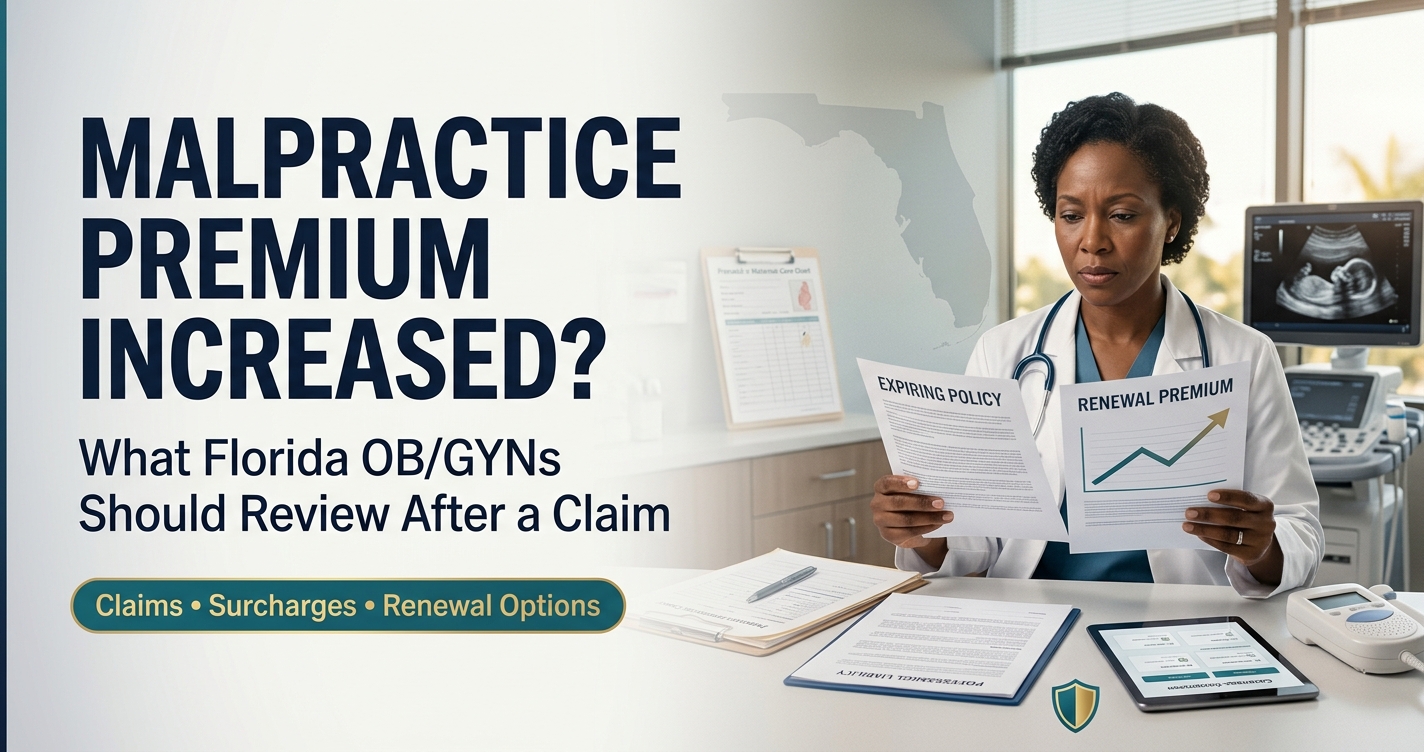
Why Did My OB/GYN Malpractice Premium Increase After a Claim?
Your OB/GYN malpractice premium increased after a claim—but that does not necessarily mean the carrier decided you committed negligence.
Medical professional liability underwriting and legal liability are different processes. A carrier may change pricing because a claim was reported, an open reserve increased, new information emerged, the practice changed, or the carrier changed how it prices obstetric risk. The claim may still be defensible. It may eventually close without payment. Your renewal can still become more expensive while the uncertainty remains.
For a Florida obstetrician-gynecologist, the right response is not to assume you are trapped—and it is not to cancel immediately. First determine what actually drove the increase. Then build a complete underwriting file, compare the current policy against realistic alternatives, and protect the retroactive coverage tied to years of prior practice.
Facing a surcharge, non-renewal, or difficult OB/GYN renewal?
Review Island Insurance Group’s dedicated guide to OB/GYN malpractice insurance in Florida, including prior claims, high premiums, group departures, prior acts, and tail coverage.
Does a premium increase mean the claim was your fault?
No. A premium increase is not a judicial finding, admission, or final determination of negligence. Underwriters are evaluating expected future loss and uncertainty. They may consider allegations, potential damages, defense costs, current reserves, claim frequency, and whether the event suggests a recurring exposure.
A case may take years to resolve. The American College of Obstetricians and Gynecologists has noted that professional-liability litigation in obstetrics and gynecology often takes several years and can create substantial stress for the physician. During that period, an insurer still has to evaluate the open file at each renewal.
That is why the reason for the increase matters. “You had a claim” is not enough information. Ask whether the change came from a formal surcharge, loss of a claims-free credit, reserve development, overall rate action, changes in practice, or several factors together.
Eight reasons an OB/GYN malpractice premium may increase
1. A new claim triggered a surcharge or removed a credit
Some carrier pricing plans can apply a claims-related surcharge, remove a loss-free credit, or re-tier an account after a reported claim. The effect can depend on whether the matter is open or closed, whether a payment occurred, the amount, incident date, and carrier rules.
Ask the carrier or agent to identify the exact rating change. A premium increase caused by the removal of a discount is different from a carrier deciding that the physician no longer fits its underwriting appetite.
2. The open reserve increased
An open reserve is an insurer’s estimate for potential claim and expense obligations. It is not the same as a payment, settlement, or judgment. However, a significant reserve can affect how an underwriter views the severity and uncertainty of the claim.
Obtain currently valued loss runs. Old loss runs can show outdated reserves or omit recent developments. Do not guess at reserve amounts or describe a claim as closed until the carrier confirms its status.
3. The allegation involves high-severity obstetric injury
Underwriters consider the nature of the allegation, not only the number of claims. Allegations involving maternal injury, neonatal injury, delivery management, fetal assessment, delayed intervention, shoulder dystocia, operative delivery, communication, or documentation can present different severity potential.
The underwriting file should explain the clinical timeline, the physician’s role, the defense position, current status, and whether practice changes followed. It should not attempt to retry the case in an emotional narrative.
4. The physician has more than one recent incident
One isolated event may be evaluated differently from several claims or incidents involving a similar allegation, procedure, or workflow. Frequency can concern an underwriter even when individual claims are defensible or relatively small.
If several matters exist, address each one separately and then explain whether there is a common pattern. If the allegations are unrelated, the documents should make that clear. If they reveal a process weakness, vague reassurances will not solve it; documented corrective action is more persuasive.
5. Your obstetric or surgical activity changed
A premium can increase because the practice changed independently of the claim. Examples include higher delivery volume, added hospital privileges, more cesarean deliveries, operative vaginal delivery activity, expanded call responsibilities, locum work, new advanced practice providers, or additional gynecologic surgery.
Conversely, changing to gynecology-only practice may alter future exposure, but it does not erase prior obstetric services. ACOG has specifically discussed professional-liability considerations when moving to gynecology-only practice. Historical obstetric exposure still requires properly coordinated prior-acts or tail protection.
6. The carrier increased rates for the class or territory
Not every increase is physician-specific. A carrier may adjust rates for OB/GYNs, a geographic area, particular limits, or its overall book based on loss experience, expenses, reinsurance, or strategy.
That distinction matters. If the entire class was repriced, another carrier may or may not view the account differently. If the increase is driven by the physician’s claims or procedures, a new carrier will likely ask for detailed supporting information before offering terms.
7. Your limits, deductible, or policy structure changed
Higher limits, lower deductibles, expanded entity coverage, additional providers, new locations, broader prior acts, or changes in defense provisions can affect premium. Compare the expiring and renewal proposals line by line. A higher premium may partly reflect more coverage; a lower proposal may achieve its price by narrowing protection.
Hospital, employment, and payer contracts may require particular limits. Do not reduce limits solely to offset a surcharge without checking contractual requirements and the physician’s own risk tolerance.
8. The carrier’s appetite changed
A carrier can become more restrictive about full obstetrics, particular procedures, prior claims, open claims, part-time practice, locum arrangements, or certain hospitals. The physician may receive a large increase, restrictive terms, or non-renewal even though the underlying facts have not materially worsened.
That does not guarantee another market will accept the account. It does mean the current carrier’s decision should not be treated as the only possible underwriting result.
What underwriters want to know about the claim
A strong submission does more than attach loss runs. It gives an underwriter enough consistent information to understand the event, current exposure, and likelihood of recurrence.
Prepare answers to these questions:
- When did the treatment, delivery, or alleged event occur?
- When was the claim reported?
- What does the claimant allege?
- Who else was involved?
- What was the physician’s specific role?
- Is the matter open, dismissed, settled, or tried?
- What indemnity, defense expense, or open reserve is shown?
- Were hospital privileges, board status, or employment affected?
- What did the physician or practice change afterward?
- Does the physician still perform the activity involved?
Use the complaint, defense information, loss runs, and claim narrative to tell one consistent story. Calling a paid settlement “nothing,” omitting a board inquiry, or minimizing an open reserve damages credibility.
What corrective action can strengthen an underwriting submission?
Corrective action should connect directly to the allegation. Generic language such as “I am more careful now” provides little underwriting value.
Depending on the circumstances, relevant changes might include:
- Targeted continuing education
- Revised documentation or escalation protocols
- Simulation or team training
- Changes in call coverage or handoff procedures
- Earlier maternal-fetal medicine consultation
- Revised patient-selection or referral criteria
- Improved informed-consent documentation
- Communication and disclosure procedures after adverse events
- Changes in procedures, privileges, or scope of practice
- Hospital quality-review participation
The goal is not to admit liability. It is to show the underwriter that the physician understands the allegation and can explain current controls. ACOG has addressed communication and appropriate discussion of adverse events; physicians should follow applicable legal, carrier, hospital, and counsel guidance when handling any specific incident.
Should you switch malpractice carriers after a premium increase?
Maybe—but “find a cheaper quote” is not a complete strategy. OB/GYN claims-made coverage can carry years of prior exposure. A new policy needs to be evaluated for the retroactive date, covered services, named insureds, exclusions, defense provisions, consent-to-settle terms, deductible, and tail obligations.
Before switching, confirm:
- The new effective date aligns with the old expiration date.
- The correct retroactive date is shown in writing.
- All entities, locations, providers, and activities are included.
- Open claims and known incidents were disclosed as required.
- Prior acts are accepted—or tail coverage is arranged.
- Hospital and employment limit requirements are satisfied.
- Material exclusions do not remove needed obstetric or surgical coverage.
- You understand who pays for tail if the new policy later ends.
Do not cancel the current policy because an alternative indication or preliminary quote looks attractive. Coverage is not secured until the carrier formally offers acceptable terms, all conditions are satisfied, and the policy is properly bound.
What documents should you gather before shopping?
- Current policy, declarations, endorsements, and exclusions
- Renewal proposal showing the new premium and terms
- Written explanation of any surcharge, credit change, or non-renewal
- Currently valued loss runs, usually for the period requested by markets
- Claim narratives and available supporting documents
- Completed application and supplemental OB/GYN forms
- Current CV and professional-license information
- Annual delivery and procedure volumes
- Hospital privileges and call arrangements
- Practice entities, provider roster, and locations
- Requested limits, deductible preferences, and retroactive date
- Board, regulatory, or credentialing documents when applicable
Starting early matters. A complex account may require follow-up questions, claim review, supporting documents, and specialized-market involvement. Waiting until the final week reduces leverage and increases the chance of a rushed coverage decision.
Can you reduce an OB/GYN malpractice surcharge?
Sometimes the realistic goal is not to eliminate the surcharge. It may be to find a carrier that evaluates the account differently, preserve necessary coverage, improve terms, adjust an appropriate deductible, or create a better path for future renewals.
No agent can guarantee a lower premium or placement before underwriting. The result depends on the claims, practice, location, activity, limits, carrier guidelines, and available market conditions. What you can control is the quality, timing, and accuracy of the submission.
For a complete specialty overview, visit the OB/GYN Malpractice Insurance in Florida page. Then complete the assessment to organize the factors an underwriter may examine.
Do not let a premium increase force a rushed coverage decision
Review the claim, current policy, renewal terms, retroactive date, delivery and procedure profile, and realistic alternatives before making a change.
Start the Physician Underwriting Assessment
Practice owners can also use the free Small Business Insurance Assessment to review broader operational exposures.
Samuel Bennett, Licensed Insurance Agent
Island Insurance Group
954-804-8144 · sam@islandinsurancegroup.com
Schedule a 30-minute coverage review
This article provides general insurance education and is not legal, medical, regulatory, employment-contract, risk-management, or coverage advice. Insurance availability, eligibility, pricing, terms, and conditions are subject to carrier underwriting and applicable law. Nothing in this article binds coverage or guarantees a quotation, premium reduction, or placement. Consult qualified professionals before changing coverage or responding to a claim.