
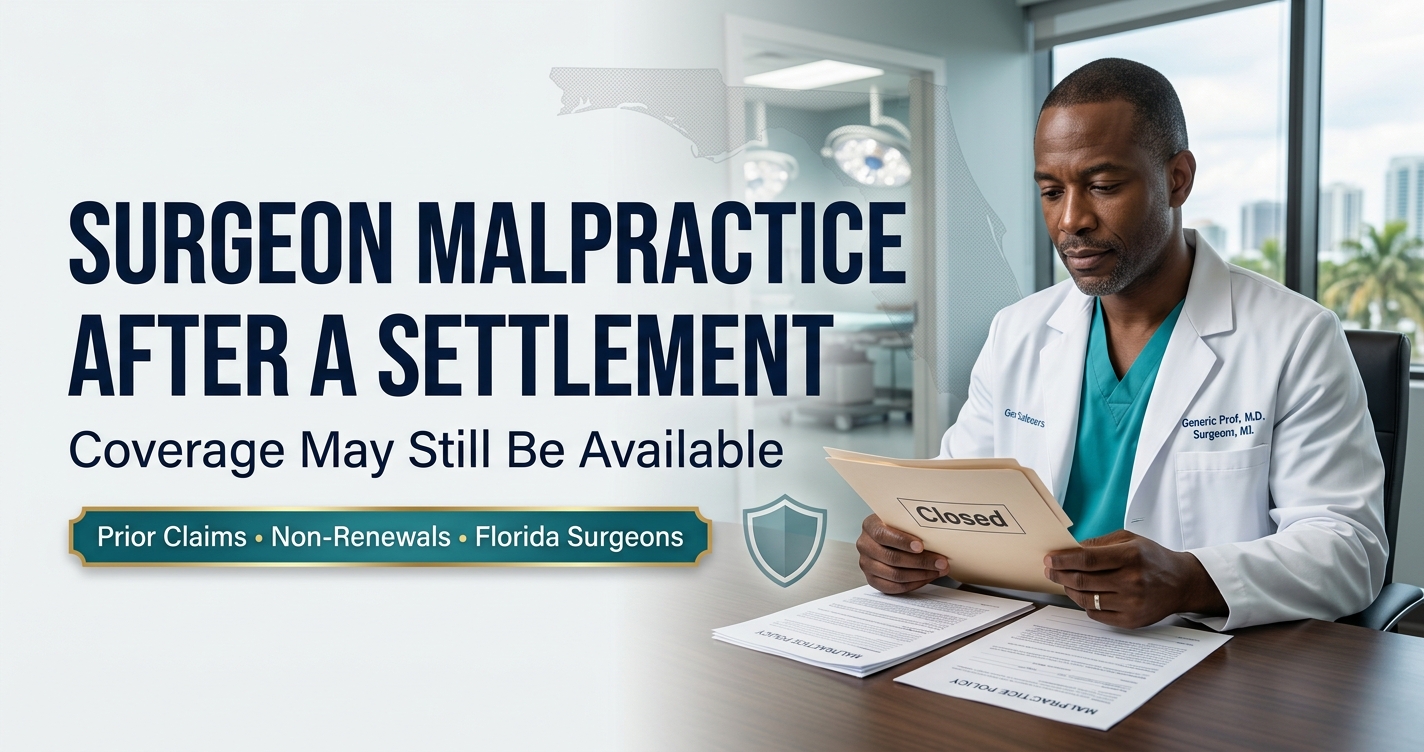
Can a Surgeon Get Malpractice Insurance After a Settlement?
Medical Malpractice Insurance for Florida Surgeons
Can a Surgeon Get Malpractice Insurance After a Settlement?
Yes, coverage may still be available. A settlement can narrow the market or increase the premium, but underwriters usually evaluate the full claim story—not just the payment listed on a loss run.
A malpractice settlement can make a surgeon’s next renewal feel uncertain. A carrier may add a surcharge, change terms, decline renewal, or ask for far more information than it did in prior years. If you are leaving a group or applying for individual coverage at the same time, the pressure is even greater.
The important point is that a settlement is not automatically the end of your insurability. Florida surgeons with prior claims may still have options through standard, excess and surplus, or wholesale insurance markets. The outcome depends on the facts of the case, the surgeon’s broader history, the current scope of practice, and how clearly the submission explains the risk.
If you need placement help now, review our malpractice insurance options for Florida surgeons with prior claims or begin the confidential physician underwriting assessment.
Why a Settlement Does Not Automatically Make a Surgeon Uninsurable
Surgical claims can involve severe injuries and large demands even when a physician has a strong professional record. Underwriters understand that a bad outcome, a disputed allegation, and a recurring pattern are not the same risk.
A carrier may be more receptive when the settlement was an isolated event, the surgeon has many otherwise claim-free years, the clinical circumstances are well documented, and any relevant process changes have been implemented. Conversely, repeated claims involving similar allegations, unresolved licensing concerns, incomplete records, or a materially expanded scope of practice can make placement more difficult.
No broker can promise approval or a particular price. The goal is to identify the markets whose underwriting appetite fits the actual case and give them enough organized information to evaluate it fairly.
What Malpractice Underwriters Review After a Surgical Claim
A loss run shows dates, status, reserves, and payments. It rarely tells the complete story. Underwriters commonly look beyond that summary and consider the following:
1. The procedure and clinical circumstances
The carrier will want to understand the operation, indication, patient condition, complication, informed-consent process, postoperative course, and allegation. A recognized complication may be viewed differently from an allegation involving wrong-site surgery, delayed recognition, inadequate follow-up, or an unsupported procedure.
2. Claim status, payment, and reserve
A closed claim with a known payment is different from an open claim with a changing reserve. An open file creates uncertainty because the eventual defense cost or indemnity payment may not be known. A dismissal, defense verdict, settlement, and consent judgment should not be described as though they are interchangeable.
3. Frequency and pattern
One serious claim over a long surgical career may receive a different assessment than several recent matters alleging the same failure. Underwriters look for recurrence: similar procedures, documentation problems, postoperative communication issues, patient-selection concerns, or repeated complications.
4. Current surgical scope
The application must accurately describe what the surgeon does today. General surgery, orthopedic surgery, neurosurgery, spine surgery, and bariatric surgery do not present identical exposures. Procedure volume, hospital versus outpatient work, trauma coverage, robotics, implant use, and the percentage of high-severity procedures can all affect underwriting.
5. Response and corrective action
Underwriters may ask what changed after the event. Useful answers can include revised patient-selection criteria, stronger informed-consent documentation, a second-review protocol, additional training, postoperative escalation procedures, or improvements in team communication. Patient-safety guidance from AHRQ Patient Safety Network also emphasizes that prevention often depends on systems of care and communication, not merely individual memory.
6. Professional and regulatory history
Carriers may review licensure actions, board inquiries, hospital privilege restrictions, peer-review outcomes, substance-use concerns, or other matters disclosed on the application. A board inquiry is not necessarily a final adverse action, but it must be answered accurately and supported with the requested documents.
Settlement, Open Claim, and Dismissed Claim: Why the Difference Matters
Surgeons sometimes say they have “one claim” without clarifying its status. For underwriting, that detail matters:
- Closed with no payment: The matter ended without an indemnity payment, although defense costs may have been incurred.
- Closed with settlement: A payment resolved the claim. The amount, allegations, allocation among defendants, and surrounding facts may be reviewed.
- Open with a reserve: The carrier is still estimating potential cost. Underwriters may request current claim notes or postpone a final decision until more is known.
- Dismissed or withdrawn: The reason and whether dismissal was with or without prejudice can affect how complete the resolution appears.
Do not minimize a reportable event or guess at its disposition. Obtain current company loss runs and confirm that your narrative agrees with the carrier’s records.
How to Write a Useful Claim Narrative
A strong narrative is factual, concise, and clinically coherent. It is not an argument brief, and it should not attack the patient, prior attorney, hospital, or former group.
Include the patient’s relevant presentation, the procedure performed, the alleged injury, the allegation against you, your role among all defendants, the defense or resolution, and the present claim status. If applicable, explain what was learned and what has changed in your practice. Clearly distinguish facts you know from matters that remain disputed.
Before submitting a narrative, coordinate with the current or former defense counsel when appropriate. Avoid disclosing privileged strategy or protected patient information beyond what the insurer legitimately requests through a secure process.
Documents That Can Help an Underwriter Reach a Decision
A complete submission can reduce repeated questions and prevent avoidable delays. Depending on the case, a broker or underwriter may request:
- Currently valued loss runs from all recent malpractice carriers
- A separate narrative for each claim or incident
- Settlement or dismissal documentation when available
- A current CV and complete work-history timeline
- Procedure types, annual volume, and practice-location details
- License, board, or hospital documents related to a disclosed matter
- Evidence of relevant training, remediation, or risk-management changes
- The expiring declarations page and retroactive date
Missing dates, unexplained employment gaps, inconsistent procedure descriptions, or loss runs that do not match the application can undermine an otherwise placeable account.
Do Not Lose Prior-Acts Coverage While Shopping
Many medical malpractice policies are written on a claims-made basis. That means coverage generally depends on the policy terms, including when the professional service occurred, when the claim was made, and the applicable retroactive date. Switching carriers without preserving prior-acts coverage—or without purchasing the necessary extended reporting endorsement, commonly called tail coverage—can create a serious gap.
This is especially important when a surgeon leaves a group. Do not assume the group automatically provides tail coverage or that a new employer’s policy will cover all prior services. Review the employment agreement, expiring policy, retroactive date, and proposed replacement terms before the old coverage ends.
A cheaper quote is not a better result if it excludes the procedures you perform, changes your retroactive date, imposes an unacceptable claims exclusion, or does not satisfy contractual or credentialing requirements.
What May Improve a Surgeon’s Insurance Submission?
Underwriters decide each case on its own facts, but several practical steps can make the risk easier to evaluate:
- Start early, particularly if the current carrier has issued a non-renewal notice.
- Disclose claims and regulatory matters completely and consistently.
- Provide a calm, specific narrative instead of a one-sentence explanation.
- Show the current scope of practice and separate it from work no longer performed.
- Document relevant risk-management changes without exaggerating their effect.
- Confirm required limits with hospitals, surgery centers, contracts, and credentialing bodies.
- Compare coverage terms, retroactive dates, exclusions, and tail obligations—not premium alone.
Where Hard-to-Place Surgical Coverage May Come From
Some cases remain eligible for an admitted or standard market. Others may require access to excess and surplus or specialty wholesale markets. E&S placement is not a declaration that a physician is uninsurable; it is a different part of the insurance marketplace that can accommodate risks outside standard underwriting guidelines. Terms, forms, pricing, and regulatory protections can differ, so the proposal should be reviewed carefully with a licensed agent.
Island Insurance Group works independently to evaluate available options for surgeons facing prior claims, settlements, non-renewal, surcharges, or complicated transitions. Learn more on our dedicated page for Florida surgeon malpractice insurance, including prior-claim cases.
Take the Next Step
If you are a Florida surgeon dealing with a settlement, open claim, high renewal premium, non-renewal, or a change in employment, start with the physician underwriting assessment. The information helps identify the facts and documents likely to matter before approaching markets.
You may also schedule a 30-minute conversation with Samuel Bennett. There is no obligation, and coverage is subject to carrier underwriting, eligibility, policy terms, conditions, and exclusions.