
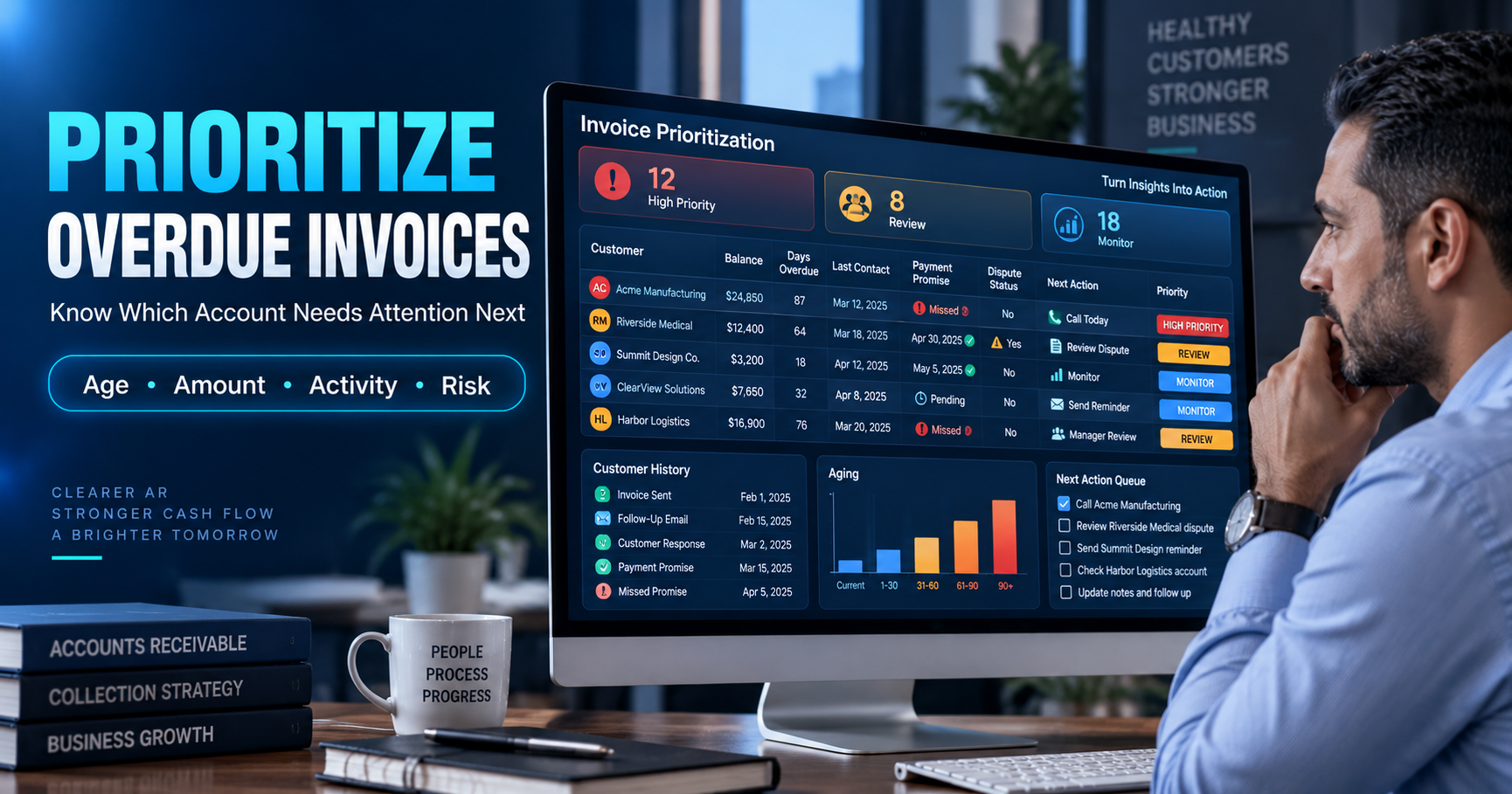
How to Prioritize Overdue Invoices for Collection
How to Prioritize Overdue Invoices for Collection
Working overdue invoices from oldest to newest may feel organized.
It is not always the best use of time.
A small invoice that is 100 days overdue may deserve less immediate attention than a $50,000 balance that is 45 days overdue and has received no recent follow-up.
Effective prioritization considers age, amount, customer behavior, account context and likelihood of recovery.
Why chronological collection falls short
Sorting by age answers one question:
Which invoice has been overdue the longest?
It does not answer:
- Which balance most affects cash flow?
- Which customer broke a payment promise?
- Which account has not been contacted?
- Which invoice is disputed?
- Which customer is likely to pay after a reminder?
- Which account represents growing exposure?
- Which follow-up is most urgent today?
Age matters, but it is only one factor.
Factor 1: Amount outstanding
Large balances can have a greater effect on working capital.
Review:
- Individual invoice amount
- Total customer balance
- Percentage of total receivables
- Additional unbilled work
- Future credit exposure
Do not ignore smaller invoices completely. Grouping them into an efficient reminder workflow may prevent them from aging further.
Factor 2: Days overdue
Use standard aging categories:
- 1–30 days
- 31–60 days
- 61–90 days
- More than 90 days
Older invoices may face greater collection difficulty and deserve escalation.
Use the Accounts Receivable Aging Calculator to identify where balances are concentrated.
Factor 3: Last contact date
An invoice may be 50 days overdue but have received a confirmed payment commitment yesterday.
Another invoice may be only 25 days overdue but has never received follow-up.
Review:
- Last contact
- Contact method
- Person contacted
- Customer response
- Next promised action
- Scheduled follow-up date
Prioritize accounts where action is overdue—not merely invoices where payment is overdue.
Factor 4: Payment promises
A broken promise deserves attention because the account did not follow the agreed next step.
Record:
- Amount promised
- Date promised
- Person making the promise
- Payment method
- Conditions
- Whether payment arrived
Do not rely on vague notes such as “customer said soon.”
Factor 5: Dispute status
A disputed invoice requires a different action from an undisputed overdue balance.
Possible next actions include:
- Review supporting documents
- Correct an error
- Speak with the responsible department
- Clarify the scope of work
- Separate disputed and undisputed amounts
- Establish a resolution deadline
Do not prioritize a disputed account for more reminders if the real next action belongs to your internal team.
Factor 6: Customer payment history
Review whether the customer:
- Usually pays on time
- Regularly pays late
- Requires repeated reminders
- Has broken previous promises
- Maintains several overdue invoices
- Recently changed payment behavior
A normally reliable customer may need a simple administrative check. A repeat offender may require closer credit review.
Factor 7: Likelihood of recovery
Consider documented facts such as:
- Customer responsiveness
- Acknowledgment of the debt
- Existing payment arrangement
- Dispute quality
- Documentation strength
- Recent partial payment
- Continued business activity
Do not make unsupported conclusions about a customer’s financial condition.
Factor 8: Cost of delay
Late payments may affect:
- Financing costs
- Employee collection time
- Available working capital
- Ability to pay vendors
- Business growth
- Opportunity cost
Use the Late Payment Cost Calculator to estimate the potential financial impact of a specific delayed balance.
Factor 9: Customer concentration
If one customer represents a significant percentage of receivables, that concentration deserves management attention.
Review:
- Total balance across all invoices
- Percentage of total AR
- Payment-term exceptions
- Current contracts
- Additional work in progress
- Operational dependence
High importance does not justify ignoring late payment. It means communication and escalation should be handled deliberately.
Factor 10: Required next action
Every priority account should have a clear action.
Examples include:
- Resend invoice
- Correct billing information
- Contact accounts payable
- Follow up on payment promise
- Resolve dispute
- Request payment date
- Review continued credit
- Escalate to management
- Seek qualified external advice
“Monitor account” is incomplete unless it includes a date and responsible person.
Create a simple priority model
A business could classify accounts as:
High priority
- Material balance
- Significantly overdue
- No recent response
- Broken payment promise
- Increasing exposure
- Action currently overdue
Medium priority
- Recently overdue
- Customer responding
- Payment date provided
- Moderate balance
- Follow-up scheduled
Lower immediate priority
- Small balance
- Recently past due
- Confirmed payment in process
- No negative history
- No action required today
This framework should guide attention, not make decisions automatically.
Reassess priorities frequently
Collection priorities change when:
- Payment arrives
- Customer responds
- A dispute is raised
- A promise is broken
- Another invoice becomes overdue
- Additional credit is extended
- Management approves escalation
A static spreadsheet can become outdated quickly if no one updates account activity.
Use technology to support judgment
PaymentPilot’s AI accounts receivable software helps organize invoices, customer activity and recommended next actions in one workflow.
Human review remains important. The highest balance or oldest invoice is not automatically the account that should receive the strongest message.
Use the technology to surface what deserves attention, then apply business judgment.
Give every important invoice a next action
Prioritization should produce an operational result.
For each selected account, assign:
- Owner
- Action
- Deadline
- Communication method
- Escalation trigger
- Follow-up date
That is how an aging report becomes a collection workflow.
Additional business resources
Use the free Small Business Assessment Tool to identify other operational and insurance considerations.
To discuss your business, schedule a 30-minute conversation.
Samuel Bennett, Licensed Insurance Agent
Island Insurance Group
sam@islandinsurancegroup.com
954-804-8144
PaymentPilot provides AI-assisted recommendations that users should review before acting. This article provides general information and is not accounting, legal, collection or financial advice.