
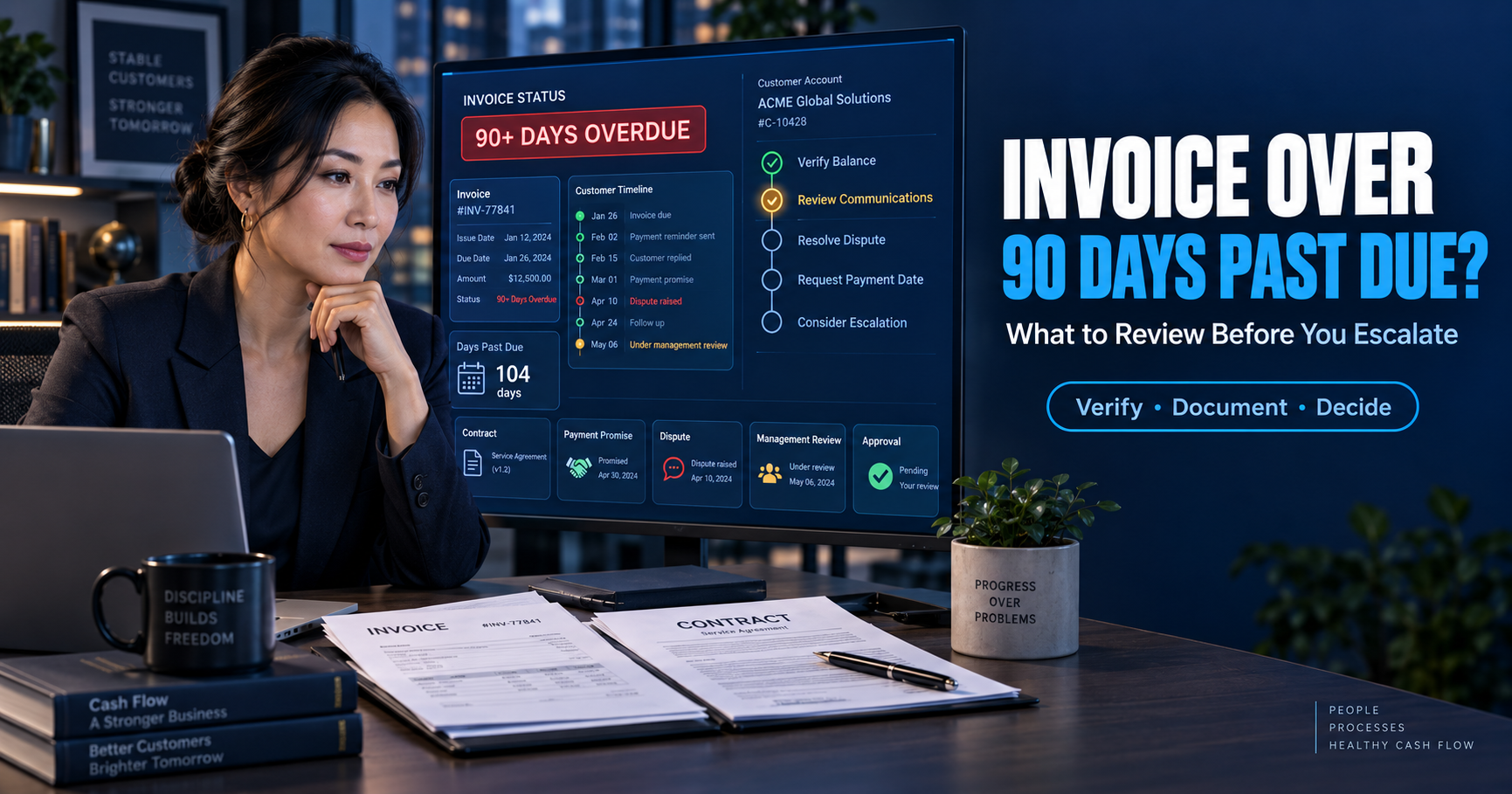
What to Do With Invoices Over 90 Days Past Due
What to Do With Invoices More Than 90 Days Overdue
An invoice that remains unpaid for more than 90 days needs a decision—not another generic reminder.
The balance may still be collectible. But continuing the same unsuccessful follow-up process wastes time and allows the account to age further.
Before escalating, verify the facts, documentation and customer history.
Step 1: Confirm the balance is accurate
Review:
- Original invoice
- Contract or engagement agreement
- Purchase order
- Delivery or completion records
- Payments received
- Credits issued
- Partial payments
- Approved adjustments
- Current outstanding balance
Do not escalate an amount that cannot be supported.
If the invoice is wrong, correct it promptly. Collection pressure does not fix inaccurate billing.
Step 2: Confirm the due date
Verify:
- Invoice date
- Contractual payment terms
- Due date
- Approved extensions
- Payment-plan terms
- Reporting date
An invoice issued 100 days ago under Net 60 terms is not 100 days overdue.
Accuracy matters, especially when communications become firmer.
Step 3: Review the complete communication history
Gather:
- Reminder emails
- Call notes
- Customer responses
- Dispute notices
- Supporting documents
- Promised payment dates
- Payment-plan discussions
- Internal approvals
- Returned mail
- Failed email notices
The history should reveal whether the customer is confused, disputing the balance, experiencing difficulty or simply not responding.
Step 4: Separate disputes from nonpayment
If the customer disputes the invoice, identify:
- Amount disputed
- Reason
- Date raised
- Supporting evidence
- Internal person responsible
- Undisputed amount
- Proposed resolution
- Deadline for response
Repeatedly demanding full payment without addressing a documented dispute can damage credibility.
Move the invoice into a dispute-resolution workflow.
Step 5: Verify the decision-maker
The person who purchased the service may not control payment.
Identify:
- Accounts-payable contact
- Department manager
- Contract signer
- Business owner
- Finance decision-maker
- Authorized representative
Contacting the correct person can resolve a long-standing administrative delay.
Step 6: Request a specific resolution
Avoid vague questions such as “Any update?”
Request one of the following:
- Confirmation of a payment date
- Explanation of the dispute
- Missing documentation request
- Proposed payment arrangement
- Confirmation that the invoice is being processed
- Meeting to resolve the account
Set a reasonable response deadline.
Step 7: Evaluate a payment arrangement
A structured payment arrangement may be appropriate when the customer acknowledges the balance but cannot pay it immediately.
Document:
- Total balance
- Initial payment
- Installment amounts
- Due dates
- Payment method
- Treatment of default
- Required authorization
- Whether existing terms are modified
Obtain appropriate professional advice before entering an arrangement with significant legal or financial consequences.
Step 8: Review continued services or credit
A business should not automatically continue increasing exposure to a severely overdue customer.
Consider:
- Current outstanding balance
- Additional unbilled work
- Contractual obligations
- Customer importance
- Payment history
- Active disputes
- Cost of stopping work
- Authority required to change credit
Do not suspend contracted services without reviewing the agreement and potential consequences.
Step 9: Estimate whether further collection is economical
Consider:
- Amount owed
- Probability of recovery
- Internal employee time
- Legal costs
- Collection fees
- Customer relationship
- Documentation quality
- Applicable deadlines
- Other available remedies
Use the free Late Payment Cost Calculator to estimate the potential financing and administrative impact of the delay.
The calculator is directional and does not determine whether escalation is worthwhile.
Step 10: Choose an escalation path
Depending on the circumstances, escalation may include:
- Senior-management contact
- Formal internal notice
- Approved payment arrangement
- Temporary credit restriction
- Attorney review
- Authorized collection provider
- Insurance notification, when relevant
- Accounting review for potential write-off
The appropriate path depends on the contract, documentation, amount, jurisdiction and customer circumstances.
Do not make legal threats you are not prepared or authorized to pursue.
Step 11: Preserve documentation
Retain:
- Agreements
- Invoices
- Delivery records
- Communications
- Payment history
- Dispute documentation
- Promises to pay
- Internal approvals
- Escalation notices
Do not alter historical notes or create records suggesting actions occurred when they did not.
Step 12: Prevent the next 90-day problem
After resolving or closing the account, determine why it aged.
Possible causes include:
- Invoice sent late
- Incorrect billing contact
- Missing purchase order
- Weak reminder process
- Unresolved dispute
- Untracked payment promise
- Excessive credit
- No escalation trigger
- Poor documentation
Use the free Accounts Receivable Aging Calculator to monitor whether balances are migrating into older categories.
Use a controlled collection workflow
PaymentPilot helps businesses organize customer and invoice activity, identify priority accounts and review AI-assisted next-action recommendations.
The software does not replace legal judgment or professional collection advice. It helps prevent accounts from remaining invisible until they are severely overdue.
Take a deliberate next step
A 90-plus-day invoice should have:
- A verified balance
- Complete documentation
- A responsible owner
- A defined next action
- A deadline
- An escalation decision
More reminders without a decision are not a strategy.
Additional business resources
Use the free Small Business Assessment Tool to review other business and insurance considerations.
To discuss your business, schedule a 30-minute conversation.
Samuel Bennett, Licensed Insurance Agent
Island Insurance Group
sam@islandinsurancegroup.com
954-804-8144
This article provides general information and is not legal, accounting, collection or financial advice. Consult appropriately qualified professionals before taking formal collection or legal action.