Your Contract Requires Insurance. Does Your Policy Actually Match?
You sign a new client contract.
The deal looks profitable.
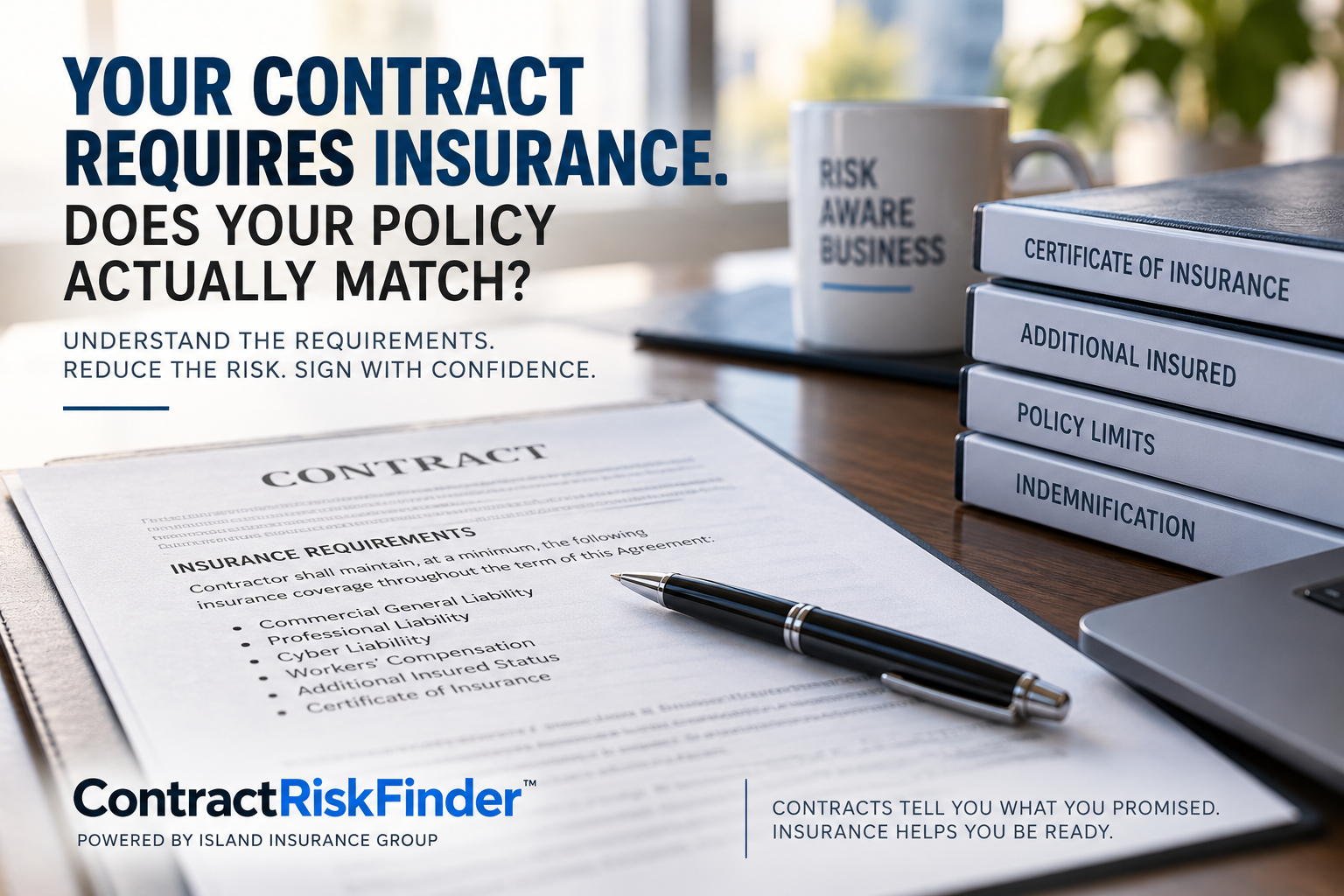
Then somebody asks for a certificate of insurance showing limits, endorsements, and additional insured status you never discussed.
Now the insurance section buried near the end of the agreement suddenly matters.
This is a common reason businesses should evaluate contracts and insurance together.
A Contract Can Create Obligations Your Insurance Policy Does Not Automatically Cover
A business agreement might require you to maintain specific insurance.
That does not necessarily mean your existing policies satisfy those requirements.
A contract may request:
- $1 million or higher liability limits
- Commercial general liability
- Professional liability or errors and omissions
- Cyber liability
- Workers’ compensation
- Commercial auto
- Umbrella or excess liability
- Additional insured status
- Waiver of subrogation
- Primary and noncontributory wording
Those terms should not simply be checked off a list.
Each requirement should be compared against your actual insurance program.
What Is an Additional Insured Requirement?
One party may require another party to add it as an additional insured under certain liability coverage.
This is common in relationships involving:
- Contractors
- Property owners
- Vendors
- Landlords and tenants
- Event operators
- Service providers
- Construction projects
But a certificate saying someone is an additional insured is not necessarily the same thing as the policy providing the contractual protection being requested.
The endorsement and underlying policy language matter.
The Indemnity Clause May Be Just as Important
Here is where contract risk becomes more complicated.
A contract may contain both:
- An insurance requirement, and
- An indemnification obligation.
Those provisions do different things.
The contract may require your company to accept a particular responsibility while your insurance policy defines when the insurer will—or will not—respond.
That creates a critical question:
Are you agreeing to something broader than your insurance is designed to cover?
This is one reason Island Insurance Group approaches insurance by first understanding a client’s operations, obligations, contracts, and exposures rather than looking only at premium.
Explore Island Insurance Group
Watch the Required Limits
Suppose your contract requires $2 million in coverage but your current policy provides $1 million.
That discrepancy should be identified before work begins.
Other contracts may require specific aggregate limits or excess coverage.
Do not assume the requirement is satisfied simply because you have “business insurance.”
Professional Liability Requirements
Consultants, technology providers, healthcare businesses, accountants, designers, engineers, and other professionals may encounter requirements for professional liability or errors-and-omissions coverage.
The contract might define:
- Minimum limits
- How long coverage must remain in place
- Required retroactive dates
- Reporting requirements
- Evidence of coverage
These provisions can become especially important with claims-made policies.
Cyber Insurance Is Appearing in More Business Relationships
Businesses that access confidential information, customer records, networks, payment information, or other sensitive data may encounter contractual cyber-insurance requirements.
A contract may also create obligations involving:
- Privacy
- Data security
- Breach notification
- Incident response
- Third-party claims
- Regulatory responsibilities
Your cyber obligations should be reviewed alongside your cyber insurance.
Use Contract Analysis Before the Insurance Question Becomes an Emergency
The worst time to discover an insurance requirement is the day a client demands proof of coverage—or after a loss occurs.
ContractRiskFinder can help identify insurance requirements and other risk-related contract provisions that deserve attention.
Once those requirements are identified, a licensed insurance professional can help you compare them against your current insurance program.
That creates a much stronger workflow:
Contract → Risk Identification → Coverage Review → Questions → Decision
rather than:
Sign → Hope → Discover the problem later.
Contracts Tell You What You Promised. Policies Tell You What Is Covered.
Those are not always the same thing.
If your business regularly signs vendor agreements, client contracts, leases, service agreements, subcontractor agreements, or professional-services contracts, create a process for reviewing both documents before making commitments.
Start by scanning the contract with ContractRiskFinder.
Then, when insurance requirements need closer attention, Island Insurance Group can help business owners evaluate coverage questions and potential gaps.
DISCLAIMER
This article provides general educational information and is not legal advice, insurance coverage advice, or a guarantee of coverage. Contract obligations and insurance coverage depend on the specific agreement, policy language, endorsements, facts, applicable law, and carrier determination. Consult qualified legal and insurance professionals regarding your circumstances.