FDA Issues New Vision-Loss Warning for GLP-1 Drugs. Is Your Practice Ready?
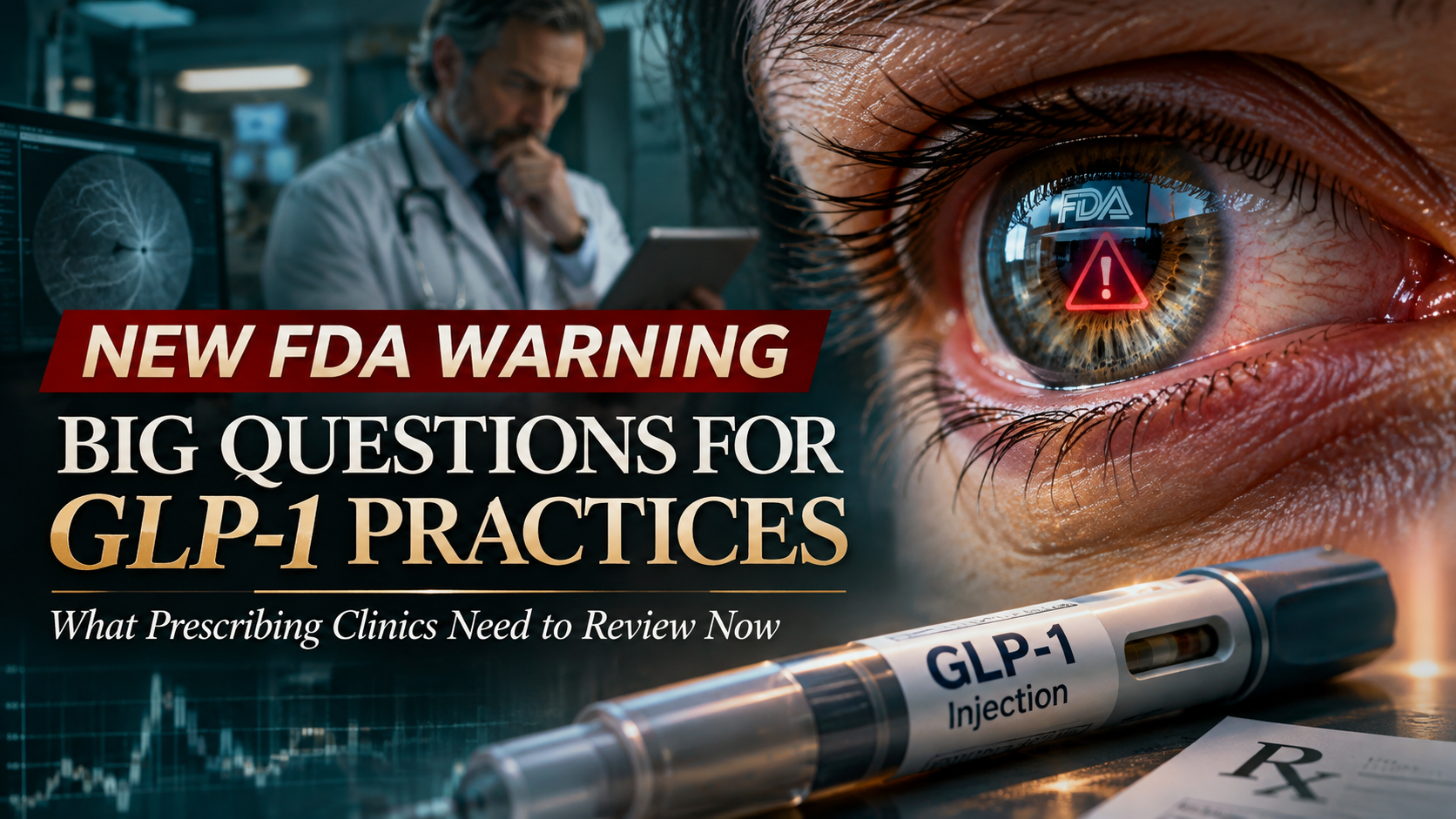
NEW FDA WARNING. A NEW QUESTION FOR EVERY GLP-1 PRESCRIBING PRACTICE.
On November 9, the FDA required a classwide labeling warning about a potential rare, serious eye condition. The immediate challenge for clinicians: turn a safety notice into a reliable patient-care workflow.
Take the Free GLP-1 Practice Safety Audit ↓Imagine a patient calling your weight-management practice on Friday afternoon. They have started a GLP-1 medication. They report sudden, painless changes in vision in one eye. The receptionist has heard headlines about a new drug warning but does not know whom to alert or what to say.
That is the real reason this week’s FDA announcement matters. For busy medical practices, a safety alert is only useful when the appropriate clinician and patient can act on it promptly.
On November 9, 2026, the U.S. Food and Drug Administration announced that application holders of GLP-1 receptor agonist medications must add information about a potential increased risk of non-arteritic anterior ischemic optic neuropathy (NAION) to the Warnings and Precautions section of product labeling.
NAION may cause sudden, painless decreased vision in one eye, sometimes permanently. Read the original FDA safety communication.
What Did the FDA Actually Find?
Across 126 randomized controlled trials involving 134,253 participants, FDA identified 15 probable NAION events: 10 in GLP-1-treated participants and five in comparator-treated participants.
The pooled incidence rates were 6.4 per 100,000 person-years in GLP-1 groups and 3.8 per 100,000 person-years in comparison groups. The agency also reviewed observational and postmarketing evidence before requiring the warning.
These numbers describe rare events. They do not mean that 6.4 out of every 100,000 prescriptions will cause vision loss; person-years account for follow-up time, and underlying patient risks differ. Nor does a classwide label imply identical evidence for each individual drug.
Importantly, the American Academy of Ophthalmology (AAO) and North American Neuro-Ophthalmology Society (NANOS) said on November 11 that causation has not been established, any added risk appears small, and patients should not independently stop treatment.
They also do not recommend routine eye exams solely to assess NAION risk before initiating GLP-1 therapy on current evidence. Read the ophthalmology societies’ response.
Why the Warning Matters to Medical Practice Owners
Obesity medicine, endocrinology, primary care, wellness programs and some medical spas may all have GLP-1 prescribing workflows. That includes intake, medication counseling, refill requests, after-hours phone calls, telehealth follow-ups and specialist referrals.
A weakness in one handoff can matter even if the prescribing clinician fully understands the safety data. A patient might report a vision symptom to a nonclinical team member or send a message through a portal that is reviewed later.
Staff therefore need a clear, clinician-approved escalation procedure.
Five Questions to Ask This Week
- Who owns the safety update? Assign a clinical lead to review the FDA communication and current product labels.
- What do patients hear? Review counseling language so it explains rare risks without telling patients to stop medication abruptly.
- What happens when a patient reports new vision symptoms? Confirm staff know how to escalate promptly to a qualified clinician and arrange appropriate evaluation.
- Where is the decision documented? Check that counseling, reported symptoms, referrals and shared treatment decisions can be recorded consistently.
- Who follows up? Identify responsibility for referral coordination, updated educational materials and continuing safety surveillance.
Should Practices Contact Every GLP-1 Patient?
There is no single universal communication plan for every prescribing organization. Practices should decide with medical leadership which patient education and outreach steps are appropriate, considering current labeling, clinical circumstances, communication channels and applicable rules.
The guiding principle is accurate counseling without alarmism. Patients should be directed to a qualified healthcare professional for medication decisions. Sudden new vision symptoms require prompt evaluation, not routine scheduling.
What About Professional Liability and Cyber Exposure?
A safety warning does not by itself establish negligence or an insurance coverage obligation. Still, practices introducing or expanding GLP-1 services should understand whether their professional liability arrangements accurately describe the entity, treating professionals, procedures and prescribing activities.
Patient-portal and telehealth workflows also merit appropriate privacy and cyber review.
Island Insurance Group helps practices examine these business and insurance exposures. It does not replace healthcare counsel or a medical director’s clinical protocols.
GLP-1 Practice Safety Readiness Audit
Answer nine operational questions and receive a tailored 30-day practice action checklist. Your answers stay in your browser.
Do not enter patient names, health records or identifying clinical details.
Your GLP-1 Workflow Review
Priority Actions for the Next 30 Days
This screening identifies self-reported process gaps. It is not a medical risk score, legal compliance certification, treatment recommendation or guarantee of insurance coverage.
The interactive report requires JavaScript. If this message remains, confirm your WPCode snippet is active.
A Practical 30-Day Response
Week 1: Review FDA and ophthalmology society guidance, current drug labeling and your existing policies.
Week 2: Review counseling language and escalation instructions with clinical leadership.
Week 3: Brief front-desk, phone, portal and clinical staff; document accountability.
Week 4: Test the workflow using a fictional scenario and review open issues with the clinical lead and appropriate advisers.
Official References for Medical Practices
- FDA Drug Safety Communication, November 9, 2026
- AAO/NANOS Response, November 11, 2026
- FDA MedWatch Adverse Event Reporting
- Island Insurance Group Insurance Tools
- Island Insurance Group Resources Center
Editorial and clinical disclaimer: Published November 12, 2026. Safety recommendations may evolve. This article and assessment are educational business-risk resources for professionals. They are not individualized medical advice, legal advice, or an insurance coverage determination. Decisions on medication, urgent evaluation, referral and reporting belong to qualified clinicians under current guidance.