
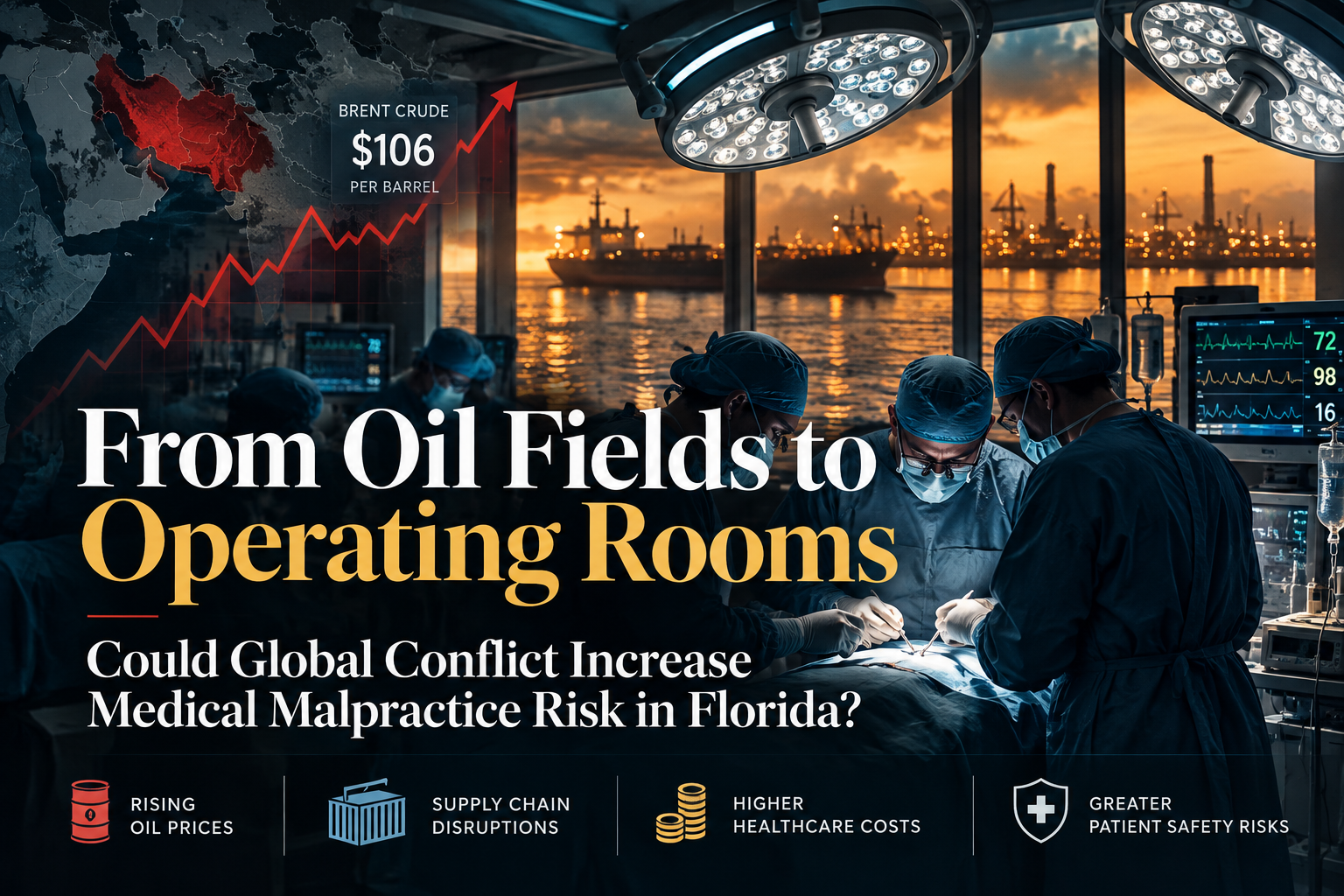
From Oil Fields to Operating Rooms: Could Global Conflict Increase Medical Malpractice Risk in Florida?
October 14, 2026 | Florida Healthcare Risk & Medical Malpractice Insurance
What does a conflict in the Middle East have to do with a physician practicing medicine in Miami, Fort Lauderdale, or Tampa?
Potentially more than it first appears.
Rising oil prices, international trade disruptions, medical supply shortages, and increasing operating expenses can create additional challenges for healthcare providers. While these developments do not automatically increase medical malpractice insurance premiums, the operational decisions that follow can affect patient safety and professional liability exposure.
For Florida physicians, the more important question may not be how much oil costs today. It may be what happens to patient care when running a medical practice becomes increasingly expensive.
From the Strait of Hormuz to Florida’s Operating Rooms
On October 14, 2026, Reuters reported renewed instability in global energy markets as escalating Middle East tensions threatened shipping and energy supplies. Brent crude was trading at approximately $106 per barrel.
These developments are not confined to the energy industry. Transportation, manufacturing, distribution, and medical logistics are all connected to energy costs.
Healthcare organizations rely on dependable deliveries of medications, diagnostic equipment, protective supplies, and surgical materials.
Higher transportation and manufacturing costs can eventually influence the prices healthcare organizations pay for essential goods. Global supply disruptions can also complicate procurement and delay deliveries.
That does not mean every Florida medical practice will experience an immediate shortage or the same increase in expenses. The impact depends on purchasing contracts, suppliers, available inventory, and the services provided.
Nevertheless, the relationship between global events and healthcare operations deserves attention.
Source: Reuters, October 14, 2026.
Healthcare Was Already Getting More Expensive Before the Latest Oil Shock
The cost pressures affecting healthcare did not begin with the latest geopolitical developments.
According to the American Hospital Association’s March 2026 Costs of Caring report, hospitals experienced the following expense increases during 2025:
- 7.5%: Increase in overall hospital expenses.
- 9.9%: Increase in hospital supply expenses.
- 13.6%: Increase in drug expenses.
- 5.6%: Increase in workforce costs.
These are hospital-sector figures, not documented expense increases for independent Florida physician practices. However, they illustrate the financial pressures already affecting the broader healthcare delivery system.
For a smaller practice operating on narrow margins, further increases in expenses may require difficult decisions about staffing, procurement, technology, and scheduling.
Those decisions should be evaluated not only for financial efficiency but also for their potential effect on clinical operations.
Source: American Hospital Association, March 11, 2026.
When Financial Pressure Becomes a Patient-Safety Concern
Consider a hypothetical Florida outpatient medical practice facing higher supply costs, increasing payroll expenses, and delayed equipment deliveries.
To control costs, management considers reducing staffing hours, extending appointment schedules, postponing equipment replacement, and consolidating administrative responsibilities.
None of those decisions automatically constitutes negligence.
However, changes that interfere with appropriate clinical supervision, timely follow-up, reliable diagnostic processes, or safe treatment protocols may create avoidable patient-safety risks.
Consider four possible exposure points:
1. Reduced Staffing and Clinical Oversight
When staff workloads increase, medical practices need to consider whether patients are still receiving appropriate monitoring, communication, and follow-up.
Administrative savings should never replace clinical judgments about safe staffing levels and supervision.
2. Delays in Medical Supplies and Equipment
Medical device shortages are not hypothetical. The FDA has identified shortages involving certain medical devices, including breast biopsy needles, with some estimated shortage periods extending into 2027.
A shortage does not itself establish malpractice liability. The important considerations are how the organization responds, whether appropriate alternatives exist, and whether patients receive care consistent with applicable professional standards.
Source: FDA Medical Device Shortages List.
3. Delayed Diagnoses and Treatment
If an essential diagnostic resource becomes unavailable, physicians and practice administrators should have procedures for escalating urgent cases, arranging alternatives, communicating with patients, and documenting clinical decisions.
The central risk-management concern is not the shortage alone. It is whether a delay creates preventable harm and whether the response met the applicable standard of care.
4. Expanding Services to Offset Expenses
Some medical practices may explore additional procedures, new service lines, or different treatment settings to generate revenue.
Such changes can affect professional liability underwriting because an insurer may evaluate procedures, specialties, locations, provider qualifications, and practice operations.
Before expanding services, physicians should confirm that their professional liability insurance accurately reflects their activities.
Does an Oil Price Spike Mean Florida Malpractice Insurance Premiums Will Increase?
Not necessarily.
There is no established direct relationship demonstrating that a particular increase in crude oil prices automatically produces an equivalent increase in Florida medical malpractice insurance premiums.
Professional liability insurers may consider factors such as:
- Physician specialty and procedures performed.
- Historical claim frequency and severity.
- Loss runs and individual claims history.
- Practice locations and patient populations.
- Risk-management procedures and underwriting information.
- Coverage limits, policy structure, and market conditions.
Broader economic conditions may affect insurers’ operating costs and the costs associated with resolving claims. But attributing a premium increase specifically to warfare, oil prices, or inflation would require supporting insurer-specific or market-level evidence.
Physicians reviewing upcoming renewals should focus on their actual coverage terms rather than assuming that every economic headline predicts an insurance increase.
For more information, see our Florida medical malpractice insurance cost guide.
Why Florida Medical Practices Should Pay Particular Attention
Florida physicians operate in a diverse healthcare environment that includes independent practices, ambulatory facilities, surgical groups, specialty clinics, and hospital-based medical professionals.
Each setting may experience different financial and operational pressures.
For example:
- Surgeons: Depend on surgical equipment, supplies, qualified support personnel, and appropriate clinical facilities.
- OB-GYN physicians: Must maintain reliable procedures for urgent clinical assessment, monitoring, and referral.
- Interventional pain physicians: May require specialized equipment, medications, and procedure-specific safeguards.
- Outpatient medical practices: Often balance staffing, administrative costs, technology expenses, and patient scheduling.
- Medical groups: May face additional complexity involving provider credentialing, supervision, multiple locations, and shared operational responsibilities.
Global events do not affect these specialties equally. Their operational dependencies differ, as do their professional liability exposures.
The practical takeaway is that cost-control decisions should account for the clinical requirements of each practice.
Five Questions Every Physician Should Ask During Economic Uncertainty
- Do we have a documented plan for supply interruptions? Identify critical medications, equipment, backup vendors, and clinically appropriate alternatives.
- Are staffing decisions being evaluated for patient safety? Review clinical workload, supervision, follow-up responsibilities, and coverage during absences.
- Have we expanded services or changed procedures? Notify the appropriate insurance representatives when operational changes may affect underwriting or coverage.
- Do we understand our malpractice policy? Review limits, claims-made or occurrence provisions, retroactive dates, exclusions, and applicable endorsements.
- Are other business risks adequately addressed? Consider cyber liability, commercial property, business interruption, general liability, and other coverage appropriate to the practice.
Business interruption insurance requires particular attention because a rise in operating costs or a supply shortage does not automatically trigger coverage. Covered causes of loss and policy conditions determine whether the policy responds.
Practices reviewing broader operational exposures can use the free business insurance assessment tool.
The Bigger Picture: Economic Instability Does Not Change the Duty of Care
A physician does not control international oil markets, foreign conflicts, or global manufacturing networks.
But healthcare organizations can control how they prepare for disruptions, communicate with patients, document clinical decisions, and evaluate operational changes.
Financial difficulties do not automatically excuse conduct that falls below an applicable professional standard of care.
The lesson is not that global conflict will inevitably create more malpractice lawsuits.
It is that financial resilience, clinical risk management, and professional liability protection should be considered together.
Physicians who understand how their practices operate under pressure may be better prepared to recognize vulnerabilities before those issues develop into serious problems.
Review Your Florida Medical Malpractice Coverage Before the Next Disruption
Island Insurance Group helps Florida physicians, healthcare professionals, and medical groups evaluate medical malpractice insurance options based on their specialties, claims histories, procedures, and practice structures.
If your medical practice has changed services, added providers, expanded locations, or experienced underwriting difficulties, a coverage review may help identify questions worth resolving before renewal.
Start with our free medical malpractice assessment tool to organize the underwriting factors that may affect your coverage options.
You may also request a free medical malpractice insurance quote. The quote tool does not bind coverage or guarantee acceptance by any insurer.
Learn more about Florida medical malpractice insurance through Island Insurance Group.
Samuel Bennett, Licensed Insurance Agent
Island Insurance Group
Email: sam@islandinsurancegroup.com
Phone: 954-804-8144
Schedule a 30-minute insurance consultation
Editorial note: Current-events information reflects reporting available October 14, 2026. This article is educational and does not provide medical, legal, or financial advice. Insurance eligibility, limits, premiums, exclusions, and coverage availability vary by applicant, carrier, and policy. Actual policy wording and endorsements govern coverage.