
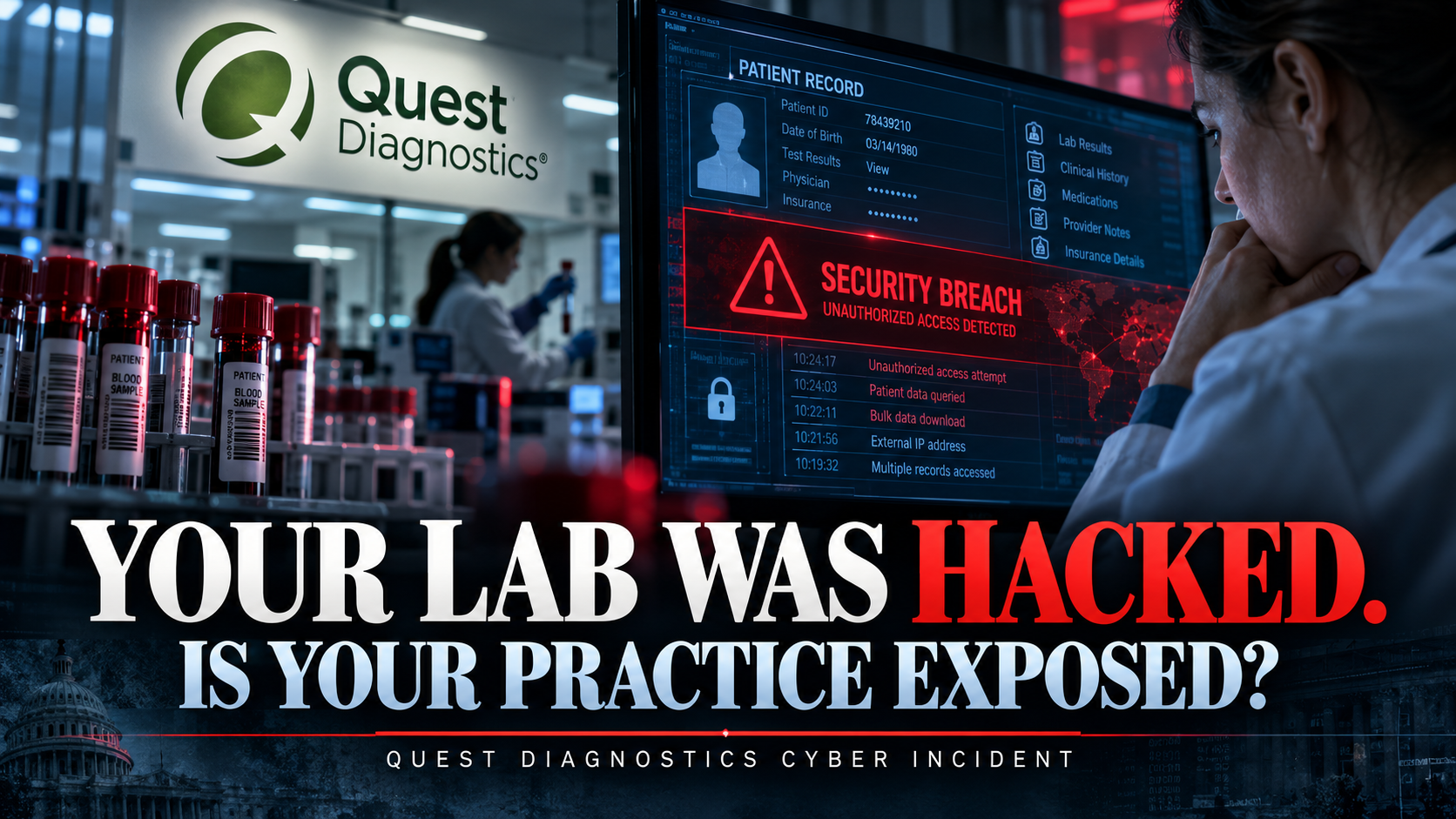
Quest Diagnostics Hacked: Your Lab Was Breached. Is Your Medical Practice Exposed?
Quest Diagnostics Hacked: Your Lab Was Breached. Is Your Medical Practice Exposed?
A newly disclosed cybersecurity incident involving patient records raises urgent questions about third-party vendors, HIPAA responsibilities, business interruption, and cyber liability insurance for medical practices.
Your medical practice may have firewalls, secure passwords, trained employees, and cybersecurity protocols. But what happens when a trusted laboratory partner experiences a cybersecurity breach?
That question has taken on new urgency following a cybersecurity incident disclosed by Quest Diagnostics, one of the nation’s largest clinical laboratory companies.
On October 22, 2026, Quest disclosed in a filing with the U.S. Securities and Exchange Commission that it learned of unauthorized access to its Quanum Lab Services Manager system on October 21.
The platform is used by certain healthcare clients to order laboratory tests, receive results, and look up patient information.
According to Quest’s filing, the company believes an unauthorized party accessed certain patient records. The company initiated its incident response procedures, notified federal law enforcement, and engaged external cybersecurity specialists.
At the time of disclosure, the complete scope of the incident remained under investigation.
Quest has acknowledged unauthorized access involving its Quanum LSM system and believes personal information and patient records were affected. The company has not publicly identified the total number of affected patients, the full categories of information, or all impacted healthcare clients. This article will require updating as additional findings become public.
What Happened at Quest Diagnostics?
The incident centers on Quanum Lab Services Manager, a digital platform that helps participating healthcare organizations manage laboratory orders and results.
According to Quest’s October 2026 SEC filing , the company discovered unauthorized activity on October 21 and began investigating the nature and scope of the access.
As reported by BleepingComputer and other news outlets, Quest temporarily paused access to the affected system while investigating.
Quest indicated that its core business operations had not been materially disrupted, although certain healthcare customers were directed to alternative laboratory ordering and results-access methods.
Timeline of the Incident
Quest learned of unauthorized access to its Quanum LSM platform and initiated incident-response activities.
Quest disclosed the incident in a filing with the SEC, indicating that certain patient records were believed to have been accessed.
Additional reporting described temporary system restrictions, alternative laboratory workflows, and the ongoing investigation into patient information.
Public information had not yet established a final patient count or the full scope of affected data. Medical practices should monitor direct vendor communications.
The Bigger Question: If Your Laboratory Is Hacked, Is Your Practice Responsible?
This is where cybersecurity becomes more than an information technology issue. It can become a legal, operational, financial, and reputational concern.
Medical practices increasingly rely on outside organizations to support essential functions, including:
- Clinical laboratory testing and diagnostic services
- Electronic health records and patient portals
- Medical billing and revenue-cycle management
- Cloud-based scheduling and practice management
- Artificial intelligence and clinical software
- Payment processing and financial services
A security incident at any one of these organizations may affect a practice’s ability to serve patients or protect information.
However, using a vendor that experiences a breach does not automatically make the medical practice legally responsible for that breach.
Responsibility depends on multiple factors, including the nature of the relationship, the information involved, applicable privacy laws, contractual obligations, and the practice’s conduct.
Who Must Notify Patients When Healthcare Data Is Exposed?
Under the federal HIPAA Breach Notification Rule, covered entities and their business associates have specific obligations when a reportable breach of unsecured protected health information occurs.
However, the notification process depends on whether the affected organization is acting as a covered entity, a business associate, or in another capacity under the applicable law.
For example, when a business associate experiences a reportable breach involving protected health information it maintains on behalf of a covered entity, federal rules generally require the business associate to notify that covered entity.
The covered entity generally retains its applicable notification responsibilities, subject to permissible contractual arrangements.
Quest’s role with respect to particular laboratory information and clients must be evaluated separately. A laboratory may itself function as a HIPAA-covered healthcare provider in relevant circumstances.
Therefore, physicians should not assume that every Quest client automatically has an independent patient-notification obligation arising from this incident.
For official guidance, review the U.S. Department of Health and Human Services’ HIPAA Breach Notification Rule .
Five Ways a Vendor Cyberattack Can Affect a Medical Practice
Exposure of Sensitive Information
Depending on the incident, compromised healthcare data may create privacy risks and require investigation, notification, or remediation.
Interrupted Clinical Workflows
If laboratory portals or other critical services become unavailable, practices may need alternate procedures for orders and results.
Potential Liability Disputes
Contract provisions, applicable privacy obligations, negligence allegations, and the facts of the incident may affect legal responsibility.
Response and Recovery Costs
Some incidents may generate expenses involving professional advisers, IT remediation, additional staffing, or operational recovery.
Patient Confidence
Patients may seek reassurance about the security of their information and the practice’s procedures for protecting it.
Coverage Questions
Whether losses from a third-party incident are insured depends on the actual cyber policy, exclusions, and coverage triggers.
Does Medical Malpractice Insurance Cover a Patient Data Breach?
Many medical practices rely primarily on professional liability insurance to address claims related to clinical care.
However, medical malpractice insurance is not automatically a substitute for dedicated cyber liability coverage.
Professional liability generally addresses covered allegations arising from professional healthcare services, subject to policy language.
Cyber liability coverage may address certain costs and claims arising from cyber incidents, privacy breaches, and technology-related disruptions.
The protection offered can differ substantially from one insurer to another.
What Cyber Insurance May Cover for Healthcare Organizations
Depending on the policy, covered cause of loss, applicable limits, deductibles, waiting periods, and exclusions, cyber insurance may provide protection for certain categories of loss.
Incident Investigation
Certain covered expenses for forensic specialists, breach counsel, and incident-response services.
Patient Notification Services
Eligible notification costs, call centers, credit monitoring, or identity-protection services where covered.
Privacy-Related Claims
Defense and certain covered liabilities arising from qualifying privacy or network-security claims.
Operational Disruption
Certain lost-income or extra-expense losses caused by a qualifying interruption, when the coverage applies.
What About a Breach at a Vendor?
This is especially important for medical practices that rely on outside laboratories, billing companies, and cloud software providers.
Some cyber insurance policies may offer contingent or dependent business interruption coverage for qualifying incidents involving specified third-party technology or service providers.
Others may restrict coverage or require specific conditions to be satisfied.
A practice should ask whether its policy responds to third-party service failures, privacy incidents, regulatory proceedings, and related expenses.
Coverage should be reviewed before an incident occurs, not after a disruption has already begun.
Your Medical Practice Depends on More Than Its Own Security.
We help healthcare professionals consider the broader insurance needs of their practices, including professional liability, general business protection, and cyber-related risks.
If you are reviewing your medical practice insurance, it may be time to examine how your coverage responds to technology dependencies, privacy exposures, and operational disruption.
Explore Insurance Solutions → Visit Our Healthcare ResourcesSeven Questions Every Physician Should Ask Technology and Laboratory Vendors
The Quest incident provides a timely reason for medical practice leaders to review vendor relationships and incident-response procedures.
- 1. Who is responsible for protecting patient data? Review the allocation of privacy and security obligations under the applicable contract and law.
- 2. How quickly will we be notified? Understand contractual notification requirements and escalation contacts.
- 3. What information does the vendor retain? Identify relevant patient, financial, and practice data and applicable retention policies.
- 4. What happens if the system goes offline? Confirm backup procedures, downtime protocols, and alternative service channels.
- 5. Are subcontractors involved? Understand whether other organizations handle or store relevant information.
- 6. What cyber insurance does the vendor maintain? Review available assurances without assuming the vendor’s policy protects your practice.
- 7. Does our own insurance cover incidents involving service providers? Ask your insurance adviser to evaluate applicable third-party and dependent business interruption coverage.
What Should a Medical Practice Do Right Now?
Practices using Quest’s affected platform should follow official Quest communications and confirm current operational instructions directly.
More broadly, the following steps may help healthcare organizations prepare for vendor-related security incidents.
Verify Official Communications
Obtain current incident information directly from trusted vendor channels. Be cautious of unsolicited messages claiming to be related to a data breach.
Preserve Documentation
Maintain relevant notices, incident correspondence, service interruption records, and communications with vendors or professional advisers.
Review Patient Safety Workflows
If laboratory ordering or results access is temporarily interrupted, confirm approved alternative procedures and ensure important test results are appropriately tracked.
Consult Privacy Professionals
Qualified privacy counsel or compliance advisers can help determine whether the practice has any incident-specific legal obligations.
Review Cyber Insurance Before Reporting a Claim
If an incident appears potentially relevant to your insurance, review prompt-notice requirements and contact the insurer or broker through approved procedures.
Certain policies may require advance approval before retaining outside response vendors or incurring expenses.
An Important Reminder: Quest’s 2019 Data Breach
The latest incident also recalls a previous major healthcare data breach.
In 2019, a breach involving the American Medical Collection Agency, a third-party billing services provider, affected information associated with approximately 11.9 million Quest patients.
The 2019 incident was separate from the October 2026 Quanum LSM event.
Together, these incidents illustrate why healthcare cybersecurity must extend beyond an organization’s own internal systems.
Vendors, service providers, and digital integration partners are essential to modern healthcare operations, but each relationship deserves appropriate security, contract, and insurance review.
Frequently Asked Questions
Was Quest Diagnostics hacked in October 2026?
Yes. Quest reported unauthorized access involving its Quanum LSM system, discovered on October 21, 2026. The full scope remained under investigation as of October 24.
How many patients were affected by the Quest breach?
A final affected-patient count had not been publicly disclosed as of October 24, 2026.
Is every medical practice using Quest affected?
No such conclusion has been established. The reported incident involved Quanum LSM, and the precise scope of impacted information and clients remained under investigation.
Can a medical practice be liable for a vendor’s data breach?
Potentially, depending on the circumstances, but liability is not automatic. Relevant considerations include applicable law, contractual obligations, the practice’s own actions, and the nature of the security incident.
Does HIPAA require every physician to notify patients?
No. Notification responsibilities depend on the reportable breach, the organization’s HIPAA role, the information affected, and other applicable requirements.
Does cyber insurance cover a third-party laboratory breach?
Coverage depends on the policy and facts. Some policies provide specified protections for vendor-related incidents or dependent business interruption. Others may not.
Is medical malpractice insurance the same as cyber insurance?
No. Professional liability and cyber policies generally address different categories of risk, although certain coverages may overlap. Actual policy terms control.
The Bottom Line: Your Practice’s Cybersecurity Is Only Part of the Picture
The Quest Diagnostics incident is a reminder of how interconnected modern healthcare has become.
Physicians rely on laboratory partners, billing companies, medical software platforms, electronic health records, and increasingly, artificial intelligence systems.
These relationships can improve efficiency and patient care. But they also introduce additional dependencies that deserve careful management.
For practice owners, the lesson is not to abandon technology.
It is to understand vendor responsibilities, prepare for interruptions, protect sensitive information, and review insurance before problems arise.
Is Your Medical Practice Properly Protected?
Island Insurance Group works with healthcare professionals seeking informed reviews of professional liability and broader business insurance needs.
From malpractice protection to cyber-related risks, understanding your policy before an incident occurs is an important part of responsible practice management.
Connect With Island Insurance Group → Explore Medical Practice ProtectionSources & Further Reading
U.S. Securities and Exchange Commission
— Quest Diagnostics Form 8-K,
October 22, 2026:
Official disclosure of
unauthorized Quanum LSM access
.
Reuters, October 22, 2026:
Laboratory Operator Quest
Reports Cyber Breach
Affecting Patient Records
.
TechCrunch, October 23, 2026:
Quest Diagnostics Confirms
Patient Data Was Compromised
.
BleepingComputer,
October 23, 2026:
Quest Diagnostics Confirms
Data Breach Exposed Patient Records
.
U.S. Department of Health
and Human Services:
HIPAA Breach Notification Rule
.
Editorial notice: This article reflects publicly available information as of October 24, 2026. The investigation into the Quest Diagnostics incident is ongoing, and reported facts may change. This article does not suggest that any particular medical practice violated HIPAA, suffered a breach, or is liable for Quest’s incident.
Insurance and legal disclaimer: Content is educational and does not constitute legal, cybersecurity, medical, or insurance coverage advice. Coverage availability, limits, conditions, exclusions, and claim eligibility depend on the actual policy and insurer determination. Consult appropriate qualified professionals about specific risks and obligations.