
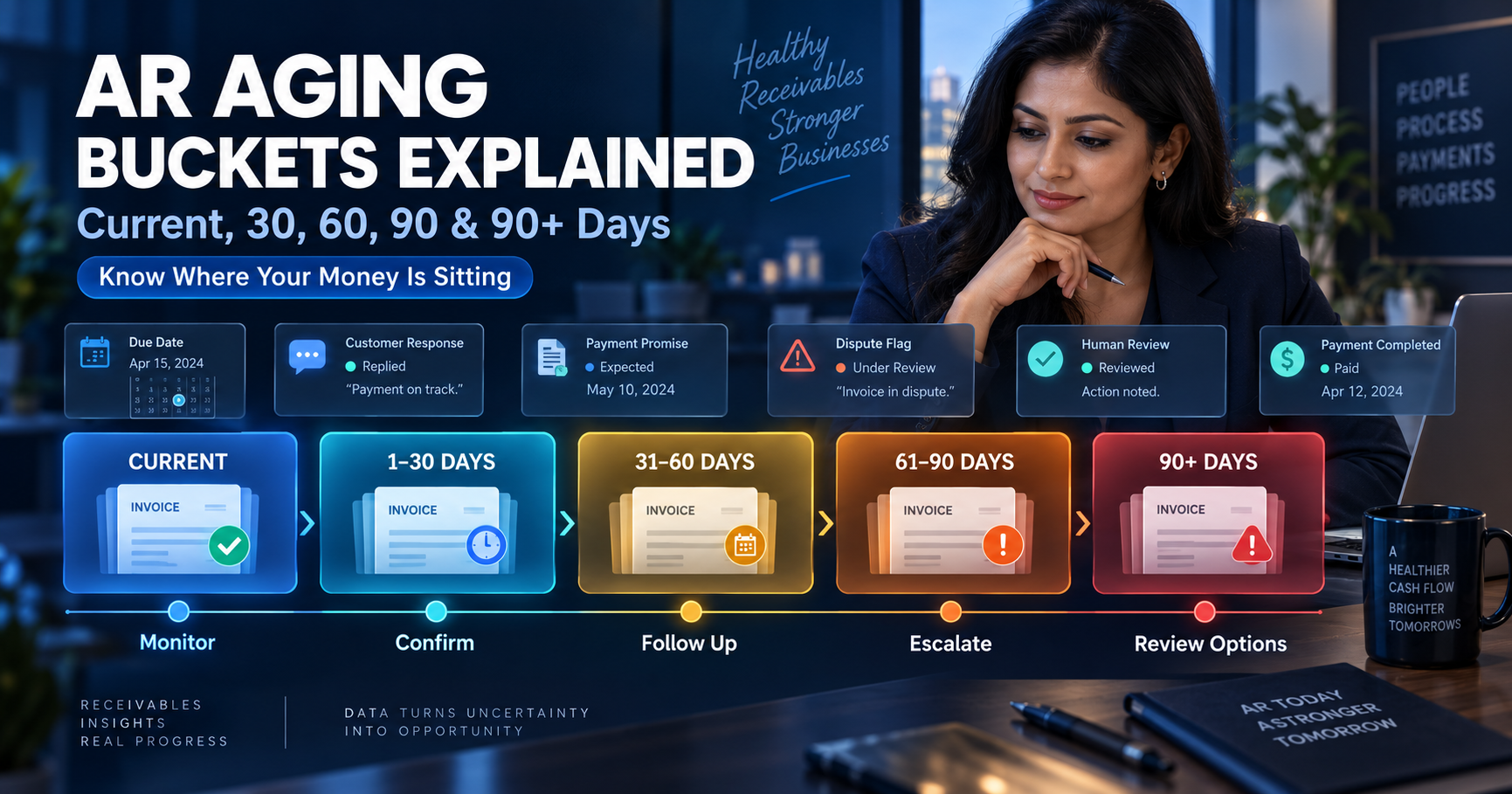
AR Aging Buckets: Current, 30, 60, 90 & 90+ Days
Understanding Current, 30-, 60-, 90- and 90-Plus-Day Receivables
Not every unpaid invoice is overdue.
And not every overdue invoice deserves the same collection response.
Accounts receivable aging buckets separate outstanding balances according to how long they have been unpaid. This helps a business distinguish a routine current invoice from a balance showing signs of elevated collection risk.
What are accounts receivable aging buckets?
Aging buckets are categories used to group invoices by age.
The standard categories are:
- Current
- 1–30 days overdue
- 31–60 days overdue
- 61–90 days overdue
- More than 90 days overdue
Some organizations use different intervals, but the method should remain consistent.
Invoice age should ordinarily be calculated using the contractual due date rather than simply the invoice date.
Current receivables
Current invoices have been issued but are not yet due.
Recommended actions may include:
- Confirming the invoice was delivered
- Checking purchase-order requirements
- Verifying the billing contact
- Sending a courtesy reminder before the due date
- Confirming supporting documents were received
Current balances are not collection problems, but proactive attention can prevent them from becoming overdue.
Receivables 1–30 days overdue
These invoices are recently past due.
The delay may result from:
- Invoice sent to the wrong contact
- Missing purchase order
- Customer payment schedule
- Administrative oversight
- Unclear payment instructions
- Minor dispute
- Simple forgetfulness
The initial message should normally remain professional and helpful.
Confirm:
- The invoice was received
- The customer agrees with the amount
- Required documents are complete
- Payment has been scheduled
- A specific issue is preventing payment
Document the response and establish a next follow-up date.
Receivables 31–60 days overdue
At this stage, vague assurances are not enough.
The business should determine:
- Why the invoice remains unpaid
- Whether it is disputed
- Who controls payment approval
- Whether a payment date has been provided
- Whether the customer has broken a prior promise
- Whether additional work or credit is continuing
Follow-up should become more direct while remaining factual and professional.
A useful request is:
Please confirm the current payment status and the date we should expect payment.
Receivables 61–90 days overdue
These balances require closer management attention.
Review:
- Complete communication history
- Prior payment promises
- Dispute status
- Supporting documentation
- Customer payment behavior
- Additional open invoices
- Continued credit exposure
- Likelihood of recovery
- Internal escalation options
The account should have a named owner and documented next action.
Do not allow repeated “checking on it” responses to reset the process indefinitely.
Receivables more than 90 days overdue
A 90-plus-day invoice does not automatically require immediate legal action, but it should not remain in an ordinary reminder sequence.
Review:
- Whether the debt is valid and documented
- Whether the customer disputes any portion
- Whether services were accepted
- Whether the billing contact is correct
- Whether a payment plan exists
- Whether previous promises were broken
- Whether continuing collection efforts are economical
- Whether qualified legal or collection advice is needed
Read What to Do With Invoices More Than 90 Days Overdue for a structured review.
Aging categories do not equal collection priority
An older invoice may appear more urgent, but priority should also consider:
- Outstanding amount
- Customer concentration
- Recent communication
- Promise-to-pay status
- Dispute status
- Payment history
- Strategic importance
- Recovery probability
- Cost of delay
For example, a $50,000 invoice that is 45 days overdue may deserve more immediate attention than a $100 invoice that is 100 days overdue.
Use How to Prioritize Overdue Invoices to combine age with other risk factors.
Analyze your aging mix
Use the free Accounts Receivable Aging Calculator to enter your balances and calculate:
- Total receivables
- Total overdue
- Percentage overdue
- Percentage 60-plus days overdue
- Distribution across aging buckets
Watch the movement between categories.
If balances continue moving from 1–30 into 31–60 and 61–90 days, the process is not resolving overdue accounts early enough.
Aging buckets and cash flow
Older receivables can tie up working capital and increase administrative effort.
Use the Late Payment Cost Calculator to estimate how a delayed payment may affect financing costs, collection effort and working capital.
Treat the result as an estimate rather than a guaranteed loss.
Assign a workflow to each bucket
A basic workflow might look like this:
| Aging bucket | Primary objective |
|---|---|
| Current | Prevent avoidable delay |
| 1–30 days | Confirm receipt and identify the problem |
| 31–60 days | Obtain a specific payment commitment |
| 61–90 days | Escalate internally and review credit |
| 90+ days | Determine the appropriate resolution path |
Adjust the workflow for disputes, payment plans and important customer circumstances.
Move from categories to next actions
Aging buckets provide visibility, but they do not perform the collection work.
PaymentPilot’s AI accounts receivable software helps businesses organize invoice activity, identify priorities, review recommended next steps and preserve human control over customer communication.
Start by determining where your unpaid balances are sitting. Then make sure every material overdue invoice has an owner, deadline and next action.
Additional resources
Use the free Small Business Assessment Tool to identify other business and insurance considerations.
To discuss your business, schedule a 30-minute conversation.
Samuel Bennett, Licensed Insurance Agent
Island Insurance Group
sam@islandinsurancegroup.com
954-804-8144
This article provides general information and is not accounting, financial or legal advice.