When a Medical Device Is Recalled: A Florida Physician’s Malpractice Checklist
Medical device recalls and malpractice are connected through the care a practice provides and how it responds to a safety notice. For Florida physicians, a recall should prompt a review of the affected products, clinical guidance, documentation, and insurance reporting requirements. It does not, by itself, establish that a physician was negligent.
A new FDA alert makes that distinction especially timely. The practical question is straightforward: if a safety notice reached your practice today, could you show who reviewed it, what action followed, and how completion was confirmed?
What does the new FDA device alert say?
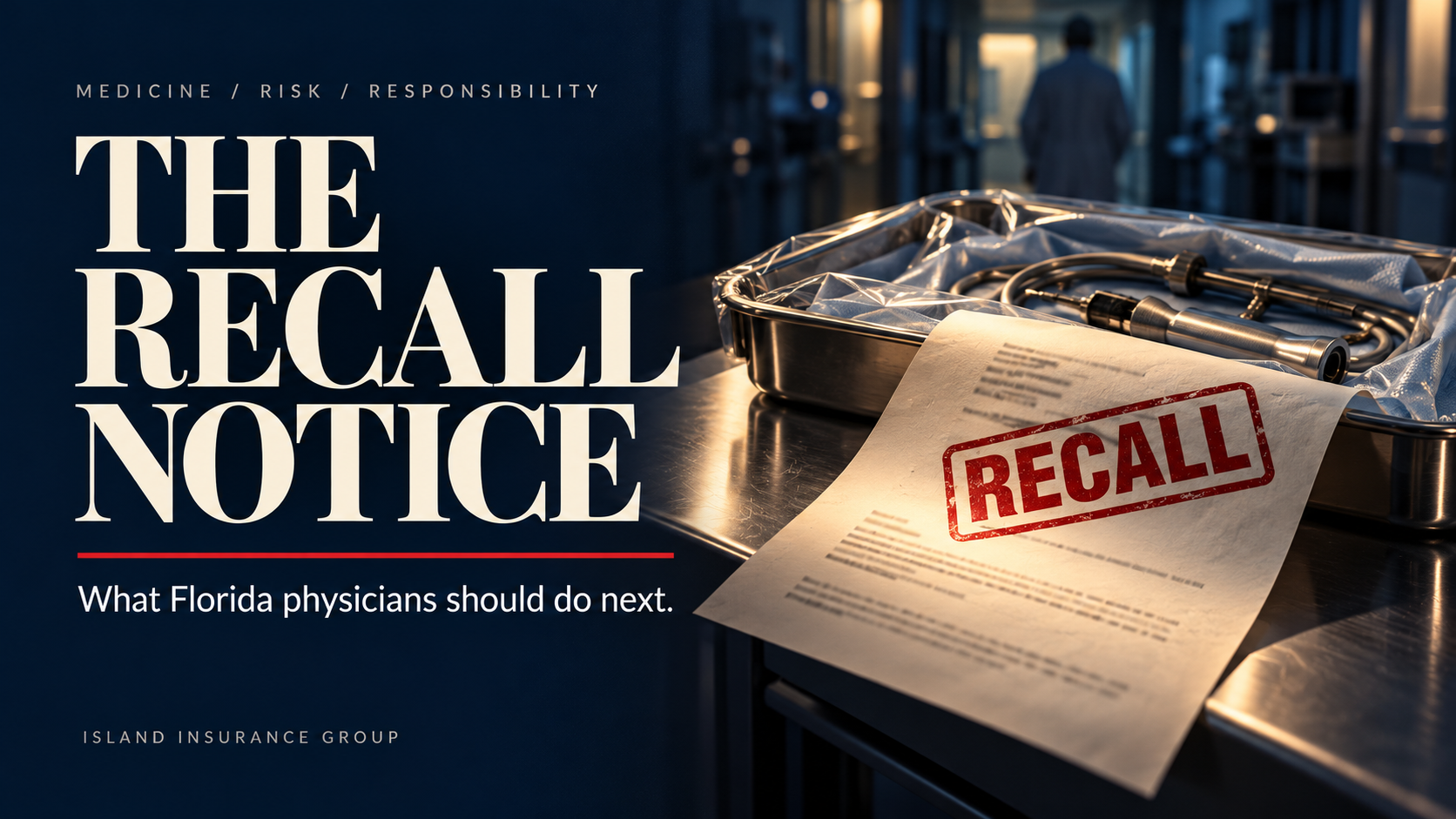
On October 15, 2026, the FDA posted an early alert concerning certain Edwards Lifesciences Commander M delivery systems used with the SAPIEN M3 transcatheter mitral valve replacement system. The notice identifies four affected lots: 67718561, 67804014, 67887043, and 67887044.
The FDA directs users not to use those affected products. It describes the manufacturer’s instructions to notify appropriate clinical staff, remove affected inventory, and arrange its return. The notice says other lot numbers are not affected by this recall.
As of October 5, Edwards had reported one death and one serious injury associated with the issue. These reports are not findings of physician negligence. Read the FDA’s current alert and product-specific instructions for updates.
This notice concerns a delivery system. It should not be described as a blanket recall of every SAPIEN M3 valve or an instruction to remove implanted valves.
Does a recalled device automatically create physician liability?
No. A product problem and a claim of negligent medical care are different issues. Florida Statutes section 766.102 places the burden on a claimant to establish a breach of the applicable professional standard of care and the required connection to injury. The statute also states that a medical injury does not itself create an inference or presumption of provider negligence. See Florida’s medical negligence statute.
A useful practice review asks separate questions: Was there a device problem? What information was available to the treating team? What clinical decisions and follow-up occurred? Those questions require case-specific assessment. A news report cannot answer them.
What should a practice review when a recall notice arrives?
Start with the actual notice and assign responsibility for carrying out its instructions. The following is a practical workflow to adapt with your clinical leadership and risk-management team, not a universal treatment protocol.
- Confirm the product match. Check the model, lot or serial number, location, and current inventory. A familiar brand name is not enough to determine whether a product is affected.
- Name an owner and a backup. Identify who routes the notice to clinicians, purchasing, storage areas, and each relevant location. Record when the notice was received and reviewed.
- Follow the specific action instructions. Distinguish removal from inventory from a correction, inspection, software update, or monitoring recommendation. Document completion and any unresolved questions.
- Evaluate patient implications. Have qualified clinical staff determine whether previously treated patients need review, communication, or follow-up under the current guidance. Do not assume every recall requires the same response.
- Keep an accurate record. Preserve the notice, product identifiers, relevant clinical records, communications, and the response timeline. Do not backdate entries or rewrite existing records to make the response appear different.
- Check reporting obligations. Review the applicable insurer, facility, manufacturer, and regulatory reporting channels. One report should not be assumed to satisfy every obligation.
The FDA explains that a medical-device recall may involve a correction or removal. It does not always require stopping all use or removing a device already implanted in a patient. Product-specific instructions and clinical judgment matter.
What should Florida physicians ask their malpractice insurer?
Use the notice as a reason to review your actual policy, rather than assume a manufacturer’s involvement settles your own coverage questions. Your Florida medical malpractice insurance review should address:
- Insured people and entities: Are the treating clinicians and the relevant practice entity insured for the services and locations involved?
- Reporting triggers: How does the policy define a claim, incident, or reportable circumstance? Where must notice go, and by when?
- Timing: How do the policy period, retroactive date, and any extended-reporting provisions apply to the facts?
- Defense terms: What limits, deductibles, defense-cost provisions, and settlement conditions could apply?
- Scope and exclusions: Are the procedures accurately disclosed, and do any endorsements or exclusions affect the exposure?
- Separate expenses: Is there any coverage for inventory replacement, patient outreach, or interrupted operations? Do not assume professional liability coverage pays these costs.
These are coverage-review questions, not a prediction that a particular insurer will accept or deny a claim. A declarations page alone cannot resolve all of them.
Should you wait for a lawsuit before contacting your carrier?
Follow your policy’s reporting requirements and seek prompt guidance when an incident may lead to a claim. Do not use the absence of a lawsuit as your only reporting test.
For example, The Doctors Company’s reporting guidance tells its members to notify it immediately about incidents that may lead to claims or claims already made. Your own insurer’s policy and instructions control your obligations.
Keep reporting channels distinct. The FDA’s mandatory device-reporting guidance distinguishes qualifying device user facilities from physician offices. Ask the responsible compliance team which requirements apply to your setting. FDA or manufacturer reporting does not replace notice to your malpractice insurer.
A simple way to test your recall-response process
Hypothetical example: A medical group has three locations. A manufacturer’s notice reaches purchasing, but no one confirms whether the other offices have affected inventory. The notice is forwarded twice, yet no person is responsible for closing the task.
The useful improvement is concrete: one response log showing the notice, affected identifiers, locations checked, responsible person, required actions, completion dates, and outstanding clinical questions. That log does not establish legal compliance or guarantee protection from a claim. It helps the team see what remains unfinished.
For broader operational exposures beyond professional liability, practice owners can also use Island Insurance Group’s free business assessment tool. It is separate from a medical malpractice coverage review.
Frequently asked questions
Does a medical-device recall prove malpractice?
No. A recall does not by itself establish physician negligence. Liability depends on the facts, the applicable standard of care, and the required connection between a breach and an injury.
Does a recall mean an implanted device must be removed?
Not necessarily. FDA guidance explains that recalls can involve different corrective actions. Follow the current product-specific guidance and the treating clinician’s individualized assessment.
Does malpractice insurance automatically pay recall expenses?
No automatic payment should be assumed. Review the policy for the specific claim or expense, including any applicable exclusions, conditions, limits, and endorsements.
Should a physician wait for a lawsuit before reporting an incident?
Follow the policy’s reporting requirements. An incident or circumstance may require notice before a lawsuit is filed; ask the insurer promptly if the reporting trigger is unclear.
Review the coverage behind your clinical work
Island Insurance Group helps Florida physicians and medical practices evaluate professional liability coverage. Bring your declarations page, policy forms and endorsements, current procedures, and relevant questions to the review. For an active incident, follow your insurer’s reporting instructions directly.
You can begin with the free medical malpractice assessment tool, or use the separate free medical malpractice quote tool to start a quote inquiry. Neither tool binds coverage or guarantees eligibility, pricing, or placement. Explore additional physician risk-management resources.
Samuel Bennett, Licensed Insurance Agent
sam@islandinsurancegroup.com | 954-804-8144
Schedule an appointment to review your malpractice coverage.
Information reviewed October 16, 2026. This article provides general insurance education, not medical or legal advice. FDA notices may change. Clinical decisions require qualified medical judgment; legal and regulatory obligations require case-specific review. Coverage, eligibility, premiums, limits, exclusions, and availability depend on the applicant, policy, and insurer.