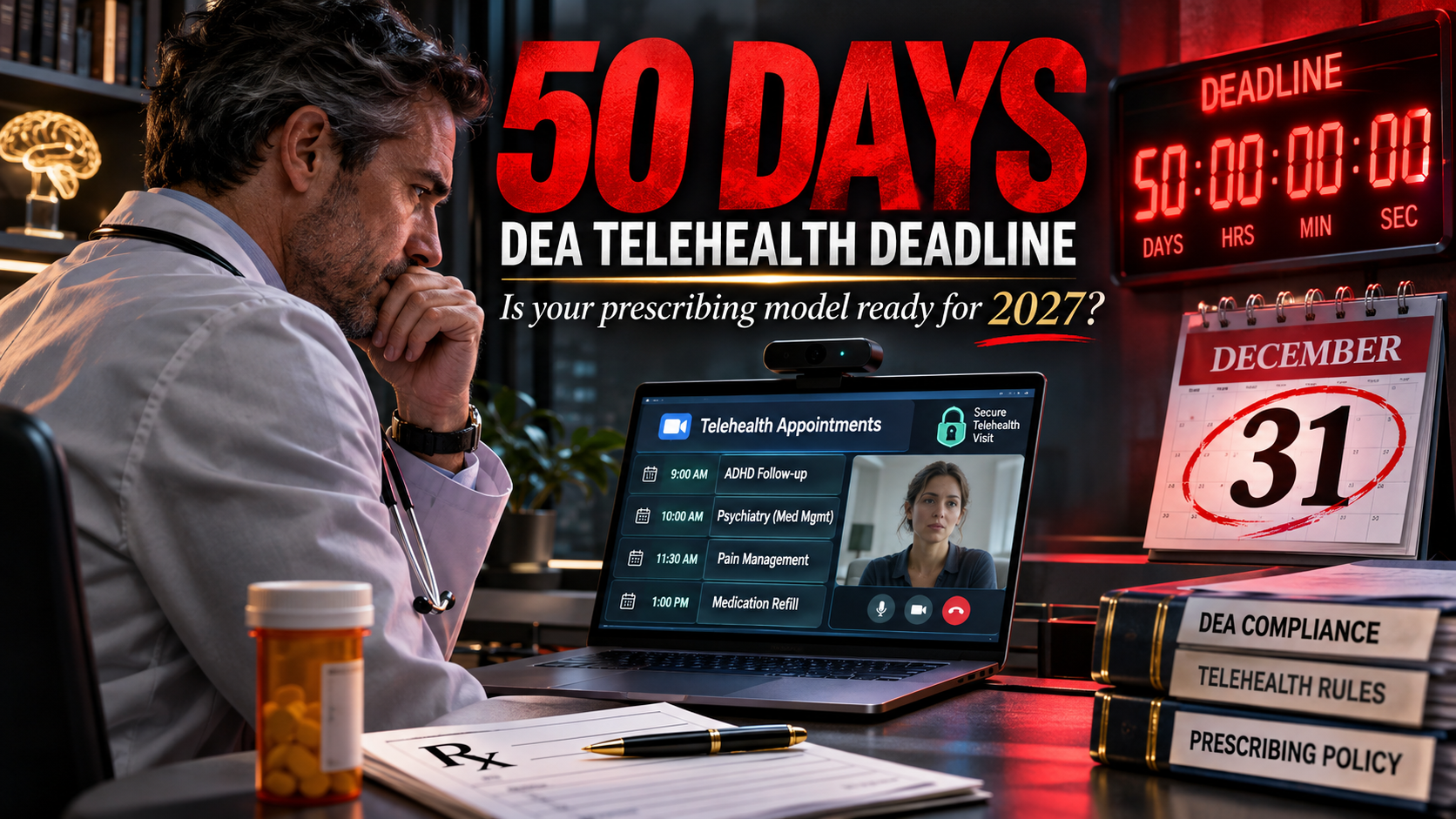
50 Days to the DEA Deadline: Is Your Telehealth Prescribing Model Ready for 2027?
50 DAYS TO THE DEA DEADLINE. IS YOUR TELEHEALTH PRESCRIBING WORKFLOW READY?
Psychiatry. ADHD care. Pain management. Medication-assisted treatment. A federal prescribing flexibility is scheduled to expire—and many practices have workflows built around it.
DEC 312026 temporary rule expiration dateYour January schedule may already be full. But a question deserves attention now: which controlled-substance prescriptions can your clinicians lawfully issue through telemedicine if the federal rules change after December 31?
On January 2, 2026, HHS and DEA confirmed a fourth temporary extension allowing qualifying DEA-registered practitioners to prescribe Schedule II–V controlled medications via telemedicine without first conducting an in-person medical evaluation. The extension runs through December 31, 2026. That is the deadline in the existing federal rule—not a declaration that every telehealth prescription becomes illegal on January 1. Read HHS’s announcement.
Why physicians should take this seriously now
For a telehealth-first practice, the risk is not simply a future legal headline. It is the logistics of how patients are evaluated, who is permitted to prescribe, whether visits may need to occur in person, and whether care can continue without unnecessary disruption. A psychiatrist whose practice treats ADHD, an addiction-medicine program, or a pain-management practice may face different operational questions.
Under the Ryan Haight framework, the general in-person evaluation requirement for remote controlled-substance prescribing has statutory exceptions. The 2026 temporary extension currently creates an additional federal pathway subject to its conditions. A prior qualifying in-person examination can materially change the analysis. State prescribing rules, professional licensure, DEA registration, clinical standards and pharmacy requirements also apply. Read the operative rule.
What the deadline does—and does not—mean
- It does mean: the broad, temporary authority written in 21 CFR 1307.41 currently sunsets at the end of December 31, 2026 unless changed by subsequent action.
- It does not mean: every form of telemedicine prescribing, all non-controlled prescriptions, or every continuing patient relationship automatically becomes prohibited on January 1.
- It does not mean: a proposed special-registration framework is already the final law. The details of a future final regulation must be read after publication.
- It does mean: practices should identify workflows that depend specifically on the expiring flexibility rather than assuming a single rule fits all patients and prescribers.
Four groups that should check their workflows
1. Psychiatry and ADHD practices
Any remote-care workflow involving Schedule II stimulants deserves a careful review of the clinician-patient evaluation history, registration and prescribing pathway. A blanket “telepsychiatry is ending” message would be wrong, but assuming current prescribing operations will remain unchanged would also be risky.
2. Pain-management practices
Confirm whether controlled-substance prescriptions rely on the temporary telemedicine exception. Identify patients whose care plans might require coordination, an appropriate in-person evaluation, or a different lawful prescribing pathway.
3. Addiction-treatment programs
Separate the broad temporary extension from the distinct, permanent federal telemedicine rule for certain buprenorphine treatment and from other applicable treatment authorities. Those rules have specific limitations and are not interchangeable. DEA discusses the separate authorities here.
4. Multi-state and virtual-first groups
Even if a federal prescribing route exists, state-specific licensure, registration, prescribing and monitoring obligations may still differ. Assess each operating state separately.
Before you change the patient schedule, run this quick assessment
The following free tool does not make a legal eligibility determination. It helps practice leaders identify which parts of their controlled-substance telemedicine workflow need documented review.
2027 Telehealth Prescribing Readiness Test
Identify your workflow dependencies and generate a practical transition checklist. No patient names or medical records requested.
Priority questions for your team
This is a workflow screening, not legal advice or a determination of prescribing eligibility. Requirements and transition dates may change. Review official federal and state sources and obtain qualified professional advice.
Interactive results require the companion WPCode JavaScript snippet. Nothing is sent to Island Insurance Group by this assessment.
What to do during the next 50 days
- Inventory workflow categories—not patient identities. Estimate how many patients and prescribers rely on telemedicine-only evaluations, grouped by medication schedule and care model.
- Separate existing lawful pathways. Review whether there was a qualifying in-person evaluation or whether a specific statutory or regulatory exception applies.
- Build a care-continuity workflow. Determine how staff will communicate any verified policy change and arrange clinically appropriate follow-up or referrals.
- Review state-by-state operations. Confirm professional licensing, registrations and controlled-prescribing requirements with counsel.
- Review your insurance and operational risk. Ask whether telehealth services, prescribing activities, licensed clinicians and entities are accurately described to your professional liability and cyber insurers. A policy review cannot substitute for legal compliance.
- Monitor the rule—not the rumors. Check DEA, HHS, the Federal Register and the current text of applicable law before modifying practice workflows.
Common questions
Will telehealth prescribing of controlled medications stop January 1, 2027?
Not categorically. The temporary federal flexibility is scheduled to expire December 31, 2026; other legal pathways may exist. Whether a particular clinician may prescribe depends on the rules then in effect and the patient’s circumstances.
Is the DEA special registration final rule already effective?
As of this article’s November 11, 2026 review, the special-registration rule was at the federal review stage; the final text was not established by the sources checked. Do not treat proposals as final requirements.
Do these rules affect every telehealth visit?
No. This is about controlled-substance prescribing under federal law, not a ban on telehealth care generally. Separate insurance coverage, reimbursement and state telemedicine standards may apply.
Does malpractice insurance cover regulatory penalties or guarantee compliant prescribing?
No such assumption is appropriate. Coverage varies by policy and allegations, and regulatory fines or penalties may be excluded. Discuss specific policy language with a qualified insurance professional and legal compliance with healthcare counsel.
Is your practice insurance aligned with your telehealth model?
Independent medical practices can review how telehealth, prescribing services, clinicians, business entities, cyber exposure and changes in care delivery are described in their insurance programs. A coverage conversation is not a legal compliance opinion.
Samuel Bennett, Licensed Insurance Agent
Island Insurance Group
sam@islandinsurancegroup.com · 1-866-820-7430
Continue exploring Island Insurance Group’s free Insurance Tools or visit the Resources Center for additional medical practice education.