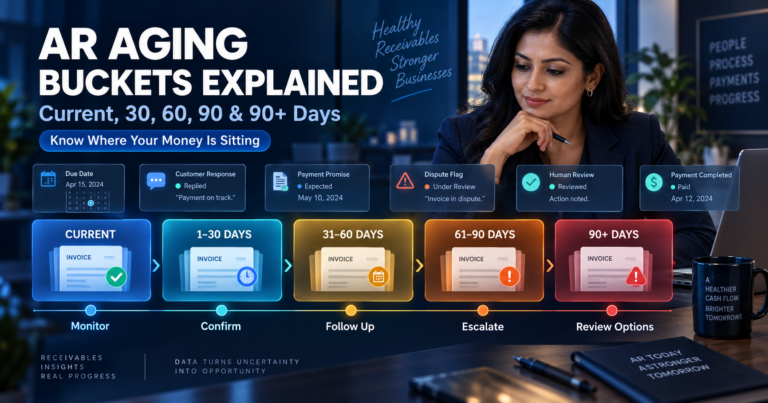

Accounts Receivable Follow-Up Schedule: What to Do and When
Getting invoices out is only the beginning.
The real problem starts when payment does not arrive on time.
Someone sends a reminder.
Someone else assumes the customer was already contacted.
A promise to pay gets buried in an inbox.
A disputed invoice sits untouched for two weeks.
And suddenly an invoice that was only a few days late is now 45, 60 or even 90 days overdue.
That is why a consistent accounts receivable follow-up schedule matters.
The goal is not to bombard customers with reminders.
The goal is to create a clear rhythm so your team knows:
When to follow up.
What to say.
What to check first.
When to escalate.
When to stop sending reminders and solve the real problem.
If you are building your entire collections process from the ground up, start with our guide to small business accounts receivable collections.
Why You Need an Accounts Receivable Follow-Up Schedule
Without a schedule, collections becomes reactive.
Your team follows up when someone remembers.
That creates inconsistent customer experiences and makes it easier for receivables to age.
A good follow-up schedule helps your business:
- Contact customers consistently
- Catch invoice problems early
- Reduce forgotten follow-ups
- Track payment promises
- Resolve disputes faster
- Avoid duplicate messages
- Keep older invoices from becoming invisible
- Create clear ownership
It also helps employees distinguish between a customer who simply forgot an invoice and one who has a real reason for delaying payment.
That distinction matters.
The Biggest Mistake: Treating Every Overdue Invoice the Same
Not every customer needs the same message on the same day.
A customer who usually pays reliably and is three days late may need a simple reminder.
A customer who is 62 days late and has already broken two promises needs a different action.
A customer disputing the invoice may not need a payment reminder at all.
Before sending anything, check:
- Days overdue
- Amount outstanding
- Recent customer activity
- Previous reminders
- Payment promises
- Active disputes
- Missing documentation
- Account owner
- Customer history
This is also why prioritization should come before blind follow-up. See our guide on how to prioritize overdue invoices.
A Practical Accounts Receivable Follow-Up Schedule
The exact timing will vary based on your payment terms, customer relationships and industry.
But this framework gives small businesses a strong starting point.
5–7 Days Before the Due Date
For larger or strategically important invoices, consider a light pre-due-date confirmation.
This is not a collection message.
The purpose is to prevent avoidable delays.
Confirm:
- The invoice was received
- The correct billing contact has it
- Purchase-order requirements are satisfied
- Supporting documentation is complete
- Payment instructions are clear
- No billing issue is already known
A short message might say:
“Just confirming you have everything needed to process Invoice 1047, due Friday.”
That is much easier than discovering 30 days later that the invoice was sent to the wrong person.
Due Date
On the actual due date, you usually do not need an aggressive reminder.
Instead, make sure the account is visible and ready for follow-up if payment does not arrive.
Your internal checklist might include:
- Confirm no payment was received
- Review any recent customer reply
- Verify invoice amount and due date
- Confirm there is no open dispute
- Check whether the customer already promised payment
The important thing is knowing the real status before taking action.
1–7 Days Overdue
This is usually the first true follow-up stage.
The tone should remain professional and low-friction.
Your goal is to determine whether the invoice is:
- Forgotten
- Processing
- Missing documentation
- Sent to the wrong contact
- Waiting on internal approval
- Disputed
A useful first reminder is simple and specific.
Include:
- Invoice number
- Amount
- Due date
- Payment instructions
- A clear request for status
Avoid vague messages like:
“Just checking in.”
Give the customer enough context to act immediately.
8–15 Days Overdue
If there has been no payment or meaningful response, follow up again.
At this point, the goal is no longer simply to remind.
You want to understand what is blocking payment.
Ask questions such as:
- Has the invoice been approved?
- Is there documentation missing?
- Is there a billing issue?
- Can you provide an expected payment date?
If the customer gives you a date, document it as a promise to pay.
Do not leave that promise inside someone’s inbox.
Record:
- Invoice
- Amount
- Promised payment date
- Customer contact
- Person who recorded the promise
- Follow-up date
A promise without a follow-up date is easy to forget.
16–30 Days Overdue
By this stage, the account deserves more deliberate attention.
Review the entire account history before sending another message.
Check:
- How many reminders were already sent?
- Did the customer respond?
- Did they promise payment?
- Has that promise been missed?
- Is the invoice disputed?
- Is the billing contact correct?
- Is the account manager aware?
The next action might be:
- Call the customer
- Escalate to a more senior billing contact
- Resend documentation
- Resolve a billing issue
- Follow up on a broken promise
- Involve the account owner
If your team is simply repeating the same reminder every week, the workflow is not really progressing.
31–45 Days Overdue
At this point, move beyond generic reminders.
Classify the account.
For example:
No Response
The customer has not acknowledged repeated attempts.
Promise to Pay
A specific payment date has been provided.
Broken Promise
The promised date passed without payment.
Dispute
The customer has raised an issue that must be resolved.
Internal Delay
Your own team needs to provide documentation, corrections or approval.
Escalation Required
The account needs management involvement.
This classification makes the next step much clearer.
46–60 Days Overdue
Invoices in this range should become increasingly visible.
Review:
- Outstanding amount
- Total customer exposure
- Payment history
- Prior collection attempts
- Broken promises
- Current disputes
- Internal relationship owner
- Risk to future work
A larger balance that has reached 60 days overdue may deserve more attention than several smaller balances combined.
This is where prioritizing overdue invoices becomes especially important.
61–90 Days Overdue
At this stage, the account should not be floating around without an owner.
Make sure you have:
- Verified balance
- Complete documentation
- Clear internal owner
- Recent customer activity
- Defined next action
- Follow-up deadline
- Escalation path
The tone can become firmer, but accuracy and context still matter.
Do not sacrifice the customer relationship by sending a harsh message when the real issue is unresolved internally.
If your overall collection cycle is getting longer, review why DSO may be increasing to identify whether billing delays, disputes, customer behavior or follow-up gaps are contributing.
More Than 90 Days Overdue
A 90+ day invoice should not simply receive the same reminder again.
At this stage, the business needs a decision.
Verify:
- Is the balance correct?
- Do you have all documentation?
- Has the customer acknowledged the debt?
- Is there an unresolved dispute?
- Has a payment plan been discussed?
- Has management reviewed the account?
- Is further escalation appropriate?
Our detailed guide on what to do with invoices over 90 days overdue covers this stage in more depth.
The key idea is simple:
An old invoice needs a strategy, not another generic reminder.
Sample Follow-Up Schedule at a Glance
Here is a simple starting framework:
| Timing | Recommended Action |
|---|---|
| 5–7 days before due | Confirm invoice receipt for important accounts |
| Due date | Verify payment status and account context |
| 1–7 days overdue | Send first professional reminder |
| 8–15 days overdue | Ask for payment status or expected date |
| 16–30 days overdue | Review history and escalate communication if needed |
| 31–45 days overdue | Classify the account and assign a specific next action |
| 46–60 days overdue | Increase priority and management visibility |
| 61–90 days overdue | Review full history, risk and escalation path |
| 90+ days overdue | Make a deliberate resolution or escalation decision |
This schedule should be adjusted to match your customer relationships and payment terms.
What Should Every Follow-Up Include?
A good collection message should make it easy for the customer to understand what you need.
Include:
- Customer name
- Invoice number
- Invoice date
- Original due date
- Amount outstanding
- Payment instructions
- Relevant documentation
- Clear next step
Keep the language simple.
Your customer should not have to search through old messages to understand what you are asking about.
Track More Than Sent Emails
One of the biggest mistakes in collections is measuring activity instead of progress.
For example:
“We sent six reminders.”
That sounds active.
But did anything change?
A better workflow tracks outcomes such as:
- Customer replied
- Payment promised
- Promise broken
- Payment received
- Dispute opened
- Dispute resolved
- Corrected invoice sent
- Documentation requested
- Account escalated
- Next action scheduled
This gives your team a real view of account status.
Promises to Pay Need Their Own Workflow
Promises are one of the most important pieces of collection information.
Suppose a customer says:
“We’ll pay $8,500 next Thursday.”
Do not continue sending standard reminders before Thursday.
Instead:
- Record the promise.
- Set the promised date.
- Pause unnecessary follow-up.
- Check for payment on the promised date.
- Reprioritize if payment does not arrive.
That is more respectful to the customer and more efficient for your team.
Disputes Should Interrupt the Normal Reminder Schedule
A dispute changes the problem.
If the customer says:
“This invoice is wrong.”
the next action should probably not be:
“Please pay this overdue invoice.”
The next action is to determine what is wrong.
Track:
- Reason for dispute
- Date opened
- Internal owner
- Customer contact
- Supporting documents
- Resolution deadline
Once the dispute is resolved, the collection workflow can continue.
This prevents unnecessary customer frustration.
When Should You Call Instead of Email?
Email is useful because it creates a written record.
But there are times when a phone call may be more effective.
Consider calling when:
- Multiple emails have gone unanswered
- The balance is significant
- A payment promise was missed
- The invoice is significantly aged
- A dispute is complex
- The customer relationship is important
- You need immediate clarification
After the call, document what happened.
Record:
- Who you spoke with
- What was discussed
- Any payment commitment
- Any dispute
- The next action
- Follow-up date
Should Collection Follow-Ups Be Automated?
Some automation can be useful.
But fully automatic reminders can create problems when the system lacks context.
For example, you do not want an automatic reminder sent when:
- The customer paid yesterday
- A dispute is being reviewed
- The customer promised payment Friday
- A corrected invoice was just sent
- Another employee is already working with the customer
That is why a human-controlled workflow can be more appropriate for customer-facing collections.
Technology can help organize and recommend.
A person should still understand the context before important communication goes out.
How PaymentPilot Supports a Follow-Up Workflow
PaymentPilot is designed to help small businesses organize the work that happens between an unpaid invoice and resolution.
Instead of keeping invoice data in one place and customer communication somewhere else, PaymentPilot helps bring collection activity into a clearer workflow.
That can include:
- Priority accounts
- Customer activity
- Follow-up history
- Payment promises
- Disputes
- Recommended next actions
- Human review before customer-facing activity
The objective is not simply to send more reminders.
It is to help your team know what deserves attention and what should happen next.
How a Follow-Up Schedule Can Help Reduce DSO
A consistent follow-up process can help prevent receivables from sitting untouched.
But reducing DSO should not come at the expense of customer relationships.
The better approach is to improve:
- Billing accuracy
- Follow-up consistency
- Dispute resolution
- Payment-promise tracking
- Account prioritization
- Visibility
For a deeper look at this, read how to reduce DSO without damaging client relationships.
Common Accounts Receivable Follow-Up Mistakes
Waiting Too Long to Make First Contact
If an invoice is important, you may want to confirm receipt before the due date rather than waiting until it becomes significantly overdue.
Sending the Same Reminder Repeatedly
If nothing changes after several attempts, the next action needs to change.
Ignoring Customer Replies
A reply may completely change the collection strategy.
Forgetting Payment Promises
A promise should trigger a future follow-up event.
Treating Disputes Like Collection Problems
Resolve the dispute first.
Failing to Assign Ownership
Every important overdue account should have a person responsible for moving it forward.
Relying on Memory
If the process only works because one employee remembers every conversation, it is not a scalable process.
Build a Follow-Up Schedule That Creates Progress
The purpose of a collection schedule is not to send more emails.
It is to prevent accounts from becoming invisible.
Every important receivable should answer:
What is the status?
Who owns it?
What happens next?
When does that happen?
When those answers are clear, your team can spend less time searching through spreadsheets and inboxes and more time actually resolving receivables.
If you need help deciding which accounts deserve attention first, read how to prioritize overdue invoices.
For the complete workflow, see our guide to small business accounts receivable collections.
And if you want a more organized way to manage collection priorities, customer activity and next actions, explore PaymentPilot.
Know what needs attention. Know what happens next.
FAQ: Accounts Receivable Follow-Up Schedule
How soon should I follow up on an overdue invoice?
Many businesses begin with a professional reminder within the first week after the due date. The appropriate timing depends on your payment terms, customer relationship and invoice value.
Should I contact customers before an invoice is due?
For large or strategically important invoices, a pre-due-date confirmation can help catch missing documentation, wrong billing contacts or approval issues before payment becomes late.
How often should I follow up on overdue invoices?
Avoid blindly sending messages on a fixed schedule without reviewing account activity. A useful cadence may begin weekly, but payment promises, disputes and customer responses should change the timing.
What should I do if a customer promises to pay?
Record the promised amount and date, stop unnecessary reminders before that date, and follow up immediately if the payment does not arrive as promised.
What should I do if the customer disputes the invoice?
Pause normal reminder activity and focus on resolving the dispute. Assign an owner, document the issue and establish a resolution deadline.
When should an overdue invoice be escalated?
Escalation may be appropriate when the balance is significant, the invoice is highly aged, repeated attempts have failed, payment promises have been broken or management review is needed.
What happens when an invoice reaches 90 days overdue?
A 90+ day invoice should receive deliberate review, including balance verification, documentation, account ownership, customer history, next action and escalation options.
Can accounts receivable software help manage follow-ups?
Yes. Collections software can help organize overdue accounts, customer activity, payment promises, disputes and next actions so teams have clearer context before following up.