
How to Prioritize Overdue Invoices Without Chasing Every Customer
Your aging report says 27 invoices are overdue.
That sounds useful.
Until someone asks:
“Which one should we work on first?”
That is where many small-business collection processes break down.
A spreadsheet may tell you how old an invoice is.
Your accounting system may tell you the amount outstanding.
But neither automatically tells your team which account deserves attention right now.
That requires prioritization.
A better accounts receivable process does not treat every overdue invoice the same. It considers aging, balance, customer history, promises, disputes and recent activity before deciding what happens next.
If you are building a broader collection process, start with our guide to small business accounts receivable collections.
Why Prioritizing Overdue Invoices Matters
The obvious approach is to sort your aging report by oldest invoice and work your way down.
That is simple.
It is also incomplete.
Consider these three accounts:
Customer A
- $450 outstanding
- 72 days overdue
- Customer replied yesterday
- Payment promised for Friday
Customer B
- $21,000 outstanding
- 18 days overdue
- No recent follow-up
- No payment commitment
Customer C
- $8,500 outstanding
- 46 days overdue
- Customer disputes part of the invoice
- Internal review still pending
Which account should receive attention first?
The oldest invoice is Customer A.
But that customer has already responded and given you a payment date.
Customer B represents a much larger exposure and has no recent activity.
Customer C may not need another collection email at all. The real next action may be resolving the dispute.
This is why prioritization matters.
The goal is not to find the oldest invoice.
The goal is to find the account where action is most useful.
What Does It Mean to Prioritize an Overdue Invoice?
Prioritizing overdue invoices means ranking accounts based on the urgency and importance of the next action.
Instead of asking:
“Which invoice has been overdue the longest?”
you ask:
“Which account needs attention most, and why?”
A practical priority model should consider several factors together.
Factor 1: Days Past Due
Aging still matters.
An invoice that has been overdue for 90 days should generally receive more attention than one that became overdue yesterday.
Common aging categories include:
- 1–30 days overdue
- 31–60 days overdue
- 61–90 days overdue
- More than 90 days overdue
As invoices move into older aging buckets, the need for review generally increases.
If your balances are regularly moving into older buckets, it may also be useful to review why your DSO is increasing.
Aging is important.
It just should not be the only factor.
Factor 2: Outstanding Balance
A $30,000 receivable and a $300 receivable have very different effects on cash flow.
That does not mean the largest invoice should always be first.
It means balance size should influence priority.
Consider:
- Total amount outstanding
- Percentage of your total receivables
- Customer concentration
- Whether multiple invoices are open
- Whether the balance is increasing
A relatively new but very large unpaid invoice may deserve attention before a much smaller balance that has aged longer.
Factor 3: Recent Customer Activity
Before contacting an overdue customer, determine what has already happened.
Ask:
- Did the customer reply?
- Did someone already send a reminder?
- Has the customer requested documentation?
- Did they ask for a corrected invoice?
- Did another employee already call?
- Is someone internally working on the issue?
Without that context, your team may duplicate work or send an unnecessary message.
This is one of the biggest weaknesses of managing collections across separate spreadsheets and inboxes.
The invoice is in one system.
The customer reply is somewhere else.
The collection decision depends on both.
Factor 4: Promises to Pay
A payment promise should directly affect account priority.
If a customer tells you:
“We will pay the invoice on Friday.”
you now have a defined event to monitor.
That account may move temporarily from “contact immediately” to “waiting for promised payment.”
A useful payment-promise record includes:
- Invoice
- Amount
- Promised payment date
- Customer contact
- Person who recorded it
- Follow-up date
If Friday arrives and the payment is missing, the account becomes actionable again.
A broken payment promise may deserve more attention than an account that simply has not received a first reminder.
Factor 5: Active Disputes
Not every overdue invoice is a collection problem.
Sometimes the customer is not paying because they believe something is wrong.
Examples include:
- Incorrect amount
- Missing purchase order
- Pricing disagreement
- Service complaint
- Duplicate invoice
- Missing documentation
- Contract disagreement
- Credit not applied
Sending another generic reminder may do nothing.
The priority action might be:
Resolve the dispute.
That distinction matters.
A good accounts receivable workflow tracks the reason the invoice is unpaid, not just how many days it has been overdue.
Factor 6: Customer Importance
Some customer relationships require additional judgment.
You may want to consider:
- Strategic importance
- Lifetime value
- Payment history
- Contract size
- Current projects
- Relationship sensitivity
This does not mean allowing important customers to ignore payment obligations indefinitely.
It means the tone and method of follow-up may need to reflect the relationship.
A high-priority account does not automatically require a more aggressive message.
It simply means the account deserves attention.
Factor 7: Previous Collection Attempts
Look at what has already been tried.
Has your team:
- Sent one reminder?
- Sent five reminders?
- Called?
- Escalated internally?
- Contacted the correct person?
- Asked whether documentation is missing?
If the same action has failed repeatedly, repeating it again may not be the best next step.
At some point, the workflow needs to change.
For older balances, see our guide on what to do with invoices more than 90 days overdue.
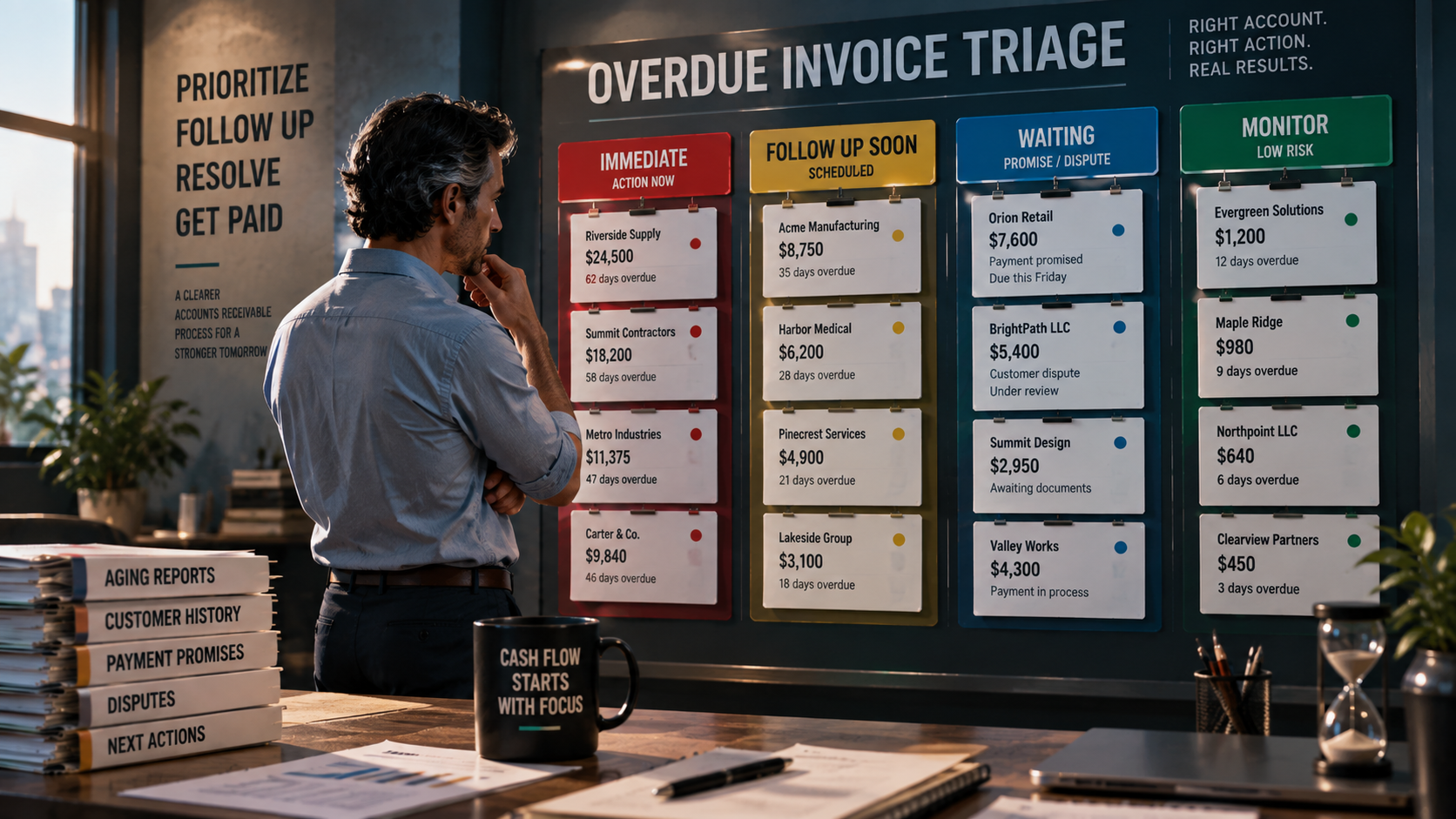
Create Four Simple Priority Categories
You do not need an overly complicated scoring system to improve collection prioritization.
Start with four categories.
1. Immediate Attention
Accounts that require action now.
Examples:
- High-value balance with no recent activity
- Significantly aged balance
- Broken promise to pay
- Important customer with unresolved issue
- Large balance approaching another aging threshold
2. Follow Up Soon
Accounts that need communication but are not immediate risks.
Examples:
- Recently overdue invoice
- First reminder due
- Customer has not acknowledged the invoice
- Minor delay with no other warning signs
3. Waiting
Accounts where the next event is already defined.
Examples:
- Customer promised payment Friday
- Internal dispute review underway
- Corrected invoice has been sent
- Customer requested documentation
- Payment is reported as processing
Waiting should not mean forgotten.
Every waiting account needs a date when it becomes actionable again.
4. Monitor
Accounts that require visibility but no immediate intervention.
Examples:
- Invoice only recently became overdue
- Reliable customer with predictable payment history
- Recently contacted account with reasonable next step already established
This structure gives employees something much more useful than one giant overdue list.
Add a Next Action to Every Priority Account
Ranking the account is only the beginning.
Every important account should answer four questions:
Who owns this account?
What is the next action?
When should it happen?
What information does the person need?
Examples of specific next actions include:
- Call billing contact
- Confirm invoice receipt
- Resend purchase order
- Review customer reply
- Send reminder
- Follow up on payment promise
- Correct invoice
- Resolve dispute
- Escalate to account manager
- Review 90+ day balance
Compare that with:
Status: overdue
“Overdue” describes the problem.
A next action moves the problem toward resolution.
A Simple Overdue Invoice Priority Matrix
You can also use a basic matrix.
High Balance + High Aging
Priority: Very high
Review immediately.
Confirm customer activity, disputes, previous follow-up and escalation options.
High Balance + Low Aging
Priority: High
Do not wait simply because the invoice is relatively new.
Large exposures deserve early visibility.
Low Balance + High Aging
Priority: Moderate to high
Review efficiently.
Determine whether the account needs escalation or a different resolution path.
Low Balance + Low Aging
Priority: Lower
Monitor and follow your standard collection schedule.
This matrix is not a rigid rule.
It is a starting point.
Customer activity and disputes can change the priority quickly.
Why an Aging Report Alone Is Not Enough
An aging report answers:
How old is the invoice?
A true collections workflow answers:
What should we do about it?
Those are different questions.
A good workflow combines:
- Aging
- Balance
- Customer history
- Previous communication
- Promises
- Disputes
- Next actions
- Ownership
This is also why a rise in DSO should be diagnosed rather than treated only with more collection pressure. Our guide on how to reduce DSO without damaging client relationships discusses improving follow-up, resolving disputes and focusing attention where it matters.
Where PaymentPilot Fits
PaymentPilot is designed to help small businesses turn scattered receivable information into a clearer collection workflow.
Instead of manually deciding where to start every morning, the platform helps organize customer and invoice activity and surface priority accounts.
Its workflow is designed around:
- Account prioritization
- Customer activity
- Recommended next actions
- Payment promises
- Disputes
- Follow-up history
- Human review of customer-facing activity
The goal is not to replace judgment.
It is to give the person making the decision better context.
AI Should Help Prioritize, Not Blindly Take Over
AI can be useful for organizing information and recommending where attention may be needed.
But collections is still a customer relationship.
That means automation should be used carefully.
A customer may already have:
- Responded
- Paid
- Disputed the invoice
- Promised payment
- Requested documentation
- Contacted another employee
Sending another automatic reminder without recognizing that activity can create unnecessary friction.
A stronger model is:
AI identifies.
AI recommends.
A person reviews.
A person decides.
That human-controlled workflow is part of how PaymentPilot is positioned.
How to Prioritize Overdue Invoices in 10 Minutes
If you need a quick process today, use this sequence.
Step 1: Pull your overdue accounts
Start with all currently overdue invoices.
Step 2: Sort by balance
Identify your highest financial exposures.
Step 3: Review aging
Flag accounts moving into 30-, 60- or 90-day categories.
Step 4: Check recent activity
Look for replies, reminders, calls and account notes.
Step 5: Identify promises and disputes
Remove accounts that are legitimately waiting on a defined event from the immediate-contact queue.
Step 6: Assign a priority
Use:
Immediate
Soon
Waiting
Monitor
Step 7: Assign a next action
Do not stop at the priority label.
Write down what actually needs to happen.
Step 8: Assign an owner and date
Someone should know that they are responsible for moving the account forward.
Common Mistakes When Prioritizing Collections
Mistake 1: Chasing the Oldest Invoice First
Age matters, but it does not tell the whole story.
Mistake 2: Only Chasing the Largest Balance
Balance matters too, but a large disputed invoice may require internal resolution rather than another payment reminder.
Mistake 3: Ignoring Customer Replies
A customer response can completely change the next action.
Mistake 4: Treating Payment Promises Like Payments
A promise is not payment.
Track the date and verify whether the commitment was met.
Mistake 5: Sending the Same Message Repeatedly
If three identical reminders have not worked, a fourth may not solve the problem.
Mistake 6: Leaving Accounts Without Owners
An invoice that “the team” owns often means nobody truly owns it.
Mistake 7: Tracking Everything in Separate Places
When invoice data, customer communication and account notes live in separate systems, collection decisions become slower and less reliable.
Prioritization Protects More Than Cash Flow
Good collections prioritization does more than help recover outstanding balances.
It can also reduce:
- Wasted staff time
- Duplicate follow-ups
- Customer frustration
- Forgotten promises
- Missed disputes
- Unnecessary escalation
It helps employees focus on the accounts where their attention can make the biggest difference.
Stop Chasing Every Invoice the Same Way
Your overdue list is not one problem.
It is a collection of different situations.
Some customers need a reminder.
Some need documentation.
Some need a dispute resolved.
Some have promised to pay.
Some need immediate escalation.
The purpose of prioritization is to tell those situations apart.
Instead of asking:
“Who is overdue?”
start asking:
“Who needs attention next?”
That is the shift from an aging report to a real collections workflow.
If you want the full process, read our guide to small business accounts receivable collections.
And if your team needs a clearer way to organize priorities, customer activity and next steps, explore PaymentPilot.
Know what needs attention. Know what happens next.
FAQ: Prioritizing Overdue Invoices
Should I always contact the oldest overdue invoice first?
No. Days overdue is important, but balance, customer activity, disputes, payment promises and previous collection attempts should also influence priority.
Should larger invoices always receive priority?
Not automatically. Large balances deserve visibility, but a smaller invoice with a broken promise or significant aging may also require immediate attention.
How should I handle a disputed overdue invoice?
Determine what is causing the dispute and assign a resolution action. Repeated payment reminders may not help until the underlying issue is resolved.
What should I do when a customer promises to pay?
Record the amount, promised payment date, customer contact and follow-up date. If payment does not arrive when promised, the account should return to the active collection queue.
When should an overdue invoice be escalated?
Escalation depends on balance, aging, customer response, documentation, dispute status and previous collection activity. Invoices more than 90 days overdue generally deserve deliberate review rather than continued generic reminders.
Can software prioritize overdue invoices?
Accounts receivable software can help organize aging, balance, customer history and recent activity so teams can make better prioritization decisions. PaymentPilot is designed around this type of prioritized workflow.
What is the difference between an aging report and a priority queue?
An aging report shows how old invoices are. A priority queue identifies which accounts need attention and what action should happen next.