He Broke His Collarbone Celebrating a NASCAR Win. Twelve Days Later, Doctors Cleared Him to Race.
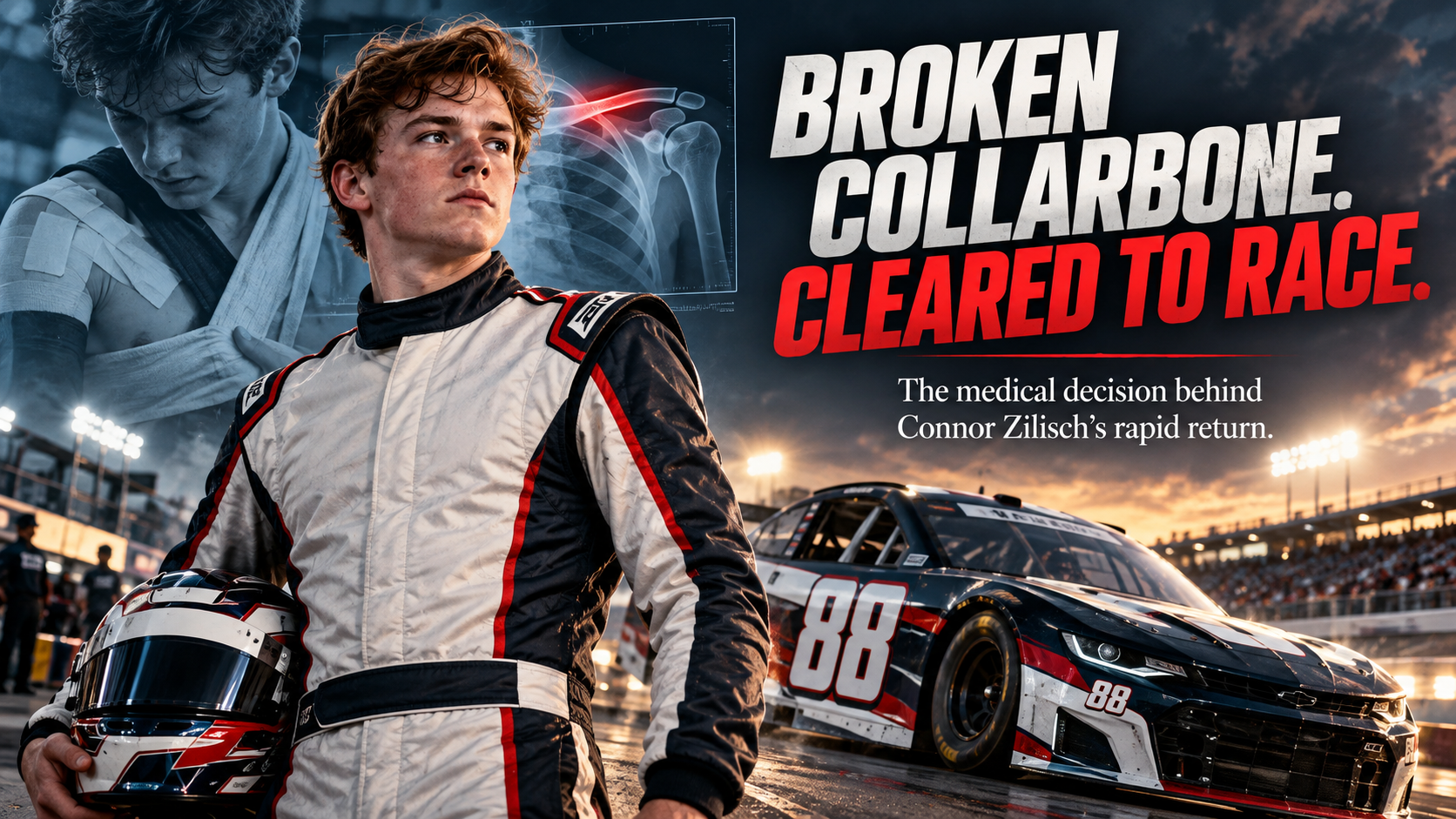
NASCAR driver Connor Zilisch had just won a race at Watkins Glen when an unexpected accident changed his celebration into a medical emergency. He slipped while climbing on his racecar in Victory Lane, fell onto the pavement, and fractured his collarbone.
Three days later, he underwent surgery. Twelve days after the accident, he was medically cleared to return to racing.
The remarkable comeback created an interesting question for anyone involved in sports medicine: What goes into clearing an athlete to return to a high-risk sport shortly after surgery?
For orthopedic surgeons, sports medicine physicians, team doctors, and medical directors, the story also highlights the importance of clearly defined professional responsibilities and medical malpractice insurance coverage.
This article examines the documented 2025 events, the medical clearance process, and the insurance considerations associated with high-stakes sports medicine decisions.
A NASCAR Victory Celebration That Ended in an Unexpected Injury
On August 9, 2025, Connor Zilisch won the NASCAR Xfinity Series race at Watkins Glen International in New York.
The 19-year-old driver had delivered another impressive performance during a successful season.
But while celebrating in Victory Lane, Zilisch lost his balance as he climbed out of his No. 88 JR Motorsports Chevrolet.
He fell from the car onto the pavement, prompting an immediate response from medical personnel.
According to NASCAR’s reporting, responders placed him on a backboard and transported him for medical evaluation. He was subsequently taken to a local hospital.
Zilisch later reported that scans of his head were clear but that he had suffered a broken collarbone.
He was released from the hospital that evening.
Source: NASCAR: Connor Zilisch Breaks Collarbone in Victory Lane Fall.
Three Days Later, Zilisch Underwent Collarbone Surgery
On August 12, Zilisch underwent surgery to repair the fractured collarbone.
He publicly explained that the procedure involved inserting a plate and screws to help stabilize the injury and support recovery.
For a professional racecar driver, upper-body function is particularly important.
Driving a racecar requires coordination, sustained physical control, and the ability to respond rapidly under demanding conditions.
A collarbone injury can affect shoulder movement, comfort, and the ability to tolerate certain physical forces.
However, a specific athlete’s recovery timeline depends on factors that cannot be determined from the diagnosis alone.
Physicians must consider the individual injury, medical findings, functional capabilities, treatment, recovery progress, and risks associated with the proposed activity.
Source: NASCAR: Zilisch Undergoes Collarbone Surgery.
Twelve Days After the Accident, He Was Cleared to Race
On August 21, NASCAR announced that Zilisch had been medically cleared to return to competition.
He was scheduled to drive at Daytona International Speedway on August 22, just 13 days after the accident and 10 days after surgery.
The timeline was particularly notable because the Xfinity Series had an off weekend following Watkins Glen.
That meant Zilisch could return for the next scheduled Xfinity Series event without missing a race in that series.
JR Motorsports also arranged for driver Parker Kligerman to be on standby if Zilisch needed to leave the car.
The decision to have a replacement available illustrates an important aspect of professional sports operations: medical clearance and organizational contingency planning can occur together.
But having a backup driver does not establish anything about whether a particular athlete is medically ready to participate.
Source: NASCAR: Zilisch Cleared to Return for Daytona.
Who Actually Clears an Injured NASCAR Driver to Return?
NASCAR’s public explanation of Zilisch’s clearance process provides useful insight into how medical responsibilities can be coordinated.
In an August 20 report, NASCAR explained that the driver’s treating orthopedic physician was expected to evaluate his recovery and communicate with NASCAR’s medical team.
NASCAR would then make the applicable return-to-racing clearance determination.
This arrangement highlights an important distinction between treating a medical condition and authorizing participation in a particular competitive environment.
The treating physician may assess healing, physical function, symptoms, and other relevant medical considerations.
The motorsports organization’s medical personnel may also evaluate the requirements and risks associated with competition.
These decisions can involve overlapping professional responsibilities, but the exact roles depend on the organization and circumstances.
Source: NASCAR: How Zilisch Would Get Cleared to Race After Injury.
Why Medical Clearance Is More Than a Calendar Date
One of the most important lessons from sports medicine is that recovery is not determined simply by counting days after an injury.
Two athletes with apparently similar diagnoses may require different treatment and recovery plans.
Medical clearance may involve evaluating:
- The nature and severity of the original injury
- The surgical procedure and postoperative findings
- Healing progress and medical stability
- Pain, strength, and functional movement
- The physical demands of the specific sport
- The possibility of reinjury or complications
- Relevant diagnostic findings
- Recommendations from treating specialists
- Any medical restrictions or required accommodations
The relative importance of each factor depends on the individual patient and activity.
For motorsports physicians, clearance may require considering vehicle control, physical endurance, restraint systems, emergency exits, and the possibility of high-impact incidents.
These are general sports medicine considerations, not a description of every test or assessment performed in Zilisch’s case.
When a Return-to-Sport Decision Becomes a Liability Question
A medical clearance decision can carry significant consequences.
When a physician provides professional services to athletes, potential malpractice allegations may involve diagnosis, treatment, follow-up care, documentation, or decisions about resuming activity.
For example, a dispute might involve allegations that a physician failed to evaluate important symptoms, did not communicate restrictions, or made a clearance recommendation inconsistent with the applicable standard of care.
However, a medical complication or unfavorable outcome does not automatically establish malpractice.
Professional negligence generally involves questions about the duty owed, applicable standard of care, alleged breach, causation, and legally recoverable damages.
The facts must be evaluated in context.
There is no basis in the reporting reviewed for this article to conclude that Zilisch’s treating physicians or NASCAR’s medical personnel acted negligently.
His case is relevant because it demonstrates the importance of medical clearance decisions, not because it establishes a medical malpractice incident.
What Professional Liability Risks Can Motorsports Physicians Face?
Physicians involved in racing medicine may perform clinical duties that differ from those of a conventional office-based practice.
Depending on the assignment, their responsibilities can include:
- Trackside injury assessment
- Emergency medical stabilization
- Concussion evaluation
- Musculoskeletal injury management
- Coordination with orthopedic surgeons and specialists
- Review of return-to-competition medical information
- Medical director and supervisory activities
- Oversight of event medical response protocols
- Care at venues outside their usual practice location
These activities may require additional underwriting information when arranging medical malpractice coverage.
A physician should not assume that a policy covering office-based treatment automatically includes every event-related activity.
Does Existing Medical Malpractice Insurance Cover Return-to-Racing Decisions?
Possibly. Coverage depends on the physician’s actual policy, insured professional services, employment arrangements, location, and other conditions.
A treating orthopedic surgeon might maintain professional liability insurance through a private practice.
An event physician may be covered under an individual policy, employer-sponsored arrangement, or another applicable professional liability program.
Medical directors may have responsibilities that extend beyond direct patient care.
These arrangements are not necessarily interchangeable.
Before accepting a motorsports medical assignment, physicians should clarify:
- Whether event medicine is included in their covered professional services
- Whether outside medical clearance activities are covered
- Which physicians and entities are named insureds
- Whether the event organizer provides applicable malpractice coverage
- How professional liability limits apply
- Whether defense costs reduce available limits
- What happens when a physician changes employers or assignments
- Whether travel and out-of-state medical services are included
For more information, explore Team Physician and Sports Medicine Malpractice Insurance in Florida.
What About Orthopedic Surgeons Treating Professional Athletes?
Orthopedic surgeons may treat athletes who depend on physical performance for their careers.
Professional responsibilities can include surgery, postoperative assessment, rehabilitation coordination, and recommendations about returning to demanding activities.
Potential professional liability exposure depends on the actual services performed and the circumstances of a claim.
An athlete’s contract value does not automatically determine malpractice damages, but alleged lost earning capacity can become an issue in certain disputes.
That makes it important to review liability limits, covered surgical procedures, defense provisions, and contractual insurance requirements.
Our related analysis examines this issue in greater detail:
$1 Million in Malpractice Coverage. A $50 Million Athlete. Is the Team Doctor Protected?
What Florida Physicians Should Review Before Taking a Sports Medicine Assignment
Florida physicians considering motorsports, athletic event medicine, or team physician responsibilities should evaluate their insurance and contractual arrangements before beginning work.
The following checklist provides a starting point.
- Review your current professional liability declarations and policy forms.
- Describe all relevant sports medicine and event-related duties.
- Confirm applicable practice locations and territorial provisions.
- Identify any medical director or supervisory responsibilities.
- Request documentation of any employer- or event-sponsored malpractice insurance.
- Review contractual insurance requirements with appropriate professionals.
- Evaluate existing per-claim and aggregate limits.
- Confirm claims-made retroactive dates and reporting requirements.
- Review available prior-acts or extended-reporting arrangements where relevant.
- Obtain written clarification of unusual activities from the appropriate insurer or representative.
Florida physicians must also consider applicable financial responsibility requirements, which are addressed in Florida Statute 458.320 for physicians licensed under Chapter 458.
Compliance with a statutory financial responsibility requirement does not establish that every sports medicine or event assignment is insured.
How Much Does Sports Medicine Malpractice Insurance Cost?
Medical malpractice premiums depend on more than the physician’s specialty alone.
Underwriters may evaluate procedures, practice locations, prior claims, policy limits, professional activities, and other relevant risk characteristics.
For physicians involved in motorsports or other athletic assignments, the insurer may also request details about event responsibilities, frequency of participation, emergency care activities, and applicable contracts.
Coverage eligibility and premium quotations vary by insurer.
Island Insurance Group provides a free medical malpractice quoting and underwriting analysis tool to help physicians explore preliminary premium estimates and risk characteristics.
Explore Your Free Medical Malpractice Premium Analysis →
This tool provides preliminary educational information. It does not confirm coverage for motorsports activities, determine an appropriate liability limit, or guarantee a formal carrier quotation.
Frequently Asked Questions About Motorsports Medical Clearance
How quickly did Connor Zilisch return after his collarbone injury?
Zilisch fractured his collarbone on August 9, 2025, underwent surgery on August 12, and was medically cleared on August 21. He was scheduled to compete at Daytona on August 22.
Who decides whether a NASCAR driver can return after surgery?
The medical clearance process can involve treating specialists and NASCAR medical personnel. For Zilisch’s return, NASCAR described a process involving orthopedic follow-up and communication with its medical team.
Does a quick return after surgery automatically indicate unsafe medical care?
No. Medical decisions must be evaluated according to the individual patient’s condition, relevant findings, activity demands, and circumstances. A short recovery interval alone does not establish negligence.
Can a sports medicine physician face malpractice allegations over a clearance decision?
Potentially. Professional negligence allegations may arise from many kinds of clinical decisions. Whether a particular claim has merit depends on the applicable law and medical facts.
Does a physician’s existing malpractice policy automatically cover motorsports assignments?
No universal rule makes such coverage automatic. Physicians should confirm that the activities, locations, and professional responsibilities involved fall within their insured services.
Can physicians with prior malpractice claims obtain specialized sports medicine coverage?
Possibly. Eligibility depends on the applicant’s complete underwriting profile, including prior claims, specialty, procedures, practice activities, and insurer guidelines.
The Bigger Lesson Behind Connor Zilisch’s Return
Connor Zilisch’s 2025 injury and return to competition illustrate how closely sports medicine and professional athletic performance are connected.
An accident during a victory celebration became a surgical recovery and medical clearance story in less than two weeks.
For the physicians involved in athletic medicine, decisions about diagnosis, treatment, recovery, and return to competition carry important professional responsibilities.
Those responsibilities deserve clearly defined clinical roles and appropriate professional liability insurance arrangements.
Island Insurance Group helps Florida physicians and medical practices review professional liability insurance considerations, including specialized clinical activities, orthopedic practice exposures, and complicated underwriting histories.
Explore our Insurance Resources Center, visit our Insurance Tools, or complete the free business risk assessment for broader practice-related insurance considerations.
For physicians preparing to request formal malpractice coverage, our free medical malpractice assessment tool provides another way to organize underwriting information.
Schedule a 30-Minute Professional Liability Consultation →
Samuel Bennett, Licensed Insurance Agent
Island Insurance Group
sam@islandinsurancegroup.com
954-804-8144
Editorial and insurance disclaimer: This article discusses events reported in August 2025 and provides general insurance education as of October 2026. It makes no allegation that Connor Zilisch’s treating physicians, NASCAR medical personnel, or related organizations acted negligently. It is not medical or legal advice, does not establish an appropriate recovery interval for any patient, and does not confirm insurance eligibility or coverage. Actual policy terms, limits, exclusions, premiums, and insurer availability vary.