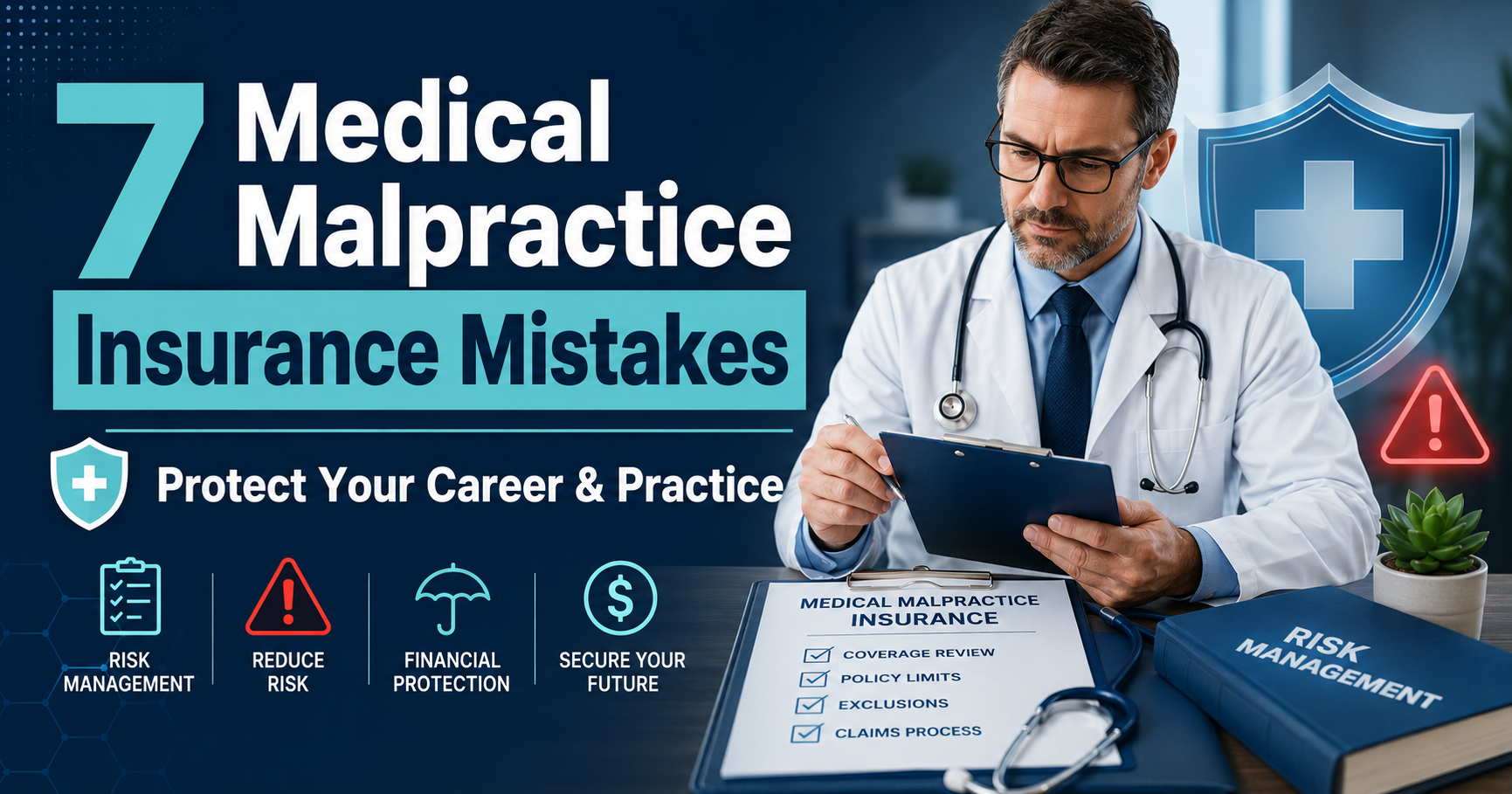
Medical Malpractice Insurance: 7 Costly Mistakes Healthcare Professionals Should Avoid
For doctors, dentists, nurses, therapists, medical practices, and other healthcare professionals, one liability claim can become far more than a legal headache.
It can threaten your finances, your practice, your reputation, and your ability to keep working.
That’s why medical malpractice insurance deserves more attention than simply asking, “What’s the cheapest policy?”
The right coverage should reflect how you actually practice medicine, the services you provide, and the risks you face.
Here are seven common medical malpractice insurance mistakes that healthcare professionals should avoid.
1. Choosing Coverage Based on Price Alone
Lower premiums can be attractive, especially for new practices or independent healthcare professionals trying to control overhead.
But price should never be the only factor.
A cheaper policy may come with:
- Lower limits
- Narrower coverage
- More exclusions
- Less favorable claim terms
- Different defense provisions
- Limited coverage for certain procedures or services
The goal is not simply to find the least expensive policy.
The goal is to find appropriate protection for your professional exposure.
Island Insurance Group can help healthcare professionals review available insurance options and better understand how different policies may compare.
2. Not Understanding Claims-Made vs. Occurrence Coverage
This is one of the most important distinctions in professional liability insurance.
A claims-made policy generally responds when both the incident and the claim meet the policy’s timing requirements.
An occurrence policy generally focuses on when the alleged incident occurred, subject to the policy terms.
Why does this matter?
Because changing carriers, retiring, selling a practice, or allowing a claims-made policy to lapse can create potential coverage issues if continuity is not handled properly.
Healthcare professionals with claims-made coverage may also need to understand concepts such as:
- Retroactive dates
- Prior acts coverage
- Extended reporting periods
- Tail coverage
Before switching policies, make sure you understand exactly how your current and future coverage will interact.
3. Ignoring Tail Coverage
Tail coverage can become extremely important when a claims-made medical malpractice policy ends.
For example, you may change employers, retire, close a practice, move to another state, or switch insurance carriers.
A claim could still be made later based on services you previously provided.
Without the appropriate extended reporting protection, you could potentially face a serious gap.
Never assume your former employer or practice automatically provides tail coverage.
Ask specifically who is responsible for it and what happens when you leave.
4. Carrying Limits That No Longer Match Your Risk
Medical practices evolve.
You may:
- See more patients
- Hire additional providers
- Offer new procedures
- Expand into telemedicine
- Purchase another practice
- Add new locations
- Treat higher-risk patients
- Increase your revenue and assets
Yet many professionals continue renewing the same policy year after year.
Your malpractice limits should be reviewed periodically to determine whether they still align with your current exposure.
If your practice has changed significantly since your last insurance review, visit IslandInsuranceGroup.com to discuss whether your coverage should change with it.
5. Assuming Your Employer’s Policy Covers Everything
Many employed healthcare professionals assume their employer’s malpractice policy completely protects them.
That may not always be the case.
Employer-provided coverage can vary significantly.
Important questions to ask include:
- Am I individually named or covered?
- What are the liability limits?
- Are the limits shared with other providers?
- Does coverage follow me outside my normal duties?
- What happens if I leave the organization?
- Who controls the defense?
- Is moonlighting covered?
- Are volunteer medical services covered?
Healthcare professionals who work multiple jobs, provide consulting services, or perform independent work should pay especially close attention.
6. Forgetting About Services Outside Your Main Practice
Your primary workplace may not be your only source of professional exposure.
You may also:
- Provide telehealth services
- Consult for another organization
- Teach or supervise students
- Volunteer at community events
- Provide independent medical advice
- Perform occasional contract work
- Moonlight at another facility
- Offer cosmetic or elective procedures
Do not assume these activities automatically fall within your existing malpractice policy.
Review every professional activity with your insurance professional so you understand what is and is not covered.
7. Waiting Until a Claim Happens to Read the Policy
A malpractice claim is not the time to discover how your policy works.
Healthcare professionals should understand key policy details before a problem arises.
That includes:
- Liability limits
- Deductibles
- Policy exclusions
- Consent-to-settle provisions
- Defense costs
- Reporting requirements
- Covered professional services
- Prior acts protection
- Retroactive dates
- Extended reporting provisions
Even one overlooked provision can make a significant difference when a claim is filed.
Why Medical Malpractice Insurance Matters
Healthcare professionals operate in an environment where even careful, experienced practitioners can face allegations of professional negligence.
A patient may believe there was:
- A delayed diagnosis
- A medication error
- A surgical complication
- Inadequate follow-up
- Failure to diagnose
- Improper treatment
- Insufficient informed consent
Whether an allegation ultimately has merit or not, responding to a professional liability claim can involve legal defense costs, documentation, expert review, and significant time away from your practice.
Medical malpractice insurance is designed to help address certain professional liability exposures, subject to the specific terms, conditions, exclusions, and limits of the policy.
Who Should Consider Medical Malpractice Insurance?
Depending on profession, state requirements, employment arrangements, and scope of practice, coverage may be relevant for:
- Physicians
- Surgeons
- Dentists
- Chiropractors
- Nurse practitioners
- Physician assistants
- Registered nurses
- Physical therapists
- Occupational therapists
- Psychologists
- Counselors
- Medical spas
- Clinics
- Healthcare facilities
- Other licensed healthcare professionals
The appropriate policy will depend heavily on the services being performed.
Is Your Current Medical Malpractice Coverage Enough?
A better question than “Do I have malpractice insurance?” is:
“Does my malpractice insurance actually match the way I practice today?”
Your specialty, patient volume, procedures, employment arrangement, location, coverage history, and business structure can all affect your insurance needs.
An annual insurance review can help identify potential gaps before they become expensive surprises.
Protect Your Career, Practice, and Reputation
You spent years building your professional career.
Protecting it should not be an afterthought.
If you are starting a practice, changing employers, expanding services, reviewing your current policy, or simply want another perspective on your malpractice coverage, Island Insurance Group can help you explore your options.
Request a Medical Malpractice Insurance Review
Before your next renewal, take a closer look at your professional liability protection.
Visit Island Insurance Group to learn more, request an insurance review, or discuss medical malpractice insurance options for your healthcare practice.
Insurance coverage, eligibility, limits, exclusions, availability, and policy terms vary by carrier and jurisdiction. This article is for general informational purposes and is not legal or insurance advice. Review your policy documents and consult qualified insurance and legal professionals regarding your specific circumstances.