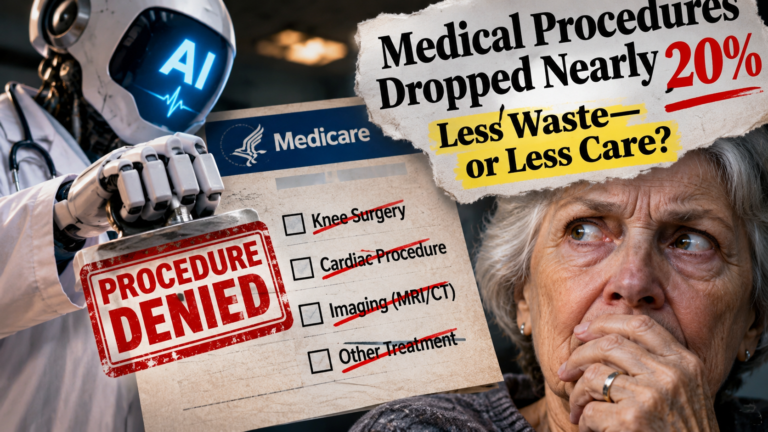

The Doctor Treated the Patient. The Insurance Claim Was Denied. Who Pays?
The Doctor Treated the Patient. The Insurance Claim Was Denied. Who Pays?
A new 2026 survey reveals how denied insurance claims, changing payer policies and delayed reimbursements are challenging healthcare providers. For independent physicians, the financial consequences can extend far beyond a rejected bill.
The patient received care. The physician documented the visit. The medical practice submitted the insurance claim. Then came the response: Claim denied.
The physician’s staff still needs to be paid. The office rent is still due. The costs of delivering medical care do not disappear because an insurer refuses or delays payment on a claim.
For independent medical practices, the growing administrative burden of claim denials has become an important financial and operational concern.
A new report from Experian Health provides fresh evidence of the problem.
The Numbers Behind the Claims Crisis
Released October 28, 2026, Experian Health’s annual State of Claims survey included 204 healthcare professionals working in finance, billing, registration, reimbursement, claims and collections.
These are survey responses from healthcare revenue-cycle professionals, not an audited national denial rate for every insurer or medical practice.
Still, the findings illustrate the growing difficulty of managing the financial side of modern medicine.
A medical practice can deliver excellent patient care and still face serious financial pressure when getting paid becomes increasingly difficult.
The Most Surprising Finding: “Services Not Covered”
The leading reason for denials reported in the survey was services not covered by insurance.
That reason appeared among the top three denial causes for 53% of respondents.
Frequently changing payer policies followed at 31%, while coding inaccuracies and difficulties obtaining prior authorization each appeared at 25%.
A denied claim does not automatically mean the insurance company acted improperly. The denial may reflect an actual coverage exclusion, an eligibility problem, missing documentation, a coding error, or a disputed determination.
But for the practice, identifying the reason, correcting errors and determining whether an appeal is appropriate often require additional staff time.
What Does a Denial Actually Cost a Practice?
A denial is not necessarily a permanent loss of revenue. Some claims are corrected and paid. Others are successfully appealed. Some remain unpaid because the service was not covered or another valid barrier to reimbursement applies.
However, even a claim that is eventually paid may generate additional administrative costs.
The Hidden Cost of Reworking Claims
Imagine a medical practice must rework 300 claims each month, requiring an average of 18 additional minutes per claim.
That equals 90 staff hours. At an illustrative fully loaded labor cost of $40 per hour, the rework costs approximately $3,600 per month, or $43,200 annually.
Example only. Assumes every claim requires the stated rework time and uses fictional labor costs. This does not estimate lost reimbursement, profit, or the typical cost of a claim denial.
That is money spent investigating billing problems rather than supporting other practice operations.
Why This Matters to Independent Physicians
Large hospital systems may have specialized departments, automation platforms and significant resources dedicated to revenue-cycle management.
Smaller independent practices may have fewer employees handling more responsibilities.
A practice manager could be coordinating patient scheduling, supervising employees, answering insurance questions and following up on unpaid claims—all during the same working day.
When denials grow more complex, the administrative work can become a substantial operating burden.
Five Ways Medical Practices Can Respond
- Measure your actual denial rate. Track initial denials, their reasons, eventual resolution and dollars ultimately recovered.
- Review eligibility and benefits before treatment. Where feasible, verify coverage information, referral requirements and applicable authorizations. A benefits check is not a payment guarantee.
- Identify payer-specific patterns. Track recurring denial codes, policy changes and problematic workflows by insurance company.
- Measure the administrative cost. Estimate how much staff time is spent correcting, resubmitting and appealing claims.
- Evaluate technology carefully. Automation may help identify errors or prioritize follow-up, but benefits depend on workflow integration, data quality, cost and appropriate oversight.
Is Artificial Intelligence Part of the Answer?
In the Experian Health survey, 64% of respondents said their organizations definitely or probably planned to invest in AI for claims and denial management.
Technology may help flag potential claim problems, verify information, and reduce repetitive administrative tasks.
But software alone cannot resolve every dispute, eliminate legitimate coverage exclusions, or guarantee payment.
Before purchasing a platform, practices should evaluate actual workflow needs, security requirements, total costs, and measurable financial returns.
The Larger Business Question: Can Your Practice Absorb the Financial Pressure?
Denied claims are only one factor affecting medical practice finances.
Physicians must also manage staffing expenses, rising overhead, reimbursement changes, patient volume and growth decisions.
A practice may appear busy and financially successful while experiencing cash-flow pressure behind the scenes.
Understanding operating margins and available cash reserves is therefore just as important as understanding total monthly collections.
Free Resource for Medical Practice Owners
Island Insurance Group has developed interactive business tools to help physicians and practice administrators explore financial scenarios, hiring decisions, cash reserves and business risks.
Explore IIG PracticeIQ and Our Healthcare Business Tools
You can also complete our Free Business Insurance Assessment or schedule a professional consultation .
PracticeIQ is an educational scenario-planning resource, not a claim-denial recovery service or financial forecast.
Frequently Asked Questions
What percentage of healthcare claims are denied in 2026?
In Experian Health’s 2026 survey, 40% of respondents reported that at least 10% of their claims were denied. That does not mean the national denial rate is 40%.
What is the most common reason for medical claim denials?
In the survey, services not covered by insurance was the most frequently cited reason, appearing among the top three reasons for 53% of respondents.
Can a medical practice recover denied claims?
Some denied claims can be corrected, resubmitted or appealed successfully. Recovery depends on the reason for denial, contractual and regulatory requirements, submission deadlines and available supporting information.
Does malpractice insurance cover lost revenue from insurance claim denials?
Medical malpractice insurance primarily addresses covered professional liability claims. It generally is not designed to reimburse ordinary medical billing denials or revenue-cycle losses. The actual scope of coverage depends on policy wording.
The Bottom Line
The financial pressures facing medical practices are not limited to the cost of delivering care.
They also involve the growing cost of documenting, submitting, correcting and collecting payment for that care.
For physicians and practice administrators, the challenge is to identify preventable administrative problems while preserving high-quality patient care and financial stability.
The question isn’t simply how much a medical practice bills. It’s how much it collects—and what it costs to collect it.
- Experian Health. 2026 State of Claims Survey Press Release. October 28, 2026.
- Experian Health. Healthcare Claim Denial Statistics: State of Claims Report 2026. October 28, 2026.
- Medical Economics. Why Are Claims Being Denied in 2026? October 30, 2026.
Survey findings describe respondents’ experiences, not a nationally audited denial rate. Financial examples are illustrative. This article is independent educational commentary.