The Portal Said ‘Viewed.’ Who Made the Call?
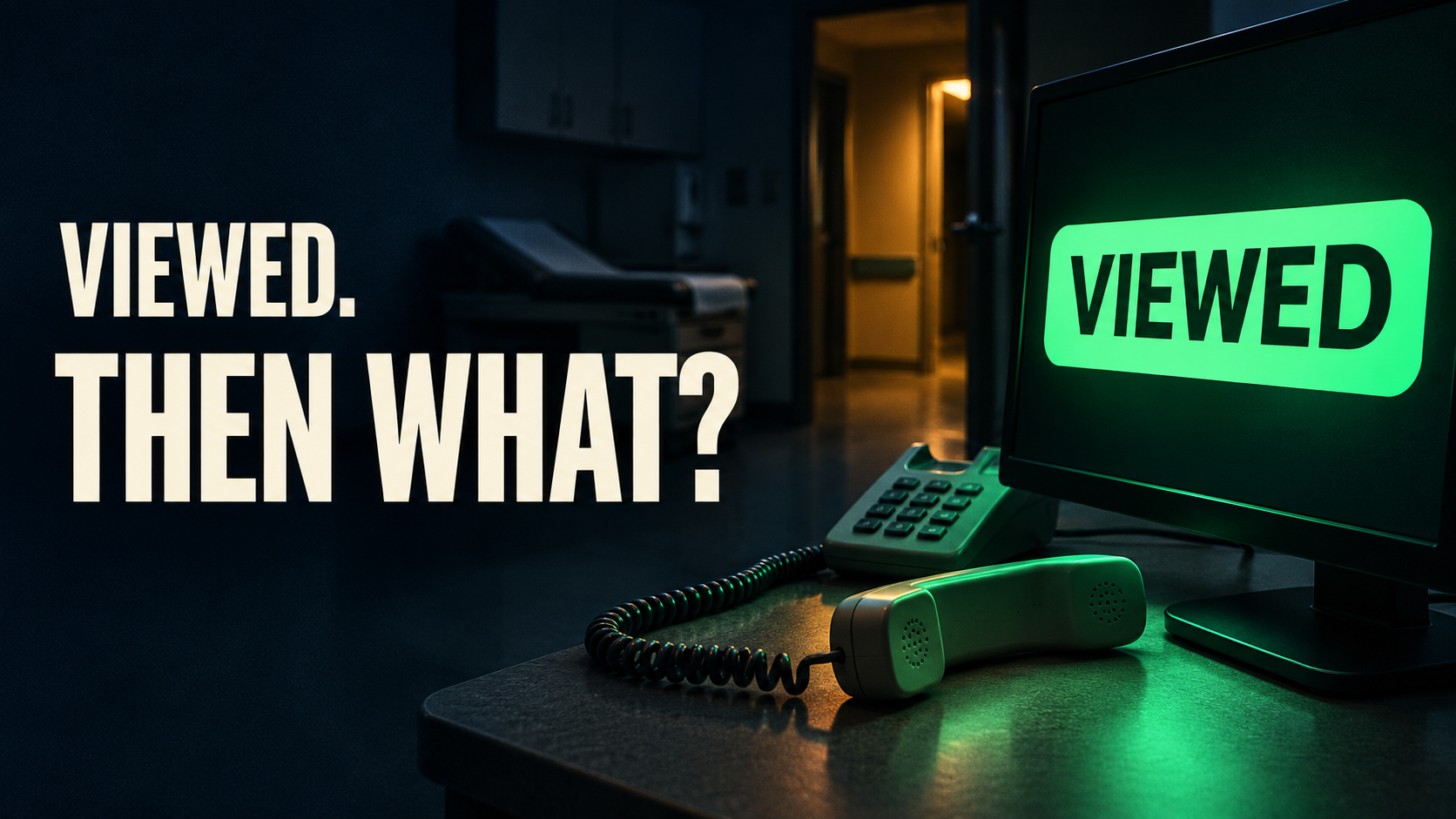
The scan was viewed. Was it followed up?
It’s Friday at 4:47 p.m. A scan shows an unexpected finding that needs follow-up. The ordering clinician is out. The patient has opened the report, but the chart doesn’t show a call or a follow-up plan.
In your practice, who owns the next step?
By Samuel Bennett, licensed insurance agent
What would your team see?
- Report posted
- Friday, 4:47 p.m.
- Report status
- Follow-up recommended
- Patient portal status
- Viewed
- Ordering clinician
- Out of office
- Follow-up owner visible in chart
- Not documented
- Follow-up plan visible in chart
- Not documented
The person covering the inbox sees that the patient opened the report. A scheduler assumes someone will send an order. The patient assumes the office will call if anything needs to happen. None of those assumptions tells you who is responsible for the next step.
“Viewed” tells you the report was opened. It doesn’t tell you the patient understood it, that a clinician reviewed it, or that follow-up happened.
This exercise is about ownership and tracking. The time in the scenario isn’t a universal deadline. The appropriate response depends on the finding, the clinician’s judgment, and the organization’s escalation process.
Could this result fall through the cracks in your practice?
Answer for what your team does on a busy day, not what the policy says should happen. This tool doesn’t ask for patient information or send or store your selections.
If the interactive questions aren’t available, ask your team the three questions in the staff huddle section below.
Three questions worth answering out loud
- Who owns the result? Pick a fictional result and have someone show where the assignment appears and how the responsible clinician or team acknowledges it.
- Who takes over when they’re out? Ask the backup to show where the result lands, how they accept it, and where an unresolved result goes for escalation under your practice’s process.
- What counts as done? Walk through what happens if the patient can’t be reached, declines follow-up, or doesn’t complete the next step. Show where your team documents the outcome or sends the item back to a clinician for a decision.
Try this at your next huddle: Ask two team members, separately, what happens to the Friday result. If they name different owners or different points at which the task is closed, you’ve found a handoff worth clarifying.
Posting a result is one step. Closing the loop is another.
In its November 2026 radiology claims review, The Doctors Company described a case in which a communication failure involving a suspected lung mass contributed to a delayed cancer diagnosis. That was a separate case from the fictional portal scenario above. The lesson is that finding something on a scan and getting it to the person who can act on it are different steps. Read the radiology claims review.
The Joint Commission’s guidance on closing the loop on test results describes an approach that goes beyond sending the result. It includes making sure the message reaches the right recipient, is acknowledged, and leads to action. Read the Quick Safety guidance.
If you manage a practice, share the Friday scenario with the people who review results, cover the inbox, and schedule follow-up. Ask each of them where the task goes next. That conversation is the point of the exercise.
Renewing or adding clinicians?
A follow-up workflow helps you see who’s responsible for the next action. A malpractice policy answers a different question: who is insured, and for what work? If you’re adding a clinician, changing locations, or comparing renewal quotes, I can help you identify what to verify in writing.
Samuel Bennett · Licensed insurance agent · Island Insurance Group
sam@islandinsurancegroup.com
· 954-804-8144