Medicare’s AI Experiment: Procedures Dropped Nearly 20%. Was That Less Waste—or Less Care?
Healthcare Investigations | Medicare, AI and Physician Autonomy
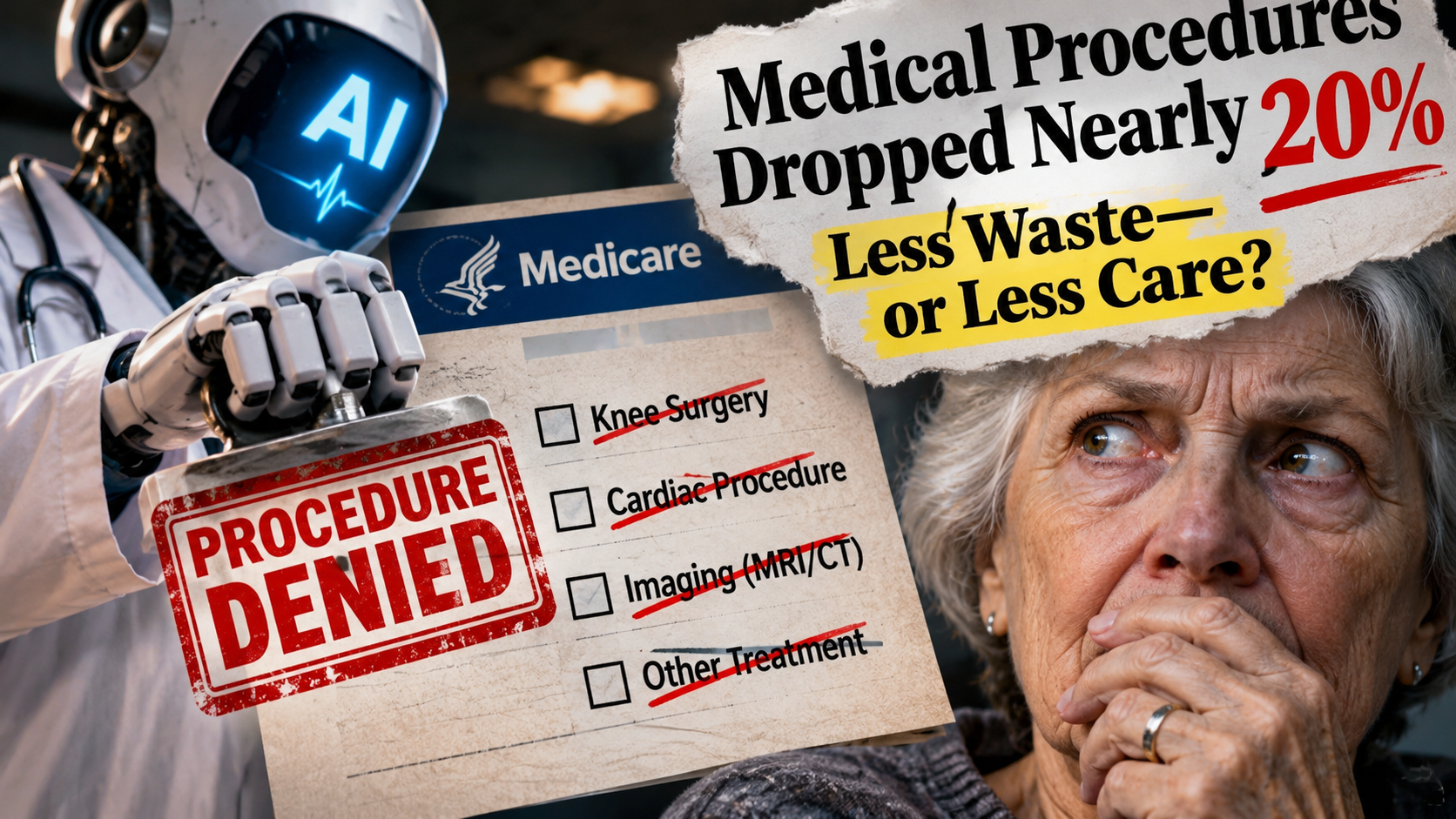
Medicare introduced artificial intelligence-assisted prior authorization in six states. Within six months, use of some targeted medical services had declined nearly 20% compared with trends elsewhere.
For physicians who have spent years fighting insurance authorization requirements, the latest findings raise a familiar concern in an unfamiliar setting: traditional Medicare.
On October 26, 2026, researchers from the University of Minnesota and Brown University published a research letter in JAMA examining the early effects of Medicare’s Wasteful and Inappropriate Service Reduction model, better known as WISeR.
Their analysis found notable declines in medical services targeted by the pilot program.
Epidural steroid injections used in pain management declined 15%. Other targeted medical services declined approximately 19.5%, relative to comparison trends outside participating states.
For supporters of prior authorization, the findings may suggest an opportunity to reduce unnecessary treatment.
For physicians concerned about administrative barriers, the same numbers raise a different question: Were some patients unable to obtain appropriate treatment?
The critical finding: The research documents lower utilization associated with the program. It does not establish whether the foregone procedures were medically unnecessary, whether patients experienced harm, or whether individual coverage requests were appropriately denied.
What Exactly Is Medicare’s WISeR Program?
WISeR stands for Wasteful and Inappropriate Service Reduction.
Developed by the Centers for Medicare & Medicaid Services (CMS), the model tests whether enhanced technology, including artificial intelligence and machine learning, combined with human clinical review, can improve medical necessity assessments for selected Medicare services.
The model began in January 2026 and is scheduled to continue through December 2031.
It operates in six states:
- Arizona
- New Jersey
- Ohio
- Oklahoma
- Texas
- Washington
It applies to selected services furnished to people with Original Medicare, not Medicare Advantage enrollees.
Importantly, the model does not change Medicare’s underlying coverage or payment policies. It adds a review process for selected services that CMS identifies as vulnerable to inappropriate use.
The model is not a universal AI approval requirement for every Medicare procedure.
Official source: CMS WISeR Model Overview .
The Numbers Behind the Controversy
The researchers examined electronic health record information from Epic Cosmos, comparing use of selected services among traditional Medicare patients in WISeR states with trends in other states and Washington, D.C.
The study used two years of pre-implementation data and the first six months of 2026.
The investigators also examined services originally considered for the program whose implementation had been delayed. Those comparison services did not show the same significant decline.
This strengthens the argument that the new authorization requirements contributed to the observed change.
However, a statistical association with policy implementation does not reveal whether the underlying clinical decisions were appropriate.
The Unexpected Detail: The Declines Became Smaller
Researchers observed that the largest decline occurred early in the pilot.
For epidural steroid injections, the relative decline was approximately 21% in the first quarter of 2026, compared with about 9% in the second quarter.
For the other targeted services, the decline moderated from approximately 21% to 18% between those quarters.
Why did the effect weaken?
One possibility is that physicians and administrators learned the authorization requirements and adjusted their documentation and submission procedures.
Another is that early workflow problems became less disruptive.
The available research does not determine which explanation is correct.
This distinction matters because a temporary decline caused by administrative adaptation has different implications from a lasting reduction in clinically inappropriate care.
Which Physicians Are Most Affected?
The model focuses on a defined set of services rather than every specialty.
Depending on the specific procedure and applicable coverage rules, relevant professionals may include pain management physicians, spine specialists, orthopedic surgeons, interventional specialists, and other clinicians involved in selected services.
| Clinical area | Selected services | Why physicians should pay attention |
|---|---|---|
| Pain management | Epidural steroid injections | Documentation, authorization, scheduling, and access to interventional pain care |
| Spine and neurosurgical care | Selected cervical fusion and vertebral procedures | Medical necessity evidence, coverage criteria, and review timing |
| Orthopedic care | Selected arthroscopic knee procedures | Distinguishing evidence-supported treatment from lower-value care |
| Other procedural care | Selected nerve stimulation and related services | Clinical documentation, claims review, and patient communication |
The table illustrates potentially affected clinical areas, not a ranking of which specialties suffered the greatest financial losses.
Specific codes and requirements should be confirmed in the current CMS provider materials .
CMS’s Position: Reducing Unnecessary Care Can Protect Patients
CMS argues that certain medical services are vulnerable to waste, inappropriate utilization, or use that does not align with existing coverage criteria.
A procedure without sufficient evidence of benefit may expose a patient to costs and clinical complications.
For example, an invasive procedure can carry risks even when performed competently.
CMS designed WISeR to encourage evidence-supported care and identify requests that may not meet existing Medicare coverage requirements.
The model uses participating technology companies to support medical necessity reviews.
CMS states that recommendations not to affirm coverage must be made by appropriately licensed human clinicians, rather than by automated technology alone.
Participating providers may submit an authorization request in advance or choose a post-service, pre-payment review route.
CMS also provides for expedited review in appropriate circumstances.
These safeguards are important features of the model’s design.
Whether they work as intended in everyday medical practice is an empirical question requiring further evaluation.
The Physician’s Concern: Is the Administrative Process Changing Clinical Decisions?
Prior authorization introduces an additional step between the physician’s treatment recommendation and payment authorization.
That review may be justified when it prevents inappropriate or unsupported treatment.
But the administrative requirements can also change how physicians organize their practices.
A clinician may need additional records, diagnostic history, clinical justification, or appeals documentation before moving forward with a proposed service.
The presence of an authorization requirement can also create uncertainty for patients who are trying to schedule care.
None of this establishes that a particular WISeR coverage decision was wrong.
It does explain why physicians have a professional interest in examining how review standards are implemented.
If a physician recommends a procedure, but an outside review process makes the procedure harder to obtain, who is accountable for ensuring that the patient receives appropriate care?
A Second Controversy: The Companies Reviewing the Claims
Unlike many traditional Medicare payment processes, the WISeR model includes private technology companies as designated participants.
CMS identifies six participating organizations, each associated with one of the pilot states.
Under the model’s payment methodology, participants may receive a percentage of expenditures associated with averting care deemed wasteful or inappropriate.
CMS also states that participant compensation is adjusted based on performance measures, including aspects of provider experience.
The arrangement raises a legitimate question about incentives:
How can a payment system reward avoiding unnecessary treatment without encouraging inappropriate restrictions on beneficial care?
An incentive structure does not establish that a participant improperly denied treatment.
It does make transparency, clinical review, appeal outcomes, and independent evaluation particularly important.
What the JAMA Study Does Not Prove
The distinction between less treatment and better treatment is fundamental.
The study does not establish:
- How many authorization requests were denied or approved.
- Whether particular patients experienced treatment delays or worsened health outcomes.
- How many of the procedures not performed would have been medically necessary.
- Whether long-term Medicare spending will decline.
- Whether physicians faced a measurable increase in administrative costs.
- Whether the observed declines will continue throughout the six-year model.
It is also important not to portray these utilization changes as an AI algorithm’s measured error rate.
The study evaluates the introduction of an AI-enabled authorization program, not the standalone accuracy of a particular AI model.
A Financial Question for Independent Medical Practices
For a medical practice, a lower volume of reimbursable procedures can affect financial planning.
The degree of exposure depends on the practice’s specialty, service mix, payer contracts, patient population, cost structure, and billing patterns.
A Hypothetical Revenue Stress Test
Consider a practice that previously performed 100 qualifying procedures per month at an average collected amount of $600 per service.
At that rate, monthly collections would be:
100 x $600 = $60,000
If procedure volume declined by 15%, with collections per procedure unchanged, monthly revenue from those services would become:
85 x $600 = $51,000
The hypothetical difference would be $9,000 per month, or $108,000 annually if the same conditions persisted for 12 months.
This is an illustrative scenario, not an estimate of WISeR’s actual financial effect on a medical practice. It excludes changes in costs, service mix, replacement treatments, and other revenue.
A practice experiencing changes in procedural volume should determine whether the change reflects clinical appropriateness, patient demand, authorization workflows, or other factors.
It should not automatically conclude that reduced procedure volume indicates lost medically necessary care.
What Does This Mean for Florida Physicians?
Florida is not among the six WISeR pilot states as of this article’s publication date.
A Florida physician should therefore not assume that the WISeR pilot currently applies to the practice.
Nevertheless, the experiment deserves national attention because CMS intends to evaluate whether the model can improve the efficiency and appropriateness of medical necessity reviews.
Physicians outside the pilot states can follow the evidence without suggesting that an expansion is certain.
Future decisions about the model should be evaluated using verified CMS announcements and study results.
Where Medical Malpractice and Professional Responsibility Enter the Conversation
A disputed authorization does not automatically constitute medical malpractice.
Nor does a denied coverage request automatically establish that a physician breached the standard of care.
Professional liability depends on the relevant facts, legal duties, clinical decisions, causation, and applicable law.
However, when treatment is delayed, changed, or not performed, clear documentation and appropriate patient communication remain important.
A physician may want to maintain records of the original clinical recommendation, the evidence supporting that recommendation, authorization correspondence, and subsequent clinical decisions.
Medical practices should also consider whether operational changes, outsourcing arrangements, new services, or added professional responsibilities require an insurance review.
Insurance policies vary. Coverage for professional liability allegations depends on the policy language and the circumstances of an individual claim.
To understand coverage considerations, visit Island Insurance Group’s Medical Malpractice Insurance Resource .
Seven Questions Physicians Should Be Asking Now
- What is the evidence? Are the services under review supported by the specific patient’s clinical circumstances?
- What do existing coverage rules require? Understand relevant national and local Medicare coverage criteria before submitting selected services.
- Who conducts clinical review? Know the review process, available clinical expertise, and communication channels.
- What happens if authorization is not affirmed? Understand applicable appeal or review routes and the difference between an authorization recommendation and a final claim determination.
- What is happening to patient access? Monitor scheduling, cancellations, treatment substitutions, and patient complaints.
- What is the administrative cost? Measure time devoted to medical records, reviews, follow-ups, and related tasks.
- How is clinical responsibility documented? Use accurate records and appropriate patient communication when the treatment plan changes.
The Real Test: Are Patients Better Off?
Medicare’s WISeR experiment represents an important policy choice: using technology-supported oversight to examine certain clinical services before payment.
Its early utilization results are significant.
But fewer medical procedures are not, by themselves, proof of better care.
They are also not proof of patient harm.
Those conclusions require evidence about medical necessity, patient outcomes, administrative costs, and longer-term changes in service use.
For physicians, the debate should not be reduced to whether artificial intelligence is good or bad.
The more consequential question is whether technology-supported medical review can distinguish unnecessary care from necessary care without placing unreasonable burdens on patients and clinicians.
Medicare’s experiment may help reduce waste. But how will we know whether it also protects the patients whose care is being reviewed?
Is Your Medical Practice Evolving Faster Than Your Insurance Coverage?
Island Insurance Group helps physicians and healthcare business owners evaluate medical malpractice and commercial insurance as practice operations, services, and risks evolve.
Whether you are expanding services, reviewing professional liability coverage, changing practice structure, or preparing for renewal, a thoughtful coverage review can help identify important questions.
Schedule a 30-Minute Consultation Explore Medical Malpractice InsuranceYou may also explore our Free Business Insurance Assessment Tool for general business risk considerations.
Sources and Further Reading
- Neprash HT and colleagues. Changes in Service Use Following the Introduction of AI-Enabled Prior Authorization in Medicare. JAMA, October 26, 2026. Read the research .
- University of Minnesota School of Public Health. Medicare’s Prior-Authorization Pilot Test Led to an Immediate Drop in Use of Services. October 26, 2026. Read the university analysis .
- Centers for Medicare & Medicaid Services. WISeR Model Overview. Official program information .
- CMS. WISeR Model Frequently Asked Questions. Official questions and answers .
- Becker’s Hospital Review. Medicare’s AI-Enabled Prior Authorization Pilot Linked to Nearly 20% Drop in Some Services. October 30, 2026. Read the reporting .
This article is provided for general educational and editorial purposes. It does not constitute medical, legal, billing, or financial advice. Island Insurance Group does not make Medicare coverage determinations. Insurance coverage is subject to applicable policy terms, conditions, exclusions, and underwriting. Readers should verify current CMS requirements and consult qualified professionals concerning individual circumstances.