Should Gun Manufacturers Help Pay for the Trauma Care Their Products Make Necessary?
Island Insurance Group · The Trauma Bill
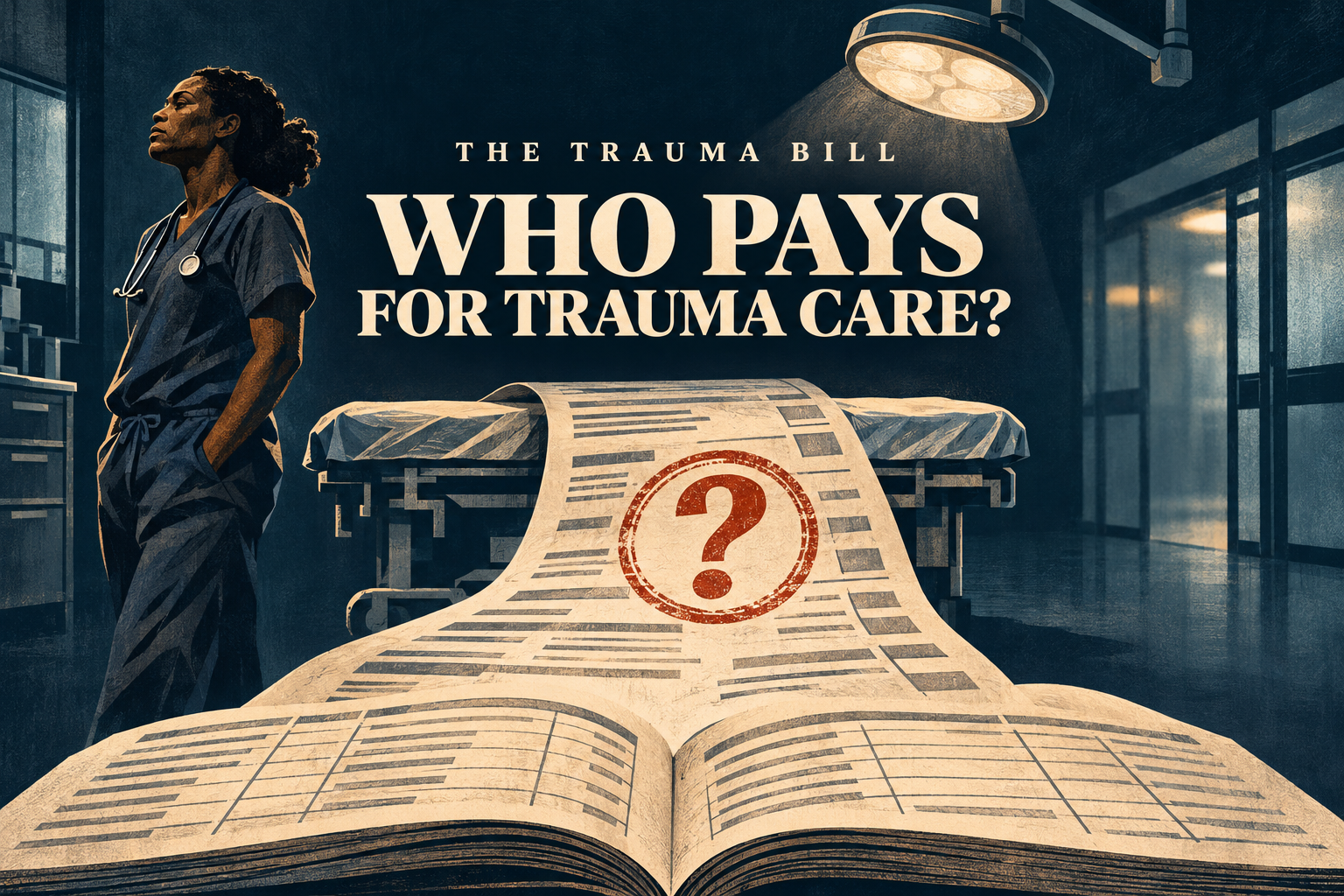
The trauma team did its job. Who should help pay?
The American Medical Association wants firearm manufacturers to help pay for the health and financial costs of gun violence. The question for hospitals and taxpayers is whether the industry should carry some of that cost even when a specific manufacturer hasn’t been found at fault. The AMA’s position isn’t a law and hasn’t changed who pays your hospital bill.
Your decision
The patient survived. Who should carry the cost?
Imagine a patient arrives at a trauma center with a gunshot injury. The team stabilizes them, they undergo surgery, and later they need rehabilitation. The facts about what happened are still being investigated. Take individual fault out of the question for a moment. As a policy choice, should the firearm industry help fund any of the cost?
Exhibit A · Fictional care summary
- 01 · Emergency and trauma care
- 02 · Surgery and inpatient stay
- 03 · Rehabilitation after discharge
Illustrative services only. Not a real patient statement, price estimate, or coverage determination.
Pick a position to see the trade-off
A · Make manufacturers contribute to a shared fund.
You’re trying to spread the cost without making the hospital or patient prove fault in every case. But an industry contribution could be passed along in prices. You’d also have to decide who pays into the fund and whether the money goes to hospitals, patients, rehabilitation, or prevention.
B · Require payment only when a company is legally responsible.
You’re separating individual responsibility from broad industry funding. The trade-off is that proving responsibility can take time, and the medical bills don’t wait for that process. Most importantly, this option doesn’t itself create a source of funding for cases without a finding of liability.
C · Keep the current payment system. No new industry contribution.
You’re saying hospitals should be paid through the usual channels and that treating an injury should not automatically create a new obligation for a manufacturer. That still leaves a question for patients, insurers, public programs, and hospitals: what happens to the costs the current system doesn’t cover?
What the AMA actually said
An advocacy position, not a bill sent to manufacturers
On November 10, 2026, the AMA announced that its House of Delegates had adopted a policy calling for firearm makers to share the costs associated with firearm injuries and deaths. The AMA said the money raised would support evidence-based violence prevention and services for affected people and communities. The announcement did not specify a per-patient reimbursement system. The choices above are ways to debate the policy, not a list of proposals the AMA adopted. Read the AMA announcement.
Follow the money
Who bears the cost now?
A 2021 U.S. Government Accountability Office report estimated that initial hospital care for firearm injuries cost just over $1 billion per year in the 2016 and 2017 hospital data it reviewed. Patients with Medicaid and other public coverage accounted for more than 60% of those initial hospital costs. That is a historical estimate of hospital costs, not the amount Medicaid paid, a current-year figure, or a total that includes all rehabilitation and follow-up care. Read the GAO report.
The disagreement
Helping pay is not the same as being found at fault
The case for an industry contribution
Trauma care, recovery, and prevention cost money regardless of whether anyone can prove a particular company was at fault. A dedicated contribution could support services that ordinary insurance payments don’t necessarily fund, including community prevention and support after discharge.
The case against it
A manufacturer may have had no role in a particular injury beyond making a lawful product. A broad charge might shift costs to customers who had nothing to do with the injury. And unless the money is earmarked for patient care, there’s no reason to assume the trauma center or the patient would see any of it.
Would you still back a manufacturer-funded program if the money could fund prevention but couldn’t pay a patient’s rehab bill?