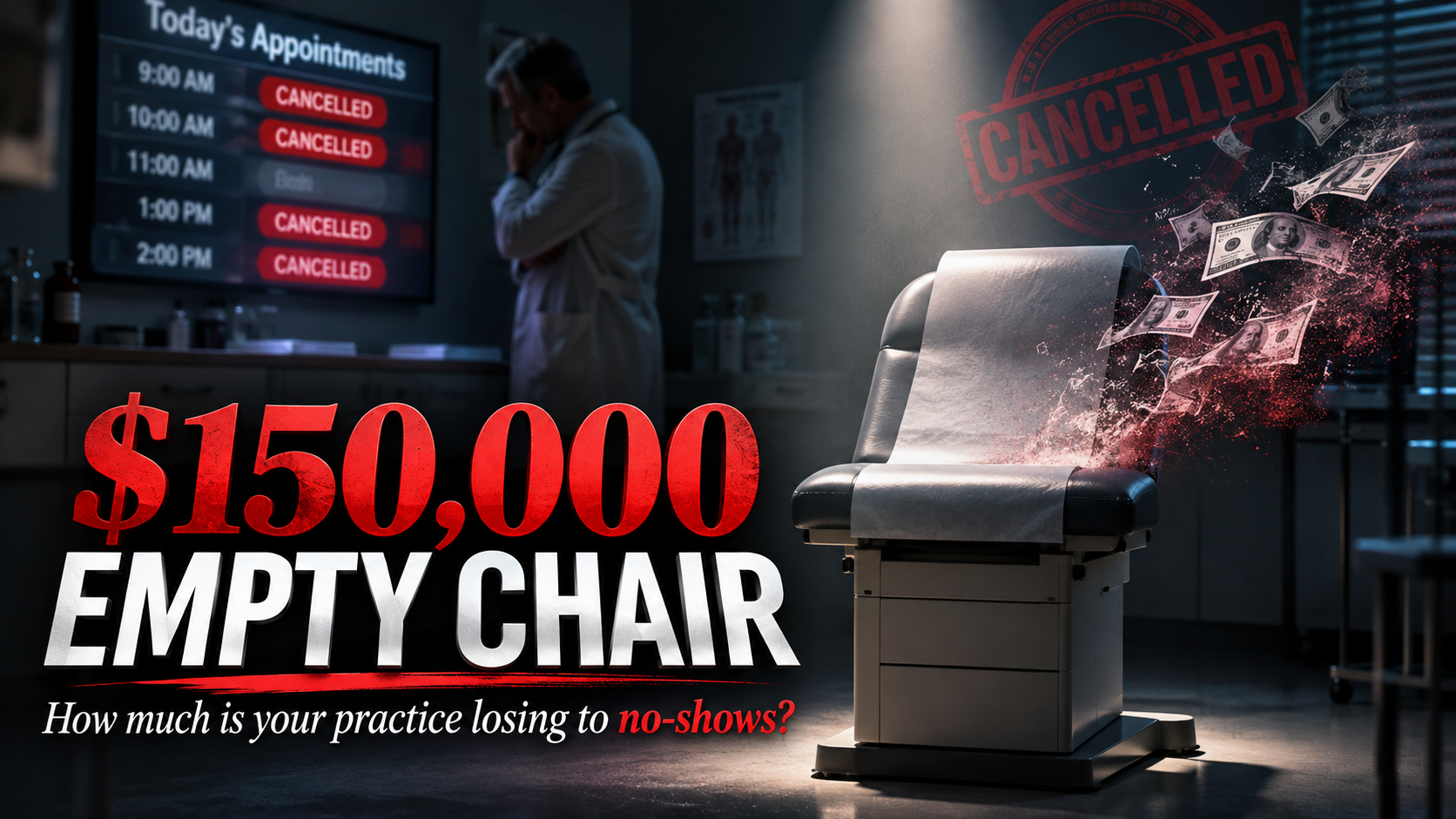
The $150,000 Empty Chair: Is Your Medical Practice Losing Revenue to No-Shows?
The $150,000 Empty Chair: Is Your Medical Practice Losing Revenue Before the Patient Even Walks In?
The appointment was booked. The team was ready. The patient never arrived. But the lights, payroll, and overhead still cost money. How much capacity is slipping through your schedule?
Calculate your empty-chair exposure →By Samuel Bennett, Licensed Insurance Agent | Island Insurance Group
It’s 10:15 a.m. Your next patient hasn’t arrived. A nurse asks whether to keep the room ready. The front desk calls, but the patient doesn’t answer. Twenty minutes later, another scheduled visit falls through. If your practice is operating near capacity, those openings may represent missed opportunities for patient care and collections—even if they don’t show up as a neat line item on your income statement.
That’s why the most revealing question might not be “How many patients did we see?” but “How many appointment slots went unused that we realistically could have filled?”
In an August 12, 2026 MGMA report, 32% of responding medical groups said their no-show rates had increased year to date compared with 2025, while 58% reported no major change and 10% said they decreased. In its earlier 2026 patient-access discussion, MGMA cited industry analyses modeling about $150,000 in annual losses per physician in certain circumstances. That figure is a provocative illustration, not a forecast of what every physician loses.
What an empty appointment actually costs
A missed appointment is not necessarily the same thing as lost profit. There are at least three different measures:
- Unfilled capacity: the booked slot that nobody used, even after any successful rebooking.
- Collections opportunity: what a completed visit might have generated on average, if a patient actually attended and the claim or payment was collected.
- Incremental margin: collections less the variable costs of delivering the additional visit. A genuine profit estimate would require more information than a simple no-show calculator can responsibly know.
And not every no-show can be recovered. Some clinicians can serve other patients; some can handle urgent messages or charting; and some slots cannot be refilled without sufficient lead time. For that reason, our free tool estimates collections associated with unfilled slots rather than asserting the whole amount is money that disappeared from the bank.
Run the Empty Chair Revenue Recovery Audit
Use your practice’s own monthly numbers—not an internet industry average. The tool separately counts no-shows and late cancellations, subtracts the late-cancellation slots you already refill, and estimates the effect of recovering a portion of the remaining unused capacity.
Empty Chair Revenue Recovery Audit
Discover the size of your unfilled appointment opportunity and build a practical recovery plan.
Your empty-chair opportunity
What happens to the unused appointment capacity?
Your 30-day recovery experiment
*Important: This is a scenario based on user-entered data. “Collections opportunity” is not earned revenue, actual lost profit, assured recovery, a verified financial statement, or evidence that individual patients were at fault. The calculator assumes average net collections per visit are stable and that recovered slots can be filled with appropriate patient visits. It does not measure payer mix, billing success, clinical suitability, substitution of other productive work, incremental costs, or scheduling constraints.
If Analyze does nothing, confirm the separate “Empty Chair Audit” JavaScript snippet is active in WPCode.
The real problem isn’t always forgetfulness
It’s tempting to treat every absence as an irresponsible patient. That’s too simplistic. Peer-reviewed reviews have identified work and family commitments, transportation challenges, scheduling problems, communication gaps, and financial strain among the reasons people miss appointments. The right response is not always another reminder: sometimes it’s a more flexible time slot, an easier cancellation route, or a clearer discussion of anticipated patient costs. See the systematic review of missed primary-care appointments and 2024 review of repeatedly unused appointments.
Five ways to put empty slots back to work
- Measure your baseline correctly. Use one consistent definition for scheduled visits, no-shows, late cancellations, and successfully refilled slots. Separate specialties and visit types when needed.
- Offer quick, low-friction cancellation. If a patient cannot attend, make it easy to release the slot in time for another patient.
- Maintain a permission-based waitlist. Offer short-notice openings to patients who actually want them, with appropriate clinical triage and scheduling rules.
- Check for barriers before blaming patients. Review lead times, transportation, appointment times, expected out-of-pocket costs, and communication accessibility.
- Run a 30-day test. Track unused slots and refills weekly; compare before and after, and measure both patient access and actual collections—not simply the number of texts sent.
What does this have to do with protecting the practice?
Routine no-shows aren’t generally an insurable business-interruption event, and buying more insurance won’t fix a poorly managed schedule. But the financial health of your practice and its insurance program should be considered together. When you’re reviewing operational risk, questions about cyber disruptions, property losses, professional liability, business continuity, and insurance limits belong in a separate, informed discussion—not inside a misleading “no-show protection” sales pitch.
Your schedule is a business asset. Treat it like one.
Run the free audit above, share the findings with your office manager, and explore more tools at Island Insurance Group Insurance Tools. For articles and practice-management resources, visit the Resources Center.
Want an independent look at how your actual insurance coverage fits the risks of operating a medical practice? Schedule a 30-minute conversation with Samuel Bennett.
Samuel Bennett, Licensed Insurance Agent
Island Insurance Group
sam@islandinsurancegroup.com · 1-866-820-7430
Research and sources
- MGMA, Aug. 12, 2026, About 1 in 3 medical groups see higher no-shows in 2026.
- MGMA, Patient access priorities for 2026 (includes cited $150,000 industry model).
- Dantas et al. (2021), Which patients miss appointments with general practice and the reasons why: a systematic review.
- Qualitative systematic review (2024), Factors influencing multiple non-utilised healthcare appointments.
- HHS, HIPAA guidance on appointment reminders.