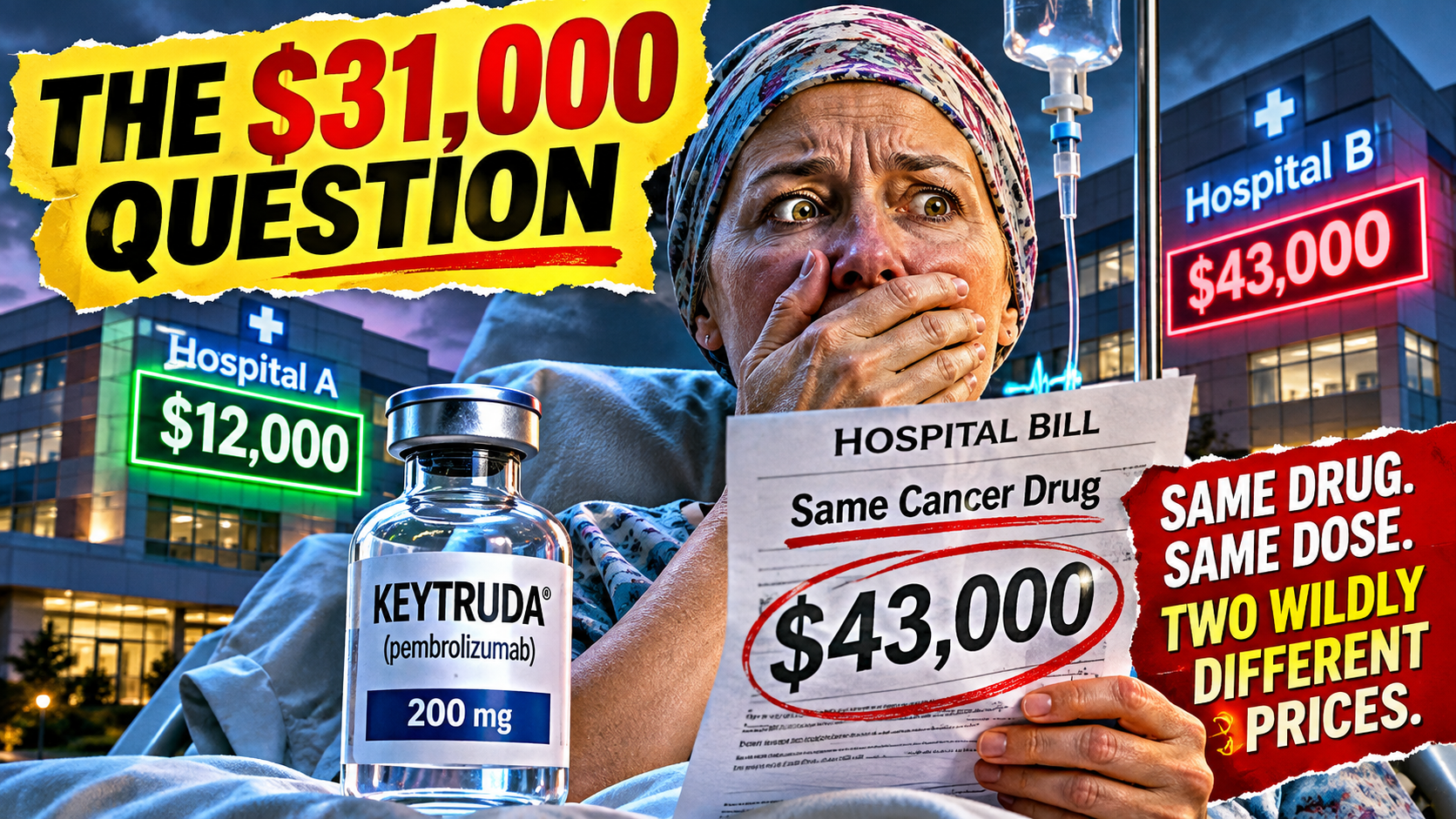
The $31,000 Question: Why Can the Same Cancer Drug Have Two Very Different Prices?
Island Insurance Group · Healthcare Business Intelligence
How can one hospital-published price for a dose of a cancer drug be about $12,000, while another reaches $43,000? The answer tells us something unsettling about how difficult it can be to understand the price of healthcare in America.
You need care. You may have insurance. You may even ask for the cost in advance. But a price shown on a hospital website, a plan’s negotiated rate, the provider’s final bill and the amount you personally owe can be four different numbers.
In a March 5, 2026 analysis by 3 Axis Advisors, researchers examined over 1,300 hospital chargemaster files for drug-price disclosures. Reporting on the findings identified published prices for a 200 mg dose of the cancer medicine Keytruda ranging from approximately $12,000 to $43,000.
Important: These are reported hospital-published price figures—not verified amounts paid out of pocket by two patients and not evidence that an individual hospital billed unlawfully. Different rate categories, payer arrangements, billing units and data quality issues can affect comparisons. This is a reason to ask better questions, not to assume a given charge is wrong.
How can one medication have so many prices?
Hospitals publish several kinds of financial information. A gross charge is a listed amount; a discounted cash price can apply to eligible self-pay patients; an insurer-negotiated rate is an agreement between a hospital and a payer. Your actual financial responsibility can also depend on the deductible, coinsurance, network status, benefit design and other charges on your bill.
Those numbers aren’t interchangeable. A $43,000 published price doesn’t mean that a patient with insurance must pay $43,000. Likewise, a low published rate does not guarantee that every patient can obtain it.
The 3 Axis analysis also found that price-data availability is not the same as usability. Although 93% of downloaded hospital files followed required formatting, only 62% provided usable price information for the high-cost medications the researchers examined. The authors highlighted inconsistent billing units and variable completeness as significant obstacles to meaningful comparisons.
The problem with ‘price transparency’ when you can’t interpret the price
Hospital transparency requirements call for hospitals to publish standard-charge information, but raw data are not necessarily a consumer-ready quote. A complicated infusion visit may involve a drug, infusion services, professional fees, laboratory work and other charges. Comparing one posted drug rate with a complete treatment bill could produce a misleading conclusion.
On October 5, 2026, federal agencies announced changes to Transparency in Coverage rules intended to improve the standardization and accessibility of health-plan pricing information. Some provisions have later applicability dates, so a new rule announcement does not mean every consumer-facing improvement is already available.
The question patients can act on: what happens when your actual bill exceeds the estimate?
For someone facing a real medical bill, the immediate task is simpler than decoding thousands of hospital records: compare a written estimate and a bill for the same provider or facility, and ask for an explanation when the figures differ.
For many uninsured or self-pay patients, federal rules require providers to issue a Good Faith Estimate in advance of certain scheduled care or when requested. If a qualifying provider’s billed charges are at least $400 higher than that provider’s Good Faith Estimate, the patient may be eligible for the federal patient-provider dispute resolution process. The process has additional conditions, including timing and insurance-use requirements. CMS explains the requirements here.
That $400 test should not be applied indiscriminately to an insured patient’s hospital bill. People who used insurance generally need to compare provider statements with their insurer’s Explanation of Benefits and review any applicable appeals or surprise-billing protections.
Was your medical bill higher than the estimate?
Use the free Medical Bill Shock Test below to calculate the difference and generate a personalized checklist. It cannot declare a bill illegal or determine federal eligibility, but it can help you identify what to investigate next.
Try the Free Medical Bill Shock Test ↓No account, patient name or medical record is requested. The calculator uses only the information you enter in your browser.
Five questions to ask before paying a surprising medical bill
Match the estimate and bill by provider, facility, date, codes or service description, and billing units. Separate professional and facility bills can arrive at different times.
Request an itemized bill. Ask whether additional treatment, supplies, medications or facility fees explain the difference.
If you used insurance, compare the provider’s balance against the insurer’s Explanation of Benefits. Ask about network status, claim processing and your actual patient responsibility.
If you were uninsured or self-pay, retain the estimate and initial bill. The federal dispute route may be available only under specific conditions, including a 120-day deadline generally measured from the date of the initial bill.
Ask about billing corrections, payment plans, charity care or financial assistance, and relevant consumer assistance programs. These options may be useful even when federal dispute requirements aren’t met.
Is the $31,000 spread proof that someone was overcharged?
No. This comparison reveals significant variation in reported prices. It does not establish the total clinical episode cost, whether the compared entries use perfectly matched billing conventions, the patient’s cost sharing, or a violation of law. More data and careful normalization are necessary for a defensible apples-to-apples comparison.
That qualification does not make the story unimportant. It makes the central question more urgent: how can ordinary patients make informed decisions when the underlying price data are often difficult even for experts to interpret?
The bottom line: you deserve an understandable explanation
Most patients are not healthcare economists. They should not have to be. If the amount on your medical bill differs from what you expected, asking for an itemized explanation is reasonable. Keeping a written estimate and reviewing official consumer guidance can help you understand the next step.
Compare your amounts using the free tool immediately below this article, or visit the Island Insurance Group Resources Center for more healthcare and insurance information.
Original research and official guidance
- 3 Axis Advisors — Analysis of Prescription Drug Prices in Hospitals (March 5, 2026).
- Axios — Wide disparities found in hospitals’ drug prices (March 5, 2026).
- CMS — Hospital Price Transparency.
- CMS — October 2026 Transparency in Coverage Final Rules.
- CMS — Dispute a Medical Bill.
- CMS — Medical Bill Rights When Not Using Insurance.
Educational journalism and an arithmetic tool, not legal, financial, medical, billing or coverage advice. Island Insurance Group does not adjudicate hospital bills. Information about deadlines and eligibility may change; check current CMS guidance and your specific circumstances.
Your medical bill was HOW MUCH?
Compare the estimate with the bill. See the difference instantly. Get practical next steps you can take today.
Run your Medical Bill Shock Test
Compare amounts from the same provider or facility for the same care, when possible. Don’t add patient names, account numbers, diagnoses, or insurance IDs.
Privacy: The amounts you enter are processed in your browser. This tool does not request or send your answers to Island Insurance Group. Avoid entering protected health information.
Here’s what your numbers show
Federal dispute pathway
Official CMS dispute guide ↗What to do next
Keep your results
Download a private text summary, print the results, or copy a comparison that contains only the two amounts and the difference. It won’t include health details.
The $31,000 question in hospital pricing
In March 2026, an investigation from 3 Axis Advisors examined more than 1,300 hospital pricing files and reported a roughly $12,000–$43,000 range in published hospital prices for a 200 mg dose of the cancer medicine Keytruda. That is a roughly $31,000 spread in published figures, not a measured patient out-of-pocket difference or proof that any individual bill was incorrect. Read the original research.
Prices may reflect gross charges, cash discounts, or insurer-specific negotiated rates, and published data may have unit or formatting problems. The practical lesson is to request a clear estimate before scheduled treatment and compare your bill against the right documentation after care.
Before you challenge a charge, ask:
- Are the estimate and bill for the same provider, facility, service, and billing units?
- Did the final bill include additional medically provided services or separate professional fees?
- What does the itemized statement show, and—if insurance was used—what does the explanation of benefits say?
- Can the billing office explain the change in writing and identify financial-assistance options?
Understand the insurance side of healthcare costs.
This tool cannot negotiate hospital bills or determine your benefits. For insurance coverage planning, speak with Samuel Bennett, Licensed Insurance Agent, at Island Insurance Group.
Samuel Bennett · Licensed Insurance Agent · sam@islandinsurancegroup.com · 1-866-820-7430
Educational use only. This calculator compares amounts; it cannot tell whether a charge is legal, accurate, medically necessary, covered by insurance, or eligible for a specific appeal. The federal patient-provider dispute process has specific eligibility conditions. For deadlines, billing rights, and official guidance, consult CMS. No health information is requested.